
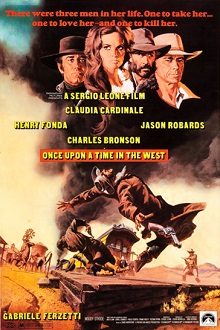
Behind the film
- Year
- 1968
- Director
- Sergio Leone
- Writers
- Sergio Leone, Sergio Donati
- Genres
- Spaghetti western, Flashback, Drama, Action
- Production
- Paramount Pictures
- Country
- Italy, United States
- Cast
- Claudia Cardinale, Henry Fonda, Jason Robards, Charles Bronson, Gabriele Ferzetti, Woody Strode, Jack Elam, Paolo Stoppa
About the film
Contains story spoilers.
At Flagstone station, three gunmen wait for a train with unnerving patience. Their small actions—the fly, the dripping water, the creak of a windmill—fill the silence until a stranger carrying a harmonica arrives and kills them. The opening announces Sergio Leone’s method: suspense grows through duration, sound and faces before the story explains itself. The stranger, known only as Harmonica, expected another man. That man is Frank, a hired gun who has just led a massacre at Sweetwater, a ranch where Brett McBain and his children were preparing for a celebration. Frank leaves evidence meant to implicate Cheyenne, an outlaw whose gang Frank is using as cover for his own violence.
Jill McBain arrives from New Orleans to discover that the family she married into has been wiped out. She is the only surviving owner of Sweetwater, and its value is not obvious from the barren ground: the transcontinental railroad is coming through, and her husband planned a watering station that would make the property a settlement. Railway magnate Morton wants the track finished before the station can be built, which would let the land revert to the company. He hired Frank to frighten Brett, not kill him, and their alliance is already fraying. Jill has little experience with the frontier’s rules, but she understands that possession of this patch of land determines who can profit from the future.
Harmonica’s business is more personal. When Cheyenne appears, the gunman recognizes that the men who ambushed him were not Cheyenne’s people, though Cheyenne is a fugitive all the same. Harmonica rescues Jill from two of Frank’s men, then notices Morton confined to a railway carriage, his body weakened by illness and his dream of reaching the Pacific reduced to a painfully slow journey. Harmonica is captured when he investigates the connection between Morton and Frank; Cheyenne frees him, and the two men cooperate for their own reasons. They use materials at Sweetwater to begin building the station, turning Jill’s legal claim into a visible challenge to the railroad’s schedule.
Frank’s control of the town is more than a gunfight threat. He corners Jill, then forces her to auction Sweetwater while his men frighten away bidders. Harmonica returns with Cheyenne in custody and bids five thousand dollars—the bounty on the outlaw—so Frank cannot simply reclaim the land at a bargain. Frank tries to buy Harmonica off, but cannot learn what grievance lies behind the stranger’s pursuit. At the same time, Morton bribes Frank’s own men to turn on him. Harmonica intervenes, not to save Frank out of compassion, but because the reckoning he has carried for years must happen on his terms.
Cheyenne escapes and rides with his gang against the men on Morton’s train. The attack leaves Morton and the other combatants dead, while Cheyenne is wounded. Frank returns to Sweetwater, where Harmonica waits. The long-delayed explanation arrives in a flashback: as a boy, Harmonica was forced to support his older brother on his shoulders while Frank prepared a hanging. The boy collapsed under the weight, and the image of his brother’s final moments has become the reason he carries the instrument. In the duel, Harmonica beats Frank to the draw and places the harmonica in his dying mouth, completing the ritual Frank began.
The ending does not turn victory into uncomplicated escape. Harmonica and Cheyenne leave the ranch together, but Cheyenne collapses from the wound he received during the train fight and dies before they can ride far. Harmonica carries his body onward. Jill remains at Sweetwater, where the railway workers arrive and she brings them water as construction continues. That final movement shifts attention from the gunmen’s private history to the community the station may create. Jill, previously treated as a prize in a men’s contest, becomes the person sustaining the work that will change the landscape.
Leone builds the film around contrasts between vast spaces and faces held in close-up. Ennio Morricone’s score gives the central figures distinct musical identities, while the opening’s sparse environmental sounds make waiting feel almost physical. Henry Fonda’s presence as Frank unsettles the clean division between familiar screen hero and villain; Claudia Cardinale gives Jill a practical steadiness that grows into authority. The railway is both plot engine and symbol of a new order: it promises settlement and commerce, yet arrives through Morton's coercion. The film’s deliberate pace lets these ideas emerge through pauses, repeated journeys and confrontations that carry personal histories into a changing West. The film also lets practical objects carry narrative weight: water, a train timetable, a deed and a bounty all become instruments of power. Jill’s insistence on staying at Sweetwater is therefore not an abstract gesture of independence; it keeps the railway’s promise from becoming Morton's property alone. The closing arrival of workers answers the opening train with a different kind of crowd, one whose presence depends on the station being completed.