
Behind the film
- Year
- 2003
- Director
- Robert Rodriguez
- Writers
- Robert Rodriguez
- Genres
- Action, Thriller, Crime, Contemporary western
- Production
- Columbia Pictures, Dimension Films, Troublemaker Studios
- Country
- United States
- Cast
- Antonio Banderas, Johnny Depp, Salma Hayek, Willem Dafoe, Rubén Blades, Eva Mendes, Mickey Rourke, Danny Trejo
About the film
Contains story spoilers.
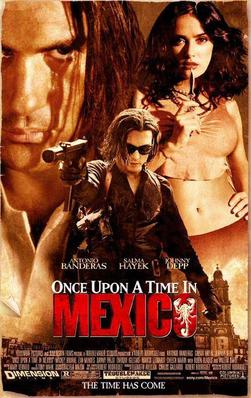
Once Upon a Time in Mexico brings the figure of El Mariachi into a plot where almost everyone is trying to use someone else’s purpose. Antonio Banderas returns as the guitar-carrying gunfighter, with Robert Rodriguez writing and directing the final film of the trilogy. Johnny Depp’s Sands offers a mission that appears to align with the hero’s private revenge, but alignment is not the same as trust. The wider cast supplies rival plans, concealed loyalties and attempts to control an approaching political crisis. The film’s pulp Western world is deliberately heightened, turning power into something exercised through striking personalities and sudden violence rather than an orderly sequence of public decisions.
Sands recruits El Mariachi against General Marquez, whose earlier attack killed the musician’s wife Carolina and their daughter. Drug lord Barillo plans to use Marquez to overthrow the president. Sands intends to exploit that coup, while retired agent Ramírez pursues Barillo for a separate loss. Barillo’s daughter Ajedrez betrays Sands, who is blinded but continues fighting. El Mariachi and his fellow musicians choose to protect the president, defeating Marquez rather than following Sands’s instructions to wait for the assassination. Barillo and Ajedrez are killed as well. The coup fails, and El Mariachi gives his share of the money to his village before departing.
The hero’s grief gives that crowded conspiracy a central emotional line. His reason to confront Marquez exists before Sands arrives, which makes the offer useful without making its author trustworthy. A person pursuing revenge can be recruited precisely because someone else knows how to frame a task as an opportunity. The film lets El Mariachi move inside that manipulation without surrendering all judgement to it. His later decision about the president distinguishes his own purpose from the purpose of the man employing him. Being given a route towards a personal enemy does not require accepting every condition attached to that route.
Sands represents a more detached form of control. Depp’s character treats local events as something that can be arranged through bargains, threats and the calculated use of other people’s desires. His confidence depends on remaining the person who sees the larger pattern while others occupy positions within it. The reversals are important because they remove that privileged distance. Once his own body becomes vulnerable, the situation can no longer be handled entirely as a game played through intermediaries. His continuing violence remains heightened, but the shift exposes how quickly apparent mastery can become dependence on whatever help and information are immediately available.
The intersecting vendettas make cooperation provisional. Ramírez and El Mariachi can oppose the same network while carrying different histories into the encounter. That difference gives the action more than one emotional destination, preventing every conflict from becoming an extension of the central hero alone. The criminal relationships are similarly unstable: protection can become coercion, and a useful subordinate can become someone who knows too much. The plot’s density comes from those shifting arrangements. People need one another’s capacities without necessarily respecting one another’s lives, so an agreement may last only until its immediate function has been served.
Music and weapons belong together in El Mariachi’s identity, giving the action an image distinct from a conventional professional soldier. The guitar associates him with performance, memory and a life beyond violence, even when the plot keeps drawing him back into violence. His companions extend that identity into a group rather than leaving it as a solitary signature. The musician figure allows the film’s Western qualities to coexist with a particular cultural setting, while the exaggerated combat remains a fictional spectacle rather than an account of ordinary Mexican life. The title’s storytelling frame encourages that scale of legend, where an individual’s presence can dominate the meaning of an encounter.
The Day of the Dead setting places the coup attempt inside a public celebration that already contains a relationship with death. That juxtaposition gives private mourning, public display and political violence a common visual environment. The action is not unfolding in an empty arena prepared solely for the fighters. It moves through a place where other people are present and where the meaning of the occasion exceeds the conspirators’ plans. The resistance to Marquez therefore belongs to more than the hero’s revenge. Protecting the president interrupts a design for power whose consequences would fall on people who never agreed to participate in the private bargains producing it.
The ending leaves El Mariachi able to depart without turning departure into an erasure of loss. Defeating the men connected with his grief does not recover the family taken from him. Giving money to the village supplies another direction for what his actions have produced, connecting the conclusion with a community beyond the immediate fight. Once Upon a Time in Mexico finishes its trilogy through the clash between manipulation and independent choice. Its spectacular betrayals create an unstable field of motives, but the hero’s decisive act is to stop treating the offered mission as the limit of his responsibility. Revenge brings him back; judgement determines what he does once there.