
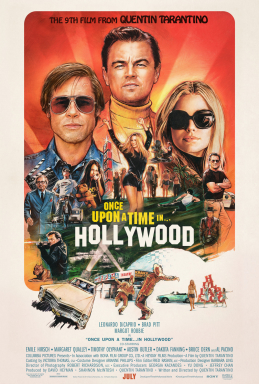
Behind the film
- Year
- 2019
- Director
- Quentin Tarantino
- Writers
- Quentin Tarantino
- Genres
- Comedy drama, Black comedy, Drama, Crime
- Production
- Heyday Films, Sony Pictures, Columbia Pictures
- Country
- United States, United Kingdom
- Cast
- Leonardo DiCaprio, Brad Pitt, Margot Robbie, Austin Butler, Dakota Fanning, Timothy Olyphant, Margaret Qualley, Al Pacino
About the film
Contains story spoilers.
Los Angeles in 1969 is both a workplace and a maze for Rick Dalton, a former television western star whose career has settled into guest roles as villains. His agent suggests that he go to Italy to make westerns, but Rick hears the proposal as proof that Hollywood has passed him by. Cliff Booth, his stunt double, driver, and closest friend, has less work too. A fight with Bruce Lee and rumors about his wife’s death have made producers reluctant to hire him. Their partnership is affectionate but unequal: Rick is the name on the marquee, while Cliff keeps the car running, handles errands, and absorbs his employer’s worries.
Rick lives beside the home of actress Sharon Tate and director Roman Polanski. He hopes that proximity might lead to an introduction and a renewed chance in the business, while Sharon is shown through quieter pleasures of her own. She visits a cinema and watches herself in The Wrecking Crew, enjoying the audience’s laughter. Cliff’s route crosses Spahn Ranch, an old western set where he once worked. He gives hitchhiker Pussycat a ride there and checks on its nearly blind owner George Spahn, concerned that the young residents might be taking advantage of him. When one damages Cliff’s car tire, Cliff forces him to change it and leaves before the group’s leader arrives.
Rick’s anxiety surfaces during a guest appearance on Lancer. He struggles to remember his lines, retreats to his trailer, and berates himself for failing at a role he ought to understand. The pause does not end his career: he returns to the set and delivers the performance, impressing the director and his young co-star. The scene moves between the western being made and Rick’s private panic, showing how much of his identity depends on being able to work. His agent’s Italian proposal now becomes a practical opportunity rather than merely an insult. Cliff accompanies him for the extended stay, and Rick makes several films and marries Italian actress Francesca Capucci.
When the pair return to Los Angeles in August, Rick can no longer afford to keep Cliff on salary. Cliff accepts the news without making it a betrayal; their friendship has survived the fact that work has always defined its terms. On their last evening together they go drinking, then return to Rick’s house. Cliff smokes an acid-laced cigarette and takes his dog Brandy for a walk while Rick prepares margaritas. The date is August 8, a night associated with the real Tate murders, but the film’s characters are fictional or dramatized and its coming events deliberately diverge from history.
Four Manson followers drive toward the Tate residence intending to attack its occupants. Rick is angered by their noisy car and orders them off the private street. Recognizing him from television, the intruders decide that Hollywood itself taught them violence and choose Rick’s house instead. Cliff and Brandy confront them inside; Rick hears the disturbance and joins the fight, eventually using a flamethrower prop from one of his films. The attackers are stopped before reaching the neighboring home. The sudden, violent sequence grows from the characters’ earlier paths—the ranch, the street, the car, and Rick’s old work—rather than from a conventional investigation of the historical case.
Cliff leaves in an ambulance for treatment, while Rick remains at home. From next door Sharon calls down to Rick and invites him over, finally granting him the encounter he had imagined as a career opening. The ending alters the historical outcome: Sharon and her guests remain safe in the movie’s version of the night. It is a fable about a fading actor and his friend, arranged around real streets, performers, television sets, and cinemas, but not a claim that the real murders unfolded this way. The final invitation connects Rick’s private wish for recognition to a human relationship, ending on a threshold rather than a public comeback.
The movie spends time with the professional routines that make Rick’s career feel tangible. He rehearses, works through costume and blocking, and watches the young Trudi perform with a confidence that briefly unsettles him. His trailer breakdown is not a career-ending collapse; it is followed by a successful take, so the film lets insecurity and skill coexist. Cliff’s work is similarly practical: he drives Rick, fixes an antenna, and performs labor that goes unnoticed when it succeeds. Their different positions in the industry appear in small habits rather than explanatory speeches.
Driving gives this Los Angeles its connective tissue. Cliff moves between Rick’s comfortable hillside home, film sets, and the trailer where he lives with Brandy, while radio broadcasts and music continue around him. The journeys put working lives beside the industry’s public image: advertisements, cinemas, and familiar screen faces share streets with people trying to earn another day’s employment. Sharon’s cinema visit makes that relationship especially warm, because she can sit anonymously among viewers enjoying her work. Rick usually measures success through what producers might offer next; her afternoon allows a performer to enjoy the immediate response of people who have simply come to watch a film.