
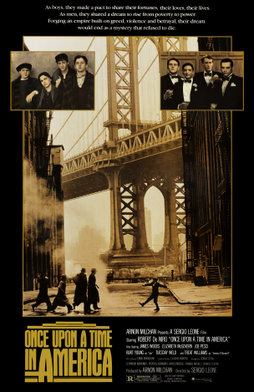
Behind the film
- Year
- 1984
- Director
- Sergio Leone
- Writers
- Leonardo Benvenuti, Piero De Bernardi, Enrico Medioli, Franco Arcalli, Franco Ferrini, Sergio Leone
- Genres
- Crime, Flashback, Drama, Gangster
- Production
- Regency Enterprises, Producers Sales Organization
- Country
- United States, Italy, France
- Cast
- Robert De Niro, James Woods, Elizabeth McGovern, Joe Pesci, Burt Young, Tuesday Weld, Treat Williams, William Forsythe
About the film
Contains story spoilers.
Once Upon a Time in America is organized around a return rather than a rise. David Aaronson, known as Noodles, comes back to New York decades after leaving with the belief that he destroyed his closest friends. The city can still supply familiar doors and faces, but the meaning of what happened has become less secure. Sergio Leone moves among periods without treating memory as a tidy explanation of the present. A ringing telephone, a face or a piece of music can pull one time into another. The result makes the gangster story feel like a life that keeps revisiting its own evidence.
The childhood passages establish a Lower East Side where money is scarce and power is visible in the people who can take it. Noodles meets Max within that world, and their friendship grows alongside schemes that turn practical ingenuity into criminal opportunity. The boys understand routes, signals and the advantages of moving unseen, making the neighbourhood a system they learn to exploit. Their alliance carries pleasure as well as danger: shared enterprise gives them a group identity they would otherwise struggle to obtain. The death of the youngest boy and Noodles' violent response end any illusion that cleverness alone can keep that life playful.
Deborah offers Noodles another kind of aspiration. Her dancing and determination suggest a future beyond the boundaries that make the boys' ventures possible. His attention to her is tender at times, but it is also bound up with wanting access to something that remains out of reach. Leone repeatedly places looking at the centre of their relationship, allowing distance to become both fascination and resentment. Jennifer Connelly's younger Deborah and Elizabeth McGovern's adult performance give that continuity a life separate from his desires. She has ambitions of her own, and the film's most painful encounters emerge when he treats those ambitions as an injury to himself.
After prison, Noodles rejoins friends whose operation has grown during Prohibition. Wealth changes their clothes and surroundings without eliminating the habits that formed them. Max's appetite for larger ventures brings them into contact with other criminal and political interests, extending the gang beyond its original neighbourhood. James Woods plays the friendship as something that can turn competitive in the middle of an apparently affectionate exchange. Robert De Niro's Noodles is less restless, but his hesitation should not be confused with innocence. Their criminal world depends on coercion, and the film makes the human damage of that power visible even when its surfaces are seductive.
The lavish outing with Deborah exposes the limit of Noodles' idea of love. When she tells him she intends to leave for her career, he assaults her, destroying the possibility he has tried to arrange through money and spectacle. The scene cannot be absorbed into a romantic account of a man losing his childhood sweetheart. It demonstrates his demand to possess someone whose independence he cannot accept. Her departure then leaves a silence that material success cannot repair. The gap between the film's beautiful settings and this brutality matters throughout: elegance belongs to the world the gangsters can buy, rather than providing a moral description of them.
The end of Prohibition threatens their business and magnifies Max's ambitions. Noodles hopes a lesser police intervention can prevent a plan he considers suicidal, but wakes to the apparent deaths of his friends and a shared fund that has vanished. That is the loss carried into the later return. The aged Noodles encounters a public figure named Bailey and a story that could transform his understanding of the betrayal. Deborah's place in that later world makes the discovery more intimate than simply finding a missing criminal. Old identities have become embedded in respectable power, giving the past consequences that extend far beyond the friends' original business.
Leone does not let the confrontation behave like a conventional exposure followed by revenge. Noodles declines to act on the terms offered to him, preserving the memory of a friend rather than accepting the proposed role in another man's ending. The garbage truck outside and the disappearance of the figure behind it remain suggestive, not a clearly witnessed death. A return to the opium den and Noodles' smile further disturb the relationship between remembered events and possible fantasy. These images can be read in different ways, but uncertainty is part of their function; assigning them a single confirmed explanation would flatten the film's handling of time.
The broad compositions, long intervals and Ennio Morricone's music give the remembered world room to become seductive before another scene reveals its cost. Streets can look monumental through a child's eyes, while an older face can make a luxurious room feel empty. The longer, nonchronological version preserves those connections rather than turning the film into a simple sequence of criminal milestones. Across its changing periods, the story asks what survives when loyalty becomes an account people tell themselves. Noodles returns looking for information, but the emotional weight lies in the distance between knowing what happened and finding a version of his life he can bear.