
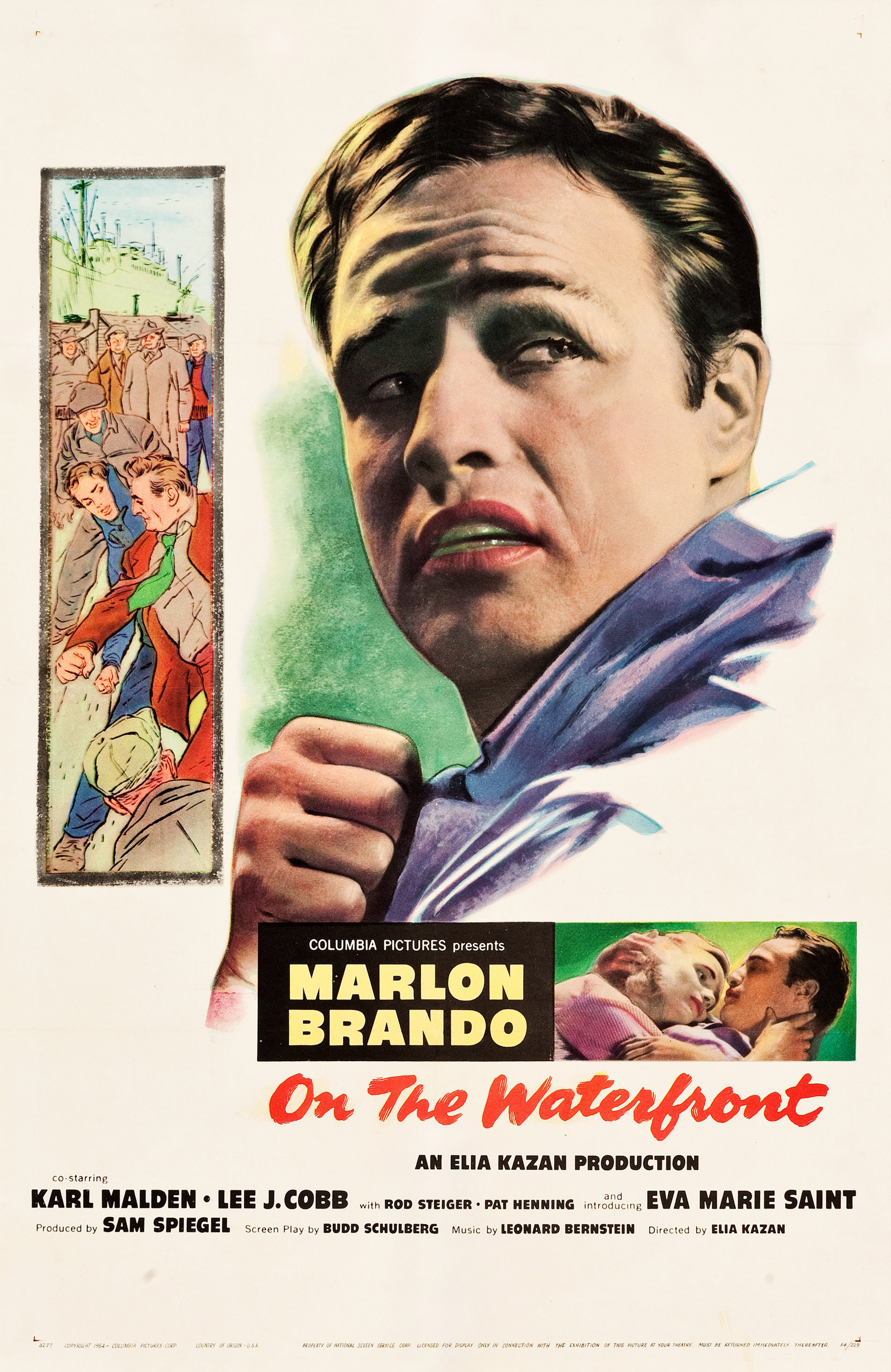
Behind the film
- Year
- 1954
- Director
- Elia Kazan
- Writers
- Budd Schulberg
- Genres
- Drama, Crime, Thriller
- Production
- Columbia Pictures
- Country
- United States
- Cast
- Marlon Brando, Karl Malden, Lee J. Cobb, Eva Marie Saint, Rod Steiger, Leif Erickson, Fred Gwynne, James Westerfield
About the film
Contains story spoilers.
Terry Malloy begins On the Waterfront inside a system he understands without fully confronting what it does. A former boxer now working on the docks, he receives favours from union boss Johnny Friendly and relies on arrangements secured partly through his brother Charley. When Terry helps lure fellow worker Joey Doyle onto a rooftop, he expects intimidation, not murder. Joey’s death makes the gap between looking away and taking part impossible to ignore. Elia Kazan’s 1954 drama follows that recognition through a waterfront where employment, violence and silence have become inseparable, asking what it takes for someone protected by corruption to stop protecting it in return.
Marlon Brando’s Terry does not arrive as a confident crusader. His manner combines physical strength with hesitation, and he often seems less certain of his own worth than the people directing him are of his usefulness. The docks provide daily evidence of how the arrangement works. Men need access to jobs, and the people distributing that access can reward compliance or punish resistance. Johnny Friendly’s power does not depend only on spectacular violence. It also depends on making ordinary survival conditional. The fear surrounding Joey’s death is therefore practical as well as personal: speaking may mean losing work, facing retaliation or finding that the people who share your circumstances will not stand beside you.
Joey’s sister Edie returns determined to understand what happened. Eva Marie Saint gives her persistence an openness that Terry cannot easily dismiss, because she approaches him as someone capable of more than the role he has accepted. Their attraction grows alongside an unequal knowledge of the killing. He knows more than he can initially admit, and her trust becomes another reason that keeping quiet feels less tolerable. Edie’s concern also pushes Father Barry toward the waterfront rather than leaving his involvement within the church. Karl Malden’s priest discovers that urging courage is inadequate unless he is prepared to remain among the people who will bear its costs.
The death of another worker willing to give evidence shows how quickly those costs can arrive. Father Barry’s response at the docks challenges the habit of treating violence as merely part of the job. His presence does not make the workers safe, but it contests the idea that their suffering can remain morally invisible. Terry is pulled between that challenge and the loyalties that have shaped his life. Friendly’s organisation can still offer protection, while Edie and Barry offer something less immediately comfortable: responsibility for what he has allowed himself to know. The film’s tension comes from the difference between having a conscience and acting on it when the available protections disappear.
The taxi conversation between Terry and Charley brings the conflict into the family. Rod Steiger’s Charley tries to persuade his brother to remain within the arrangement that sustains them, but Terry finally speaks about the boxing career sacrificed to other people’s interests. The hurt is not limited to a missed sporting achievement. It concerns a younger man who trusted his brother to look after him and learned instead to accept being used. The enclosed car makes their choices feel painfully intimate. Neither can escape into the anonymity of the waterfront, and Charley’s eventual refusal to deliver Terry as requested turns brotherly feeling into a dangerous act of resistance.
Charley’s murder makes that resistance visible through loss. Terry’s decision to testify then changes his place among the dockworkers as well as his relationship to Friendly. Giving evidence does not automatically make him welcome or employed. The final return to the docks forces the struggle into public view: Terry demands work, confronts the boss and is brutally beaten. His battered walk toward the warehouse matters because others finally refuse to continue without him. The moment shifts responsibility from one isolated witness to a group of workers whose cooperation has sustained Friendly’s authority. Terry cannot repair the whole system alone, but his willingness to stand exposes the choice everyone else must now make.
Boris Kaufman’s black-and-white photography gives stairways, rooftops, streets and the working waterfront a hard physical presence. The pigeons Terry keeps supply a quieter space where his attentiveness is visible outside the demands of the job. Leonard Bernstein’s score supports the tension between intimacy and collective action, while Brando’s pauses and small movements keep Terry’s transformation from becoming a series of polished speeches. Lee J. Cobb gives Friendly the bluster of a man accustomed to having his wishes translated into other people’s behaviour. When that translation starts to fail, the same confidence becomes rage. The drama turns on changes in who will obey, who will listen and who is willing to remain silent.
Budd Schulberg’s screenplay centres a specific conflict between corrupt loyalty and moral responsibility. Its depiction of waterfront labour is not a claim that all unions or workers resemble Friendly’s organisation. The group’s exploitation is precisely what allows the film to separate solidarity from enforced silence. Terry’s testimony can be discussed alongside Kazan’s controversial history of naming names, but the story’s emotional force comes from its own relationships: Joey’s family, the brothers, the priest and the men waiting for work. The ending offers a collective refusal rather than proof that every consequence has been resolved. Terry reaches the doorway injured, carrying the cost of becoming someone who can no longer say he did not understand.