
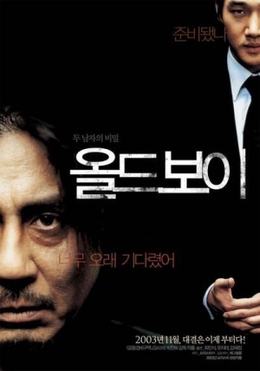
Behind the film
- Year
- 2003
- Director
- Park Chan-wook
- Writers
- Hwang Jo-yun, Lim Jun-hyung, Park Chan-wook
- Runtime
- 120 minutes (archive Blu-ray edition)
- Genres
- Drama, Thriller, Mystery, Action
- Country
- South Korea, Japan
- Cast
- Choi Min-sik, Yoo Ji-tae, Kang Hye-jung
About the film
Contains story spoilers.
Park Chan-wook’s 2003 South Korean Oldboy follows Oh Dae-su through a revenge story built around confinement, memory and the awful possibility that a person can be manipulated into repeating a past mistake. After being kidnapped, Dae-su wakes in a private cell furnished with a television. News reports tell him that his wife has been murdered and that he is suspected of the crime. Fifteen years pass in isolation, with meals arriving through a slot and no clear explanation for who arranged the imprisonment. He trains his body, marks the passage of time and tries to understand what he has done to deserve it. Then he is drugged and released. The abrupt transition from a controlled room to an open city does not feel like freedom; Dae-su is given no time to rebuild a life before an unseen captor begins steering his next steps.
Dae-su’s first days outside combine investigation with a growing appetite for violence. He is drawn to a sushi restaurant, where chef Mi-do takes an interest in him and later becomes his closest companion. Dae-su follows the trail of the food delivered to his prison, locates the private facility and forces its manager, Park, to explain the service. He is told that clients can pay to have people locked away, but the answer does not explain the fifteen-year sentence. A mysterious caller, using the name Evergreen, gives him five days to discover the reason for his captivity and threatens Mi-do if he fails. The deadline converts a broad search into a cruel contest with a prize that is itself part of the trap. Dae-su wants to punish the person who stole his life, yet every clue seems to have been placed so that he will arrive at the next revelation on schedule.
His recollection of school eventually provides the name behind the alias: Lee Woo-jin, a former classmate. Dae-su remembers seeing Woo-jin in a sexual relationship with his sister Soo-ah and mentioning it to another student. The gossip spreads, and Soo-ah later dies by suicide. The film presents that memory as the source of Woo-jin’s revenge, while leaving the audience to watch how a casual act of speech becomes, in retrospect, the hinge on which several lives turn. Woo-jin’s wealth and preparation make him seem almost omniscient, but the emotional logic is more intimate than his elaborate plan. He has preserved a grievance for years and built an entire scenario to make Dae-su feel the same helplessness and shame he associates with his sister’s death. Dae-su, who has treated memory as a tool for identifying an enemy, discovers it can also be used as a weapon against him.
Woo-jin reveals the final part of his design when he shows Dae-su a photo album: Mi-do is Dae-su’s daughter, separated from him when he was abducted, and the two have been brought together without knowing their relationship. Woo-jin says hypnosis helped direct their paths toward each other. The revelation transforms the romance that has developed between Mi-do and Dae-su into the centre of the revenge scheme. Dae-su begs Woo-jin not to tell her and cuts out his own tongue as an act of penance for the gossip he once spread. Woo-jin accepts the gesture, but his revenge has not made him whole. In the elevator, the memory of Soo-ah’s death returns to him, and he shoots himself. The story does not frame his suicide as justice or a clean release; it leaves the survivors with consequences that Woo-jin’s death cannot undo.
Dae-su seeks out the hypnotist and asks her to remove his knowledge of the truth. The final meeting with Mi-do takes place in a snowy landscape, where she finds him after the hypnosis and embraces him. His expression shifts between a smile and visible pain, leaving it unclear whether the procedure has erased what he wanted erased or merely given him a way to live beside it. That uncertainty is central to the film’s ending. A conventional revenge plot might treat the antagonist’s death as closure, but Oldboy instead ends with a question about what Dae-su can know, what he can bear, and what the audience is entitled to conclude from his face. The film’s most frightening prison may be the memory he cannot confidently control.
The film is an adaptation of the Japanese manga by Garon Tsuchiya and Nobuaki Minegishi, but it is specifically Park Chan-wook’s 2003 Korean feature, not the 2013 American remake. Park and co-writers Hwang Jo-yun and Lim Jun-hyung build the story as a sequence of jolts: a brief image or piece of dialogue can return with a changed meaning once Dae-su learns more. The famous corridor fight compresses many attackers into a narrow horizontal frame. Rather than cutting rapidly between every blow, the camera tracks Dae-su’s exhausting progress in a rough side view, making the effort and damage legible. Elsewhere the film uses colour, abrupt tonal shifts and deliberately heightened compositions to make ordinary places feel unstable. The style does not simply decorate the plot; it gives the viewer the same sense of being pushed through a plan whose rules are hidden.
Oldboy’s brutality can dominate discussion, but the film’s central mechanism is communication: a rumour, a coded nickname, a message from a hidden caller, an image in an album. Dae-su believes he can solve the puzzle by uncovering facts, yet the facts have been arranged by someone who understands how he will react to them. Mi-do is not just a reward or a clue; the ending’s emotional discomfort depends on her having acted within a relationship whose history was withheld from her. The film leaves the viewer with no painless interpretation of Dae-su’s final expression. He may be trying to believe the hypnosis worked, or he may be unable to separate relief from terror. Its unresolved close keeps revenge from becoming a tidy moral equation: the person who engineers suffering is destroyed, but the survivors still have to inhabit the life his scheme produced.