
Behind the film
- Year
- 2007
- Director
- Steven Soderbergh
- Writers
- Brian Koppelman, David Levien
- Genres
- Heist, Comedy, Action
- Production
- Warner Bros. Pictures
- Country
- United States
- Cast
- George Clooney, Brad Pitt, Matt Damon, Al Pacino, Ellen Barkin, Elliott Gould, Andy Garcia, Don Cheadle
About the film
Contains story spoilers.
Ocean's Thirteen puts a different motive underneath the familiar pleasure of watching a complicated theft come together. The crew already knows how to work as a team. What needs explaining is why they would put that machinery into motion again, and the answer is a friend who has been mistreated. That changes the emotional direction of the job. Money remains essential to the mechanics, but it is no longer the most convincing account of what the men want. The target has broken a social understanding, and the response is designed to make him feel the consequences in the language he values.
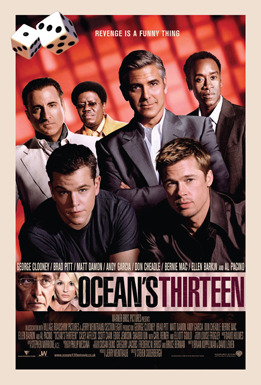
Steven Soderbergh directs the 2007 film from a screenplay by Brian Koppelman and David Levien. George Clooney, Brad Pitt and Matt Damon return as Danny Ocean, Rusty Ryan and Linus Caldwell, with Al Pacino playing Willy Bank. It is the third film in this version of the Ocean series, so its ensemble operates with an established shared vocabulary. That familiarity lets the story begin from confidence rather than laboriously introducing everyone's credentials. There is a comic contrast between the scale of the task and the casual manner in which experienced collaborators can discuss it. Preparation becomes a social rhythm as well as a practical necessity.
Bank's betrayal leaves Reuben hospitalised, and Danny's team targets his new casino's opening. They aim to spoil its prestigious rating and engineer enormous gambling losses, overcoming its surveillance system with deception and disruption. Financing brings Terry Benedict into the scheme; a diamond theft and a rival thief add further complications. Bank is financially ruined, Reuben receives land for a fresh start, and Benedict's share becomes a donation in his name. Rusty finally arranges a large win for a genuine hotel reviewer whom the operation has inconvenienced. Revenge succeeds, but the conclusion also finds room to compensate someone caught in its machinery.
The casino is a particularly suitable opponent because it sells the appearance of possibility while relying on a controlled imbalance. Its customers are meant to feel that fortune could turn at any moment, whereas its owners expect the business to remain firmly in their favour. A heist aimed at that arrangement has a built-in irony. The crew needs to make the promise of winning more real than the proprietor intended. The fantasy is therefore not just entering a secure building and removing an object. It is temporarily making a powerful institution obey the enticing story it tells the people paying to enter.
Prestige gives the plan a second point of attack. A luxury venue needs admiration as well as revenue, and those two needs do not operate in exactly the same way. Wealth can fund an impressive surface, but it cannot simply command genuine recognition. In that gap, the story finds room for humiliation. Bank's standards become vulnerabilities because he depends on other people confirming his exceptional status. The film treats this as a form of dependence hidden inside dominance: someone who appears able to buy everything can still be made anxious by a judgement that arrives from beyond his own authority.
The ensemble's disguises make another distinction visible, between seeming important and being useful. A person can attract attention, supply a convincing cover or perform a narrow task that nobody outside the operation would notice. The team's advantage lies in connecting those different jobs. Individual charm would be insufficient without coordination, while coordination would become brittle if no one could improvise. That is the central enjoyment of the heist form here. The spectator gets to think about a large problem as a collection of human-sized contributions, then watch those contributions become effective because someone has understood how they fit together.
Loyalty does not make the crew morally uncomplicated. They are still manipulating people, treating institutions as objects to be bent and accepting collateral inconvenience. The comic register allows those acts to become entertaining, but the ending's gesture toward the reviewer also acknowledges that the target and everyone around the target are not the same thing. Revenge stories can flatten that distinction until anyone nearby seems disposable. This one leaves a small opening for generosity after the main objective has been achieved. It is a fitting counterweight to an antagonist whose idea of success appears to leave little room for other people's dignity.
The film's closing satisfaction rests on restoring an understanding among friends rather than merely producing a spectacular balance sheet. A scheme can be perfectly calculated and still have a recognisably personal centre. That combination is what makes Ocean's Thirteen an ensemble caper rather than a demonstration of casino vulnerabilities. Its world is a stylised playground of wealth, bluff and professional confidence, with the audience invited to enjoy ingenuity without mistaking the invented operation for practical instructions. Under the elaborate arrangements sits a simpler promise: people who have chosen to belong to one another will notice when one of their number has been hurt.