
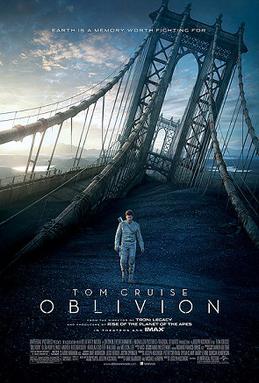
Behind the film
- Year
- 2013
- Director
- Joseph Kosinski
- Writers
- Karl Gajdusek, Michael deBruyn
- Runtime
- 2h 5m
- Genres
- Science fiction, Alien invasion, Thriller, Post-apocalyptic
- Production
- Universal Pictures, Relativity Media, Peter Chernin
- Country
- United States
- Cast
- Tom Cruise, Morgan Freeman, Olga Kurylenko, Andrea Riseborough, Nikolaj Coster-Waldau, Melissa Leo
About the film
Contains story spoilers.
Oblivion begins with the confidence of a workplace that has an explanation for everything. Joseph Kosinski's science-fiction film gives Tom Cruise's Jack Harper a practical job, sophisticated equipment and a routine through which an extraordinary situation can become familiar. That familiarity matters. The mystery does not initially ask whether he can defeat an obvious enemy; it asks whether he can recognise that his understanding of the world has been arranged for someone else's benefit. Competence is therefore an unstable advantage. Jack can accomplish the tasks placed before him while remaining mistaken about their purpose, making the film's sleek technology part of its unease rather than a guarantee of progress.
Jack and Victoria maintain drones after a supposed human victory over invading aliens. Julia arrives in a crashed spacecraft, recognises Jack as her husband and contradicts his erased memories. The people labelled hostile scavengers are human survivors led by Malcolm Beech. Jack discovers another technician with his face: he is one of the clones serving the Tet, an alien machine draining Earth's resources. Victoria dies when she reports their partnership compromised. A planned drone attack fails, so Jack carries a bomb into the Tet with the dying Beech concealed in Julia's place. They destroy it together. Julia remains at Jack's secluded lakeside home and raises their daughter. Years later, another Jack reaches her, suggesting that recovered memory and attachment can survive the system that produced him.
Cruise's performance draws on the appeal of someone who knows how to handle a difficult machine. Physical assurance makes Jack's circumstances initially feel manageable, even when the landscape is strange. Yet that assurance cannot answer the problem of identity. A task has an observable outcome; a memory may resist both measurement and command. The film puts these kinds of knowledge beside one another and lets their disagreement grow. Jack's confidence is useful when it carries him toward danger, but inadequate when it encourages him to accept the categories already supplied. His independence begins when he treats discomfort as information instead of a distraction from work.
Andrea Riseborough's Victoria gives that tension an intimate setting. A partnership can feel secure because its routines have become so efficient that neither person needs to reconsider them. Here efficiency has the further attraction of making a frightening situation appear temporary and controlled. Her composure helps establish the emotional price of Jack's curiosity: asking another question may disturb the life they believe they share. That does not reduce her to an obstacle placed in front of an adventurous man. It makes visible a different response to uncertainty, one in which preserving a familiar arrangement feels safer than allowing an unexplained feeling to change its terms.
Olga Kurylenko's Julia brings a competing form of recognition. Her presence matters beyond the mechanism of a revelation because it makes identity relational. Knowing a person involves histories, habits and attachments that cannot be replaced simply by assigning a name and a function. The film's romantic element grows from this disagreement between an administered self and a remembered connection. It also leaves a difficult question inside the resolution: resemblance and inheritance do not make individual lives interchangeable. The possibility of continuity remains emotionally compelling because the story has made loss important, rather than treating another matching face as a technical replacement that cancels what happened.
The visual world holds these competing ideas in a single contrast. Smooth, elevated interiors promise clarity and protection, while the damaged ground contains texture, remnants and awkward evidence of a life outside the assignment. Clean design can appear reassuring until its completeness starts to resemble isolation. Objects that have no immediate operational value consequently acquire emotional weight. They offer reasons to care about a place beyond the resources that can be extracted from it. Kosinski uses that difference to make the question of Earth's future tangible: a world can remain useful to a system even after that system has stopped recognising what living there means.
Morgan Freeman's Beech changes the scale of the problem without taking away its personal centre. Resistance asks Jack to reconsider the interests behind his instructions, bringing collective survival into a story organised around private recognition. The connection between those scales is the film's central moral turn. Remembering becomes consequential when it changes what a person is willing to do for others. The action therefore carries more than a demand for technical success. It tests whether the skills cultivated by an exploitative arrangement can be redirected against that arrangement, and whether the person exercising them can accept a future that does not preserve his own position within it.
The title describes a danger larger than forgetting a piece of information. Losing a history can make an imposed role seem natural, especially when that role offers comfort, purpose and a convincing explanation of the enemy. Oblivion turns its machinery of discovery toward the fragile materials that resist such an account: affection, curiosity, remembered places and the suspicion that a useful answer may still be false. Its science fiction remains a fantasy rather than a prediction about actual technology, but the emotional conflict is clear. A life becomes one's own through the willingness to examine its conditions, even when that examination breaks the order that once made it feel secure.