
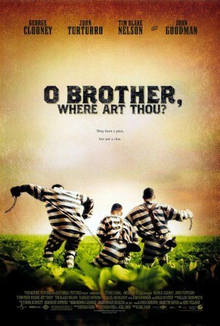
Behind the film
- Year
- 2000
- Director
- Joel Coen
- Writers
- Joel Coen, Ethan Coen
- Genres
- Buddy, Comedy, Treasure hunt, Crime
- Production
- Mike Zoss Productions, Touchstone Pictures, Working Title Films
- Country
- France, United States, United Kingdom
- Cast
- George Clooney, John Turturro, Tim Blake Nelson, Chris Thomas King, John Goodman, Holly Hunter, Charles Durning, Wayne Duvall
About the film
Contains story spoilers.
In 1937 Mississippi, Everett escapes a chain gang with Pete and Delmar, promising treasure before a valley floods. Their travels include a baptism, a bank robber and a recording session with guitarist Tommy, producing an unsuspected hit as the Soggy Bottom Boys. Everett actually wants to stop his former wife Penny marrying again. Pete is recaptured, then rescued; the trio save Tommy from a Klan lynching. Their music wins a political audience, and Governor Pappy pardons them after rival Stokes exposes his racism. Penny demands her original wedding ring. A sheriff ignores the pardon and prepares to hang them, but the new reservoir floods the site after Everett prays. A recovered ring proves wrong, leaving his domestic problems unresolved. The adventure ends with reconciliation still requiring something grand escapes cannot supply.
Everett, played by George Clooney, is the engine of the story because he thinks being articulate makes him the sensible one. His confidence has its own comic rhythm: he offers an explanation, arranges his appearance and assumes the others ought to accept his authority. Yet confidence and judgment are different things. John Turturro's Pete and Tim Blake Nelson's Delmar can be foolish without becoming interchangeable fools. Pete's suspicion challenges Everett's right to lead, while Delmar's openness gives the group a very different way of responding to uncertainty. Their arguments make the road feel inhabited by three incompatible temperaments. Friendship here grows out of continuing together despite irritation, rather than discovering that everyone secretly has the same outlook.
The Mississippi they move through has the shape of an American folk tale. Roads connect scattered encounters more readily than they connect stable institutions, and a stranger may bring hospitality, danger or both. The setting invites you to notice how easily a grand story can attach itself to an ordinary place. A crossroads becomes a question about belief; a public gathering becomes a stage for competing versions of community. The connection with Homer's Odyssey works as a loose imaginative framework, giving the search for home a mythic echo without requiring every incident to behave like a faithful translation. Its ancient scale and shabby material circumstances coexist: people can speak as though fate is carrying them while still needing money, food and a way to travel.
Music gives that world a form of recognition Everett cannot talk his way into. A voice can reach people who have never met the person singing, allowing a reputation to circulate separately from a body. That is a useful tension in a comedy about men who repeatedly struggle to understand how others see them. Their identities depend on the immediate situation until a song begins doing different work. The soundtrack also gives public feeling a richness political slogans cannot match. Harmony suggests shared effort without erasing distinct voices, while the surrounding story keeps exposing how unevenly membership in a community is offered. The warmth of collective music sits beside exclusion, making the question of who gets to belong more complicated than a cheerful celebration of the region.
The political comedy follows men who understand crowds as opportunities. Pappy's genial manner belongs to an experienced performer of authority, and Stokes packages his ambition in its own public costume. Their rivalry makes politics look partly like entertainment: the ability to seize a mood can matter more than any coherent principle. Beneath that absurdity is a harsher division between appearing respectable and acting justly. The film lets persuasive public identities conceal ugly private commitments. It also leaves room for opportunism to produce a helpful outcome without transforming the opportunist into a moral hero. You can enjoy the reversal while still recognising that these men are responding to advantage, and that the people exposed to their power need more than a successful performance to be safe.
Belief creates another argument that never quite settles. Everett favours an explanation he can present as rational, but his certainty repeatedly feels like a performance of its own. Delmar's willingness to believe can look naive and generous at once. Rather than giving either outlook uninterrupted victory, the film keeps changing the scale of what confronts them. A strange experience may seem supernatural to one person and explicable to another, yet the explanation does not necessarily remove the feeling of wonder. That uncertainty is part of the comedy's texture. These men are small enough beside the landscape and its transformations that insisting on complete intellectual command can itself become ridiculous, even when a practical account of an event is available.
The visual world supports that feeling with earth colours, open country and faces that seem ready to become characters in a song. Everyday untidiness does not disappear beneath the period atmosphere. Everett's concern with his grooming, for instance, creates a wonderfully narrow standard of order in a life that is otherwise precarious. The contrast makes his dignity both understandable and silly. Joel Coen's direction and the screenplay by Joel and Ethan Coen allow broad jokes to share space with genuine menace, so the journey does not flatten into an uninterrupted series of charming eccentricities. A funny voice or an exaggerated gesture can belong to someone dangerous, and a beautiful landscape offers no guarantee of fairness. The setting is attractive without becoming an assurance that its inhabitants are kind.
Home is consequently more demanding than reaching a destination. Everett wants his old life back, but wanting it does not restore his standing with the people whose lives continued without him. Penny's resistance gives the adventure a limit: he cannot convert every difficulty into another heroic episode starring himself. That is why the domestic thread matters as much as the stranger encounters. The desire to belong is real, even when the person expressing it has been vain, evasive or unreliable. O Brother, Where Art Thou? finds room for affection without declaring the work of repair finished. Its wandering becomes an account of how much a man can experience while remaining uncertain about the simplest relationship he hopes to recover.