
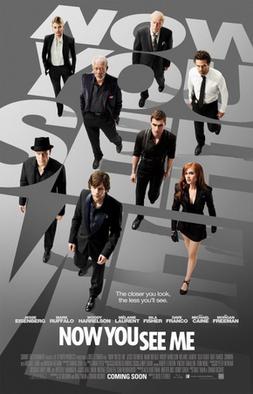
Behind the film
- Year
- 2013
- Director
- Louis Leterrier
- Writers
- Ed Solomon, Boaz Yakin, Edward Ricourt
- Genres
- Crime, Heist
- Production
- Summit Entertainment
- Country
- United States, France
- Cast
- Jesse Eisenberg, Mark Ruffalo, Woody Harrelson, Isla Fisher, Dave Franco, Mélanie Laurent, Michael Caine, Morgan Freeman
About the film
Contains story spoilers.
Four magicians become the Four Horsemen, performing a Las Vegas illusion that seemingly empties a Paris bank. FBI agent Dylan Rhodes and Interpol detective Alma Dray consult debunker Thaddeus Bradley. The Horsemen next transfer sponsor Arthur Tressler’s money to people denied insurance payouts. Jack Wilder apparently dies during the chase, but survives through another deception. A security-company robbery ends with Thaddeus framed and arrested. Dylan secretly organised the performances to avenge his father Lionel Shrike, who died in a faulty safe during an escape act; the targets had contributed to his downfall or denied insurance. Dylan welcomes the Horsemen into the Eye, a secret magical fellowship. Alma learns his motive and keeps the secret, leaving the investigator’s apparent authority entangled with the scheme he pursued.
The film’s central game is not simply whether a trick can be explained, but who gets to control the explanation. The Horsemen treat an audience as an active part of an illusion, while the investigators try to rebuild the event from evidence left behind. That gives the film two simultaneous forms of attention: the show asks viewers to look closely, and the mystery asks them to question what looking can prove. The title describes a problem of focus. An image may be visible and still misleading because the observer has not understood the frame. The movie uses this idea as a story mechanism, but it also applies it to the audience, inviting us to revise assumptions as the inquiry changes shape.
The four performers are designed as complementary specialties rather than a band of interchangeable tricksters. Jesse Eisenberg’s Daniel Atlas projects control and polish; Woody Harrelson’s Merritt brings verbal play and mentalism; Isla Fisher’s Henley supplies an escape artist’s authority; and Dave Franco’s Jack adds close-up skill and physical nerve. Their group chemistry depends on different kinds of confidence. Atlas wants to lead, Merritt enjoys unsettling others, and the rest have reasons to resist being treated as supporting acts. The film gives the quartet a pop-stage surface—names, showmanship and carefully timed entrances—while suggesting that a performance also requires rehearsal and mutual trust. Their public image can look effortless because each member has a specific job.
Mark Ruffalo plays Dylan as an investigator whose personal investment is hidden inside professional discipline. Mélanie Laurent’s Alma offers a different angle on the case: she is both a colleague in the pursuit and someone capable of stepping back from its assumptions. Their partnership lets the film contrast procedural authority with a more intuitive sense of what the tricks may mean. Morgan Freeman’s Thaddeus provides a third perspective, that of a former magician who has made a career out of explaining illusions to the public. He is useful because he understands the craft, but his confidence in explanation is also a performance of its own. Michael Caine’s Tressler embodies the polished power that the Horsemen challenge; his self-image makes the spectacle’s redistribution feel personal as well as financial.
Leterrier’s direction gives the movie a glossy, mobile visual style suited to public magic. Stages, crowds, city streets and controlled interiors offer different conditions for watching. The camera frequently moves among performer, audience and investigator, making point of view part of the puzzle. Cuts can make an action feel immediate while withholding the larger arrangement that would explain it. This does not mean every reveal is perfectly solvable in advance; the film prizes surprise as entertainment. Still, the strongest moments are those where a visual clue can be reconsidered after the fact. The movie’s rapid movement creates an energetic surface, and its settings keep the puzzle from becoming a static conversation about how a trick might work.
The investigation supplies a more grounded rhythm against the spectacle. Dylan and Alma must ask what can be established, while Thaddeus approaches the same events as a person who knows how entertainers manipulate expectation. These methods are not identical. A magician can create an impression; an investigator needs a chain of evidence. The contrast is the film’s most useful source of friction, because the Horsemen’s confidence keeps provoking the question of whether cleverness is being mistaken for truth. The screenwriters—Ed Solomon, Boaz Yakin and Edward Ricourt—build the ensemble around competing versions of knowledge: performance, policing, public skepticism and private motive. The story moves quickly, but that underlying conflict gives the shifting explanations a recognizable structure.
The moral shape of the tricks is deliberately complicated. The Horsemen frame themselves as punishing wealthy targets and benefiting people harmed by those targets, while the methods also involve deception, theft and the manipulation of public trust. The film gives that contradiction dramatic charge instead of settling it into a simple rule. It leaves the viewer to weigh whether a claimed good cause changes the meaning of manipulation, and whether public spectacle can make unequal power more visible or merely turn it into entertainment. The story’s appetite for revelation generates a further question: the more completely a scheme explains its steps, the less room there is for trust. The film stays interested in that tension, allowing the audience to enjoy the puzzle while questioning the moral license its performers claim.