
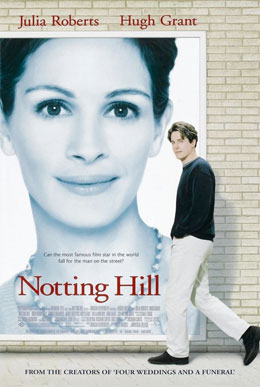
Behind the film
- Year
- 1999
- Director
- Roger Michell
- Writers
- Richard Curtis
- Runtime
- 2h 4m
- Genres
- Romantic comedy, Comedy drama
- Production
- PolyGram Filmed Entertainment, Working Title Films, Notting HIll Pictures
- Country
- United Kingdom, United States
- Cast
- Julia Roberts, Hugh Grant, Rhys Ifans, Emma Chambers, Tim McInnerny, Gina McKee, Hugh Bonneville, James Dreyfus
About the film
Contains story spoilers.
Notting Hill gives a romantic comedy an imbalance that cannot be solved by introducing the right people at a party. Anna Scott is a globally recognisable actress; William Thacker owns a small London travel bookshop. Julia Roberts and Hugh Grant play characters whose chance meeting creates access to very different worlds, while Roger Michell directs Richard Curtis’s screenplay around the awkwardness of trying to cross between them. William can walk down a street with almost no one taking notice. Anna cannot assume that an ordinary moment will remain hers. The film uses that distinction as a practical difficulty as well as a fantasy. Falling in love may be private, but arranging somewhere to meet, explaining a relationship or opening the front door can become a public event before either person is ready.
Anna enters William’s shop, and a later collision sends spilled juice over her clothes, bringing her to his nearby flat. Their developing romance passes through a hotel press event and his sister’s birthday dinner before Anna’s existing relationship interrupts it. She later returns to hide from a tabloid scandal, but photographers gather outside after Spike inadvertently alerts them. William is hurt again when he overhears her distancing herself from him on a film set. Anna subsequently declares her love; he refuses because he fears another departure. His friends help him reconsider, and he reaches her press conference to ask for another chance. The film ends with their marriage and a return to the private park where their relationship had begun to take shape.
The bookshop makes William’s position immediately legible. It is a place of imagined travel rather than a glamorous destination in itself, with the owner behind the counter while other people discuss journeys. His life has a small circumference: work, home, family and a group of friends who know his disappointments. Anna’s arrival briefly makes that ordinary territory exceptional without changing its furniture or practical limitations. The comedy repeatedly asks William to improvise when the rules of one world turn up in another. At the hotel, he needs the identity of a journalist simply to get through a conversation he did not expect to have. The difference between access and belonging becomes visible: he can reach the room while having almost no idea how to conduct himself inside it.
Grant’s hesitant speech suits a character whose first defence is to make an awkward situation a little less direct. A qualification or apology can protect him from embarrassment, but it can also delay saying what he means. Roberts’s Anna has a different kind of control to manage. She knows how to occupy a public role, yet that does not mean every part of her life follows a confident script. The film gives her encounters with people who think familiarity with her image is familiarity with her. A stranger’s opinion can be delivered as though she is an object under discussion instead of someone within earshot. The romance depends on William making space for the person beside him while also learning that he cannot simply wish away the industry and attention surrounding her.
The supporting friends help keep that relationship from existing in an empty romantic bubble. Emma Chambers’s Honey, Tim McInnerny’s Max, Gina McKee’s Bella and Hugh Bonneville’s Bernie offer different forms of warmth, disappointment and comic uncertainty. Their birthday gathering can absorb a celebrity because it already has its own relationships and reasons to be together. Rhys Ifans’s Spike is disruptive in a more conspicuous way, treating the flat and its sudden fame with very little restraint. His presence prevents William’s home from becoming a perfectly protected sanctuary. The same loose openness that makes William’s life welcoming also makes privacy fragile. That gives Anna’s retreat into the flat a complication beyond the simple contrast between an unpleasant public world and an entirely safe private one.
Curtis’s story also allows refusal to matter. William’s fear of being hurt is understandable, but it cannot tell him everything about Anna’s latest attempt to reach him. A decision meant to protect him can close off the relationship he still wants. The friends’ response gives him a place to test that decision rather than treating his first answer as the final proof of emotional wisdom. The rush to the press conference turns private reconsideration into visible action. William has to speak within the very public machinery that once made him feel out of place. The film revisits his improvised journalist role, but this time the disguise carries a question he genuinely needs to ask. The comic device acquires a different purpose because he is willing to risk an answer.
Michell’s London setting gives the fantasy room to breathe through streets, doorways, shops and a secluded garden. The passage of seasons around William connects a long emotional pause to a neighbourhood that continues moving. Notting Hill is presented as a place people can inhabit and return to, while Anna’s working life keeps threatening to carry her elsewhere. The final images join their worlds without pretending that she has become anonymous. Public occasions remain part of the relationship, but so does the quieter space of the park. The film’s resolution is an agreement to continue together in those conditions. Its romantic promise rests on finding an ordinary life within an extraordinary imbalance, with enough honesty to recognise the pressures and enough willingness to stop using those pressures as reasons never to begin.