
Behind the film
- Year
- 1922
- Director
- F. W. Murnau
- Writers
- Henrik Galeen
- Genres
- Silent, Horror, Drama, Vampire
- Production
- Prana Film
- Country
- Germany
- Cast
- Max Schreck, Gustav von Wangenheim, Greta Schröder, Alexander Granach, Georg H. Schnell, John Gottowt, Gustav Botz, Wolfgang Heinz
About the film
Contains story spoilers.
In 1838, Herr Knock sends his employee Thomas Hutter from Wisborg to visit Count Orlok, who wants to buy a house across from Hutter’s home. Knock’s secret correspondence and Hutter’s route through increasingly wary villages establish a world where ordinary commerce brushes against occult danger. At an inn, local residents react fearfully when Orlok is mentioned, and Hutter finds a book about vampires but dismisses its warnings. When the coach refuses to continue through the mountain pass, Hutter walks until nightfall and is taken the rest of the way to Orlok’s castle.
Orlok receives Hutter in his remote home. When Hutter cuts his thumb during supper, the count tries to drink the blood before Hutter pulls away. The next morning, Hutter sees marks on his neck and assumes they came from mosquitoes. Orlok examines a small portrait of Ellen, Hutter’s wife, and is drawn to her. At midnight, the castle door opens by itself and Orlok enters; at the same moment in Wisborg, Ellen sleepwalks onto her balcony and calls for Hutter as a doctor attends her. The cross-cutting joins the distant couple through dread, without explaining the connection in ordinary terms.
Hutter explores the castle and discovers Orlok asleep in a coffin. Later he watches the count load coffins onto a coach and climb into one himself. Hutter escapes, injuring himself, and eventually makes his way home. The coffins travel by ship, where the crew finds rats among the cargo; the sailors die and the vessel continues with no living crew. When it arrives at Wisborg, the count leaves carrying a coffin and enters the house he has bought. The journey by sea turns the plague from a private nightmare into a public crisis, as the town begins to suffer unexplained deaths.
Local authorities blame the illness on rats from the ship, while Knock descends into madness and is confined in an asylum. Despite Hutter’s warning not to read it, Ellen opens the vampire book and learns that a pure-hearted woman can distract a vampire until sunrise by willingly offering her blood. She decides to act, without telling Hutter her full intention. She pretends to be ill and sends him to fetch Professor Bulwer, leaving the house open to Orlok. Her choice is not a sudden victory over the count; it is a deliberate sacrifice made after the town’s ordinary explanations and protections have failed.
Orlok enters Ellen’s bedroom and drinks from her as night passes toward morning. He is so absorbed that he does not notice dawn until the sunlight reaches him; then he vanishes. Ellen lives long enough for Hutter to return and hold her, while Knock senses Orlok’s destruction from his cell. The film ends on the ruined castle. It resolves the plague by tying the vampire’s survival to darkness and Ellen’s willingness to keep him until daylight, but the human cost remains present in the final embrace.
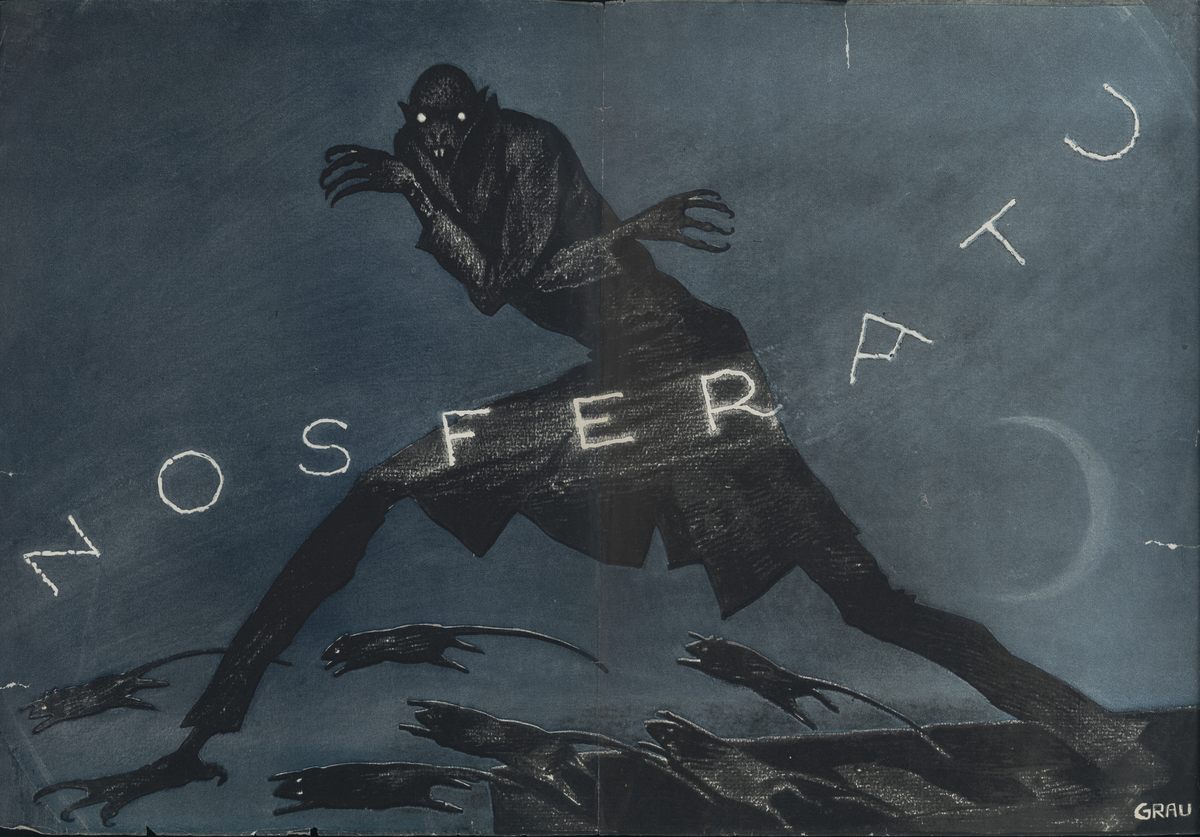
F. W. Murnau and cinematographer Fritz Arno Wagner create dread through real landscapes, stark contrasts and carefully staged movement rather than relying only on artificial sets. Orlok’s elongated fingers and rigid silhouette make ordinary doorways and rooms feel unsafe; the castle and the sailing ship extend the same threat across different spaces. The film’s intertitles and imagery turn the journey into a series of ominous documents and encounters. Its names and setting differ from Bram Stoker’s Dracula, but it is an unauthorized adaptation of that novel; this account follows the 1922 film’s Hutter, Ellen and Count Orlok, not later versions or the novel’s renamed characters.
The film’s visual rhythm keeps the threat moving even when Orlok is absent. A coach crossing the mountains, coffins stacked for transport, the ship’s emptying crew and the spread of illness allow the vampire to be felt through consequences before he appears again. Ellen’s distant perception of Hutter at the castle anticipates the final act, when her decision becomes the one action the count does not control. Murnau’s horror is rooted in the collision between supernatural events and recognizable places: an inn, a bedroom, a street and a harbor become points along the same spreading danger.
Max Schreck’s Orlok is physically unlike the sociable aristocrat Hutter expected to meet. His rigid posture, pointed features and reaching fingers let stillness become threatening before any attack begins. Gustav von Wangenheim’s Hutter starts with the eager gestures of a man pursuing an opportunity, while Greta Schröder’s Ellen registers distress from a distance and eventually acts on knowledge he tried to keep from her. Henrik Galeen’s screenplay joins those contrasting responses through letters, the vampire book and the ship’s passage. Knock, played by Alexander Granach, makes the practical business connection more sinister: his instructions send Hutter away, and his later behavior turns him into a target for public fear. The count is thus able to cross boundaries through ordinary arrangements before the town recognizes what has arrived. A property transaction and a cargo delivery become parts of the same disaster, giving the supernatural threat a route through recognizable social life.