
Behind the film
- Year
- 1959
- Director
- Alfred Hitchcock
- Writers
- Ernest Lehman
- Runtime
- 2h 16m (theatrical version)
- Genres
- Crime, Thriller, Mystery, Spy
- Production
- Metro-Goldwyn-Mayer
- Country
- United States
- Cast
- Cary Grant, Eva Marie Saint, James Mason, Leo G. Carroll, Jessie Royce Landis, Martin Landau, Philip Ober, Josephine Hutchinson
About the film
Contains story spoilers.
North by Northwest turns a simple misunderstanding into a journey across an America of hotels, railways, open roads and official buildings. Roger Thornhill, an advertising executive in New York, is mistaken for George Kaplan when two men see him summon a waiter at the Plaza Hotel. They abduct him and take him to an estate, where Phillip Vandamm interrogates him. Roger insists he is not Kaplan, but the group treats his denial as a tactic. They try to kill him by forcing him to drive drunk; he survives the crash and cannot persuade the police, or even his mother, that the danger is real.
Roger returns to the estate and discovers that the man he met there was posing as Lester Townsend, a diplomat. At the United Nations building, Roger confronts the real Townsend, but a henchman kills him with a thrown knife and frames Roger by making him appear to hold the weapon. The police now have a straightforward story in which Roger is a fugitive murderer. His frantic escape shifts the film from an eccentric kidnapping mystery into a national chase. Hitchcock keeps the danger public: Roger moves through crowded spaces, yet the crowds and authorities make it harder for him to explain what has happened. The mismatch between the crowded city and the open countryside also shifts the tone from social embarrassment to physical vulnerability.
The intelligence service knows Roger has been mistaken for Kaplan, a fictional agent invented to distract Vandamm’s group, but its chief, known as the Professor, refuses to rescue him for fear of exposing the real operation. Roger boards a train to Chicago and meets Eve Kendall, who hides him from police in her compartment. She appears to be helping him, and their flirtation offers a brief shelter from the chase. When she sends him to a rural bus stop to meet Kaplan, a crop-dusting plane attacks him in a wide, empty field. The daylight and lack of cover make the scene’s suspense depend on space itself: Roger can see the threat but has nowhere safe to go.
At a Chicago hotel, Roger realizes that Kaplan checked out before Eve claimed to speak with him. He follows her to an art auction and encounters Vandamm, the man who had posed as Townsend. When the criminals try to seize him, Roger disrupts the auction so the police will take him away rather than leave him with the gang. The Professor finally tells him the truth: Kaplan does not exist, and Eve is an intelligence agent embedded in Vandamm’s circle. Roger agrees to help protect her cover as the operation moves toward Mount Rushmore, where Vandamm expects to leave the country with stolen microfilm.
At the visitor center, Roger pretends to be Kaplan while Eve appears to shoot him with blanks and escape. The deception keeps her cover intact, but Roger later learns she will be on Vandamm’s plane with Leonard, the dangerous aide who has begun to suspect her. The Professor tries to remove Roger from the situation by having him confined in a hospital room. Roger escapes, reaches Vandamm’s house and overhears the plan to throw Eve from the plane once the microfilm is secure. He finds a way to warn her before the party leaves for the mountain, turning his pursuit into a rescue effort.
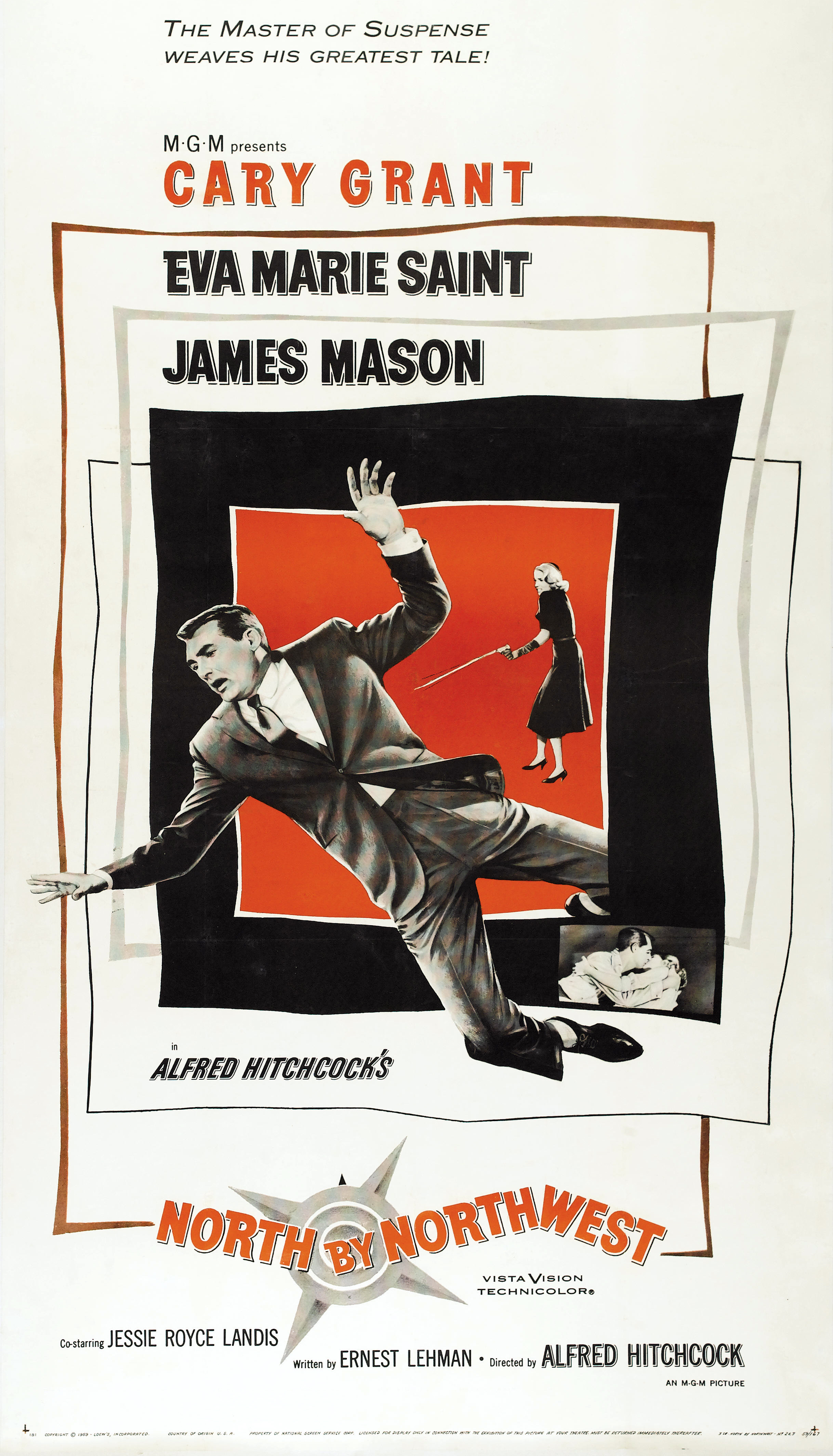
Hitchcock’s formal choices help the chase alternate between comedy and genuine danger. The film opens with Saul Bass’s geometric titles, then moves into city streets where Roger’s polished advertising persona can briefly persuade people to listen. Bernard Herrmann’s score gives the pursuit a pulse, while the VistaVision compositions leave room for bodies and landscape to compete inside the frame. The crop-duster scene is a clear example: there is no dark alley or crowd to conceal a threat, only a man exposed in a broad field and a plane that does not belong there. The later Mount Rushmore sequence uses studio effects and carefully composed views rather than pretending every action took place on the monument itself. Across both set pieces, the film makes suspense come from what Roger can see and what he cannot explain.
Eve takes the microfilm-bearing sculpture and runs to Roger as the group boards the plane. They flee across Mount Rushmore’s rock face while Vandamm’s men chase them. A park ranger kills Leonard, and the Professor’s agents take Vandamm into custody. Roger pulls Eve up from a ledge, and the film cuts directly to him pulling her into the berth of a train, where he addresses her as his wife. Ernest Lehman’s screenplay keeps Roger’s social fluency available even as his usual advantages fail. Cary Grant makes him capable of turning embarrassment into a joke, while Eva Marie Saint’s Eve must keep her public role convincing for people who could kill her. James Mason’s Vandamm can discuss criminal business without abandoning polished manners, and Martin Landau’s Leonard notices details that charm cannot conceal. The apparent lightness therefore depends on people performing confidence under pressure. Roger begins by insisting everyone has the wrong man; by the end, he willingly enters the invented role to help someone whose own identity he has finally learned to trust.