
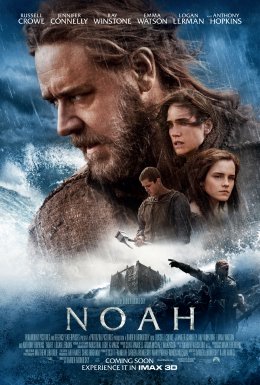
Behind the film
- Year
- 2014
- Director
- Darren Aronofsky
- Writers
- Darren Aronofsky, Ari Handel
- Runtime
- 2h 18m
- Genres
- Adventure, Speculative fiction, Epic, Fantasy
- Production
- Paramount Pictures, Regency Enterprises, Protozoa Pictures
- Country
- United States
- Cast
- Russell Crowe, Jennifer Connelly, Ray Winstone, Emma Watson, Logan Lerman, Douglas Booth, Anthony Hopkins, Kevin Durand
About the film
Contains story spoilers.
Darren Aronofsky’s Noah builds a mythic landscape around a family trying to understand a series of visions. As a child, Noah sees his father Lamech murdered by Tubal-cain over land. Years later, Noah lives with Naameh and their sons Shem, Ham and Japheth, but recurring dreams of a flood convince him that the world is nearing judgment. He takes the family to consult his grandfather Methuselah. On the journey they find a massacre and rescue Ila, the only survivor, a girl with an abdominal wound. Naameh fears the injury has left her unable to bear children, a prediction that becomes central to the family’s future.
The film’s world is dry, violent and stripped of ordinary civilization. Tubal-cain commands a settlement that consumes the land, while Noah’s family keeps apart and tries to live by a moral code that forbids taking animal life. Pursued by Tubal-cain’s men, they enter the territory of the Watchers: fallen angelic beings trapped in rock-like bodies. Methuselah gives Noah a seed from Eden, and when Noah plants it, water releases and a forest rapidly grows. The Watchers initially distrust him, but the sign persuades them to help build an enormous ark. Their stone forms make the construction and protection feel like a supernatural labor force, while the human family remains divided about what the coming flood means.
As the ark rises, animals arrive in successive groups and are put to sleep with incense so they can survive the voyage. Tubal-cain sees the gathering creatures and tries to seize the vessel, but the Watchers create a defensive ring. Noah refuses to provide a place for the people who have damaged the earth, convinced that the flood is meant to end human wrongdoing. His family does not share his certainty. Ham resents his father’s authority and longs for a life beyond the ark; Shem loves Ila, but Noah believes his sons will have no wives and that humanity should end with them. Naameh protests this conclusion and turns to Methuselah, who heals Ila’s infertility.
Ham leaves the family and befriends Na’el, a young refugee. When the rain begins, Noah searches for his son but leaves Na’el trapped in a foothold trap; she is killed by the fleeing crowd. That loss deepens Ham’s anger. Tubal-cain slips onto the ark and persuades Ham to help him while hiding aboard. The Watchers defend the vessel against the mob and sacrifice themselves, returning to heaven as the waters rise. Methuselah stays behind and is swept away. The flood sequence turns the building project into a claustrophobic survival story: animals sleep below deck, the family is crowded into a wooden structure, and each choice has consequences beyond the immediate danger outside.
Ila discovers she is pregnant after boarding the ark. Noah interprets his visions as a command to prevent any human descendants and tells the family he will kill the child if it is a girl. The twins are revealed later at the birth; his threat comes while the pregnancy’s outcome is still unknown. On the ark, Tubal-cain remains hidden and tries to influence Ham, while Naameh challenges Noah’s certainty. The conflict is not simply between a good father and a villainous intruder: Noah’s fear that humanity will repeat its violence has made him capable of carrying out violence himself. The family’s survival becomes inseparable from a moral argument about whether judgment can leave room for mercy.
During Ila’s labour, Tubal-cain attacks Noah and Ham kills the intruder before Noah reaches his newborn granddaughters. Noah approaches the twin girls intending to kill them, but cannot carry out the act. On land he isolates himself and drinks, believing he has failed his mission. Ham leaves to travel alone. Ila’s intervention helps Noah reconcile with the family, and he blesses the twins and gives them a chance to live. The resolution comes through his relinquishing the certainty that he alone understands the Creator’s intention. The film’s added family crisis sits beside the recognizable ark story while remaining a dramatic invention of this particular film.
The movie closes on a rainbow and a family that has survived but cannot return to its earlier innocence. Its visual design favors stark landscapes, blackened settlements, and the vast wooden geometry of the ark; the Watchers’ heavy stone bodies make the supernatural visible as weight and labor rather than as graceful spectacle. Russell Crowe plays Noah as a man whose discipline curdles into fanaticism, while Jennifer Connelly’s Naameh gives the family’s emotional resistance a persistent voice. Aronofsky’s film is a speculative retelling, not a claim about literal history, and its most distinctive question is what survival should mean when the survivors carry both compassion and the capacity for harm. The family’s scattered reactions matter more than a clean declaration of forgiveness: Shem and Ila build a future, Ham leaves to find a separate path, and Noah must live with the distinction between a vision and his interpretation of it. The rainbow is thus a promise made to a family that has argued, grieved and survived together.