
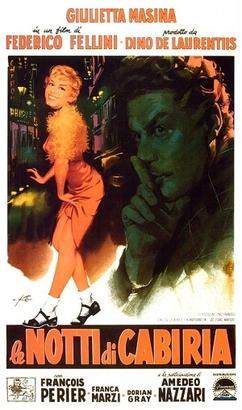
Behind the film
- Year
- 1957
- Director
- Federico Fellini
- Writers
- Federico Fellini, Ennio Flaiano, Tullio Pinelli
- Genres
- Drama
- Country
- France, Italy
- Cast
- Giulietta Masina, François Périer, Amedeo Nazzari, Aldo Silvani, Franca Marzi, Dorian Gray, Polidor, Ennio Girolami
About the film
Contains story spoilers.
Nights of Cabiria follows a woman whose capacity to expect something better repeatedly meets people willing to exploit that expectation. Cabiria is not unaware that life can be cruel. She has survived enough of it to be forceful, suspicious and protective of what belongs to her. The difficulty is that knowing the risk does not remove the wish for affection. Federico Fellini builds the film around that coexistence. Cabiria can be combative in public and vulnerable to a promise in private, with neither side making the other false. Giulietta Masina's central role gives the story a person to follow rather than a case to diagnose or an example to pity.
Cabiria's lover steals her money after pushing her into a river. She returns to life as a sex worker, later spending an awkward night in a film star's home when his girlfriend reappears. Religious hopes bring no transformation. A hypnotist exposes her dream of marriage to an amused audience. Oscar courts her afterwards, and she sells her home for their future. Near a cliff she recognises another robbery; he takes her savings and leaves. Walking away in despair, she encounters young people making music and manages a tearful smile. Her circumstances have not been repaired. The ending allows a moment of human response without undoing what has happened.
Cabiria's independence makes the betrayals more specific. She has a home and a sense of herself, so the promise of a different life involves giving up something real. The film does not make hope harmless simply because hope sounds admirable. Wanting to trust can place possessions, security and pride at risk. That gives her decisions weight without requiring the viewer to condemn her for making them. The question is not why someone foolish failed to recognise danger. It is how a person is supposed to build a life with others when the wish to belong can itself become the means of exploitation. Self-protection alone cannot supply the affection she wants.
The city gives that problem many different surroundings. Rome can contain glamour, religious feeling, public entertainment and ordinary working life without granting everyone equal access to their promises. Cabiria moves through environments that seem to offer a route out of her usual circumstances, yet entry does not necessarily mean acceptance. A prestigious room or an impressive public occasion can leave a person just as isolated as a street. This makes the film's journey more than a tour of locations. Each setting raises the possibility of being recognised differently. The disappointment often comes when that recognition proves temporary, conditional or concerned with a role rather than with Cabiria herself.
Performance runs through the relationship between those public spaces and her private hopes. A person can attract attention by becoming entertaining while remaining unseen in a more important sense. The film's encounters invite a distinction between laughter that joins people together and laughter that turns one person into an object. Cabiria's outward forcefulness cannot always protect the part of her that has been exposed. Masina's characterisation permits both comic energy and humiliation to belong to the same woman. That combination asks the viewer to stay aware of who is paying for a scene's amusement. What may look light from the outside can leave a serious consequence for the person at its centre.
The promise of romance becomes especially troubling because it speaks to an existing desire rather than inventing a new one. Oscar does not have to teach Cabiria that she wants companionship or a different future. He only has to make those things appear reachable. The resulting deception shows how an apparent intimacy can borrow its credibility from the person being deceived. Hope does some of the persuading, and that makes the eventual violation more personal than an ordinary theft. The financial loss matters, but so does the misuse of a future she had allowed herself to imagine. The film keeps both forms of damage present instead of reducing the episode to a simple warning against trust.
Fellini's black-and-white film, with music by Nino Rota, can hold stark circumstances and a movement towards sociability in the same world. The ending's emotional uncertainty comes from refusing to make either cancel the other. A smile does not return money, restore a home or establish a dependable relationship. Equally, the presence of terrible harm does not require Cabiria to lose every possibility of responding to another human being. Her face can register more than one truth at once. This is a different kind of conclusion from a rescue or a punishment. The story leaves its central woman alive to feeling, even when feeling has helped make her vulnerable.
That distinction is what gives Cabiria's final response its force. She is not proven safe, and the film does not promise that the next person will treat her properly. It allows her to remain part of the world after people have used that world against her. The young people's music supplies an encounter without demanding a grand bargain or an irreversible sacrifice. For a moment, participation is possible on smaller terms. Nights of Cabiria has followed hopes large enough to endanger an entire life, then closes on a gesture that does not claim to fix that life. Its tenderness lies in letting the person continue beyond the damage, without asking her to pretend the damage has disappeared.