
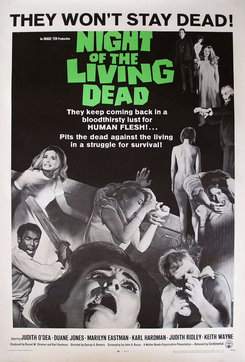
Behind the film
- Year
- 1968
- Director
- George A. Romero
- Writers
- John A. Russo, George A. Romero
- Runtime
- 1h 36m
- Genres
- Horror, Science fiction horror, Zombie, Splatter
- Production
- Image Ten
- Country
- United States
- Cast
- Duane Jones, Judith O'Dea, Karl Hardman, Marilyn Eastman, Keith Wayne, Judith Ridley, Kyra Schon, Charles Craig
About the film
Contains story spoilers.
Barbra and Johnny are attacked in a Pennsylvania cemetery, and Barbra escapes to a farmhouse after Johnny is killed. Ben arrives and boards the house against the gathering dead. Other survivors emerge from the cellar: Harry and Helen Cooper, their injured daughter Karen, and young couple Tom and Judy. Broadcasts describe a widespread outbreak, but the group disagrees about whether to remain upstairs or hide below. An attempt to refuel Ben's truck ends in an explosion that kills Tom and Judy. The dead enter the house; Ben shoots Harry during a struggle, Karen reanimates and kills Helen, and the undead Johnny drags Barbra away. Ben survives the night in the cellar. In the morning, an armed posse mistakes him for one of the dead and shoots him. His body is burned with the other corpses, turning the arrival of apparent rescue into the film's final horror.
The farmhouse makes safety a problem of organization as much as defence. Its doors and windows can be boarded, but the people sharing it have no agreement about who should decide what happens next. Romero keeps those questions physically close together. A barrier against the dead is also a point where somebody inside can refuse to let another person enter. The building becomes a small, improvised society under pressure, complete with conflicting priorities and uncertain authority. That concentration gives the horror an immediate social texture. The characters do not need an elaborate history together to reproduce the habits of suspicion, control and exclusion that make cooperation difficult.
Duane Jones gives Ben a practical focus that makes competence easy to recognize. He looks for things that can be used and tries to turn the room into a defensible place. The performance carries authority through attention and action rather than through an official title. That distinction matters when others resist his decisions. The film does not present leadership as something everybody will gratefully accept once it becomes useful. Ben's capability has to coexist with fear, hostility and the limited information available to him. Jones also lets strain become visible, keeping the character from functioning as an effortless solution to the group's problems. He has to work at every small improvement in their situation.
Barbra's shock gives the film another relation to danger. Judith O'Dea makes her difficulty responding part of the atmosphere rather than simply an absence of useful action. Fear can interrupt someone's ability to explain what has happened, leaving the others uncertain how much they can ask of her. This complicates the idea that survival is only a test of decisiveness. The group contains people with different capacities at a given moment, and a workable refuge would have to make room for that difference. Romero lets vulnerability remain inconvenient without treating inconvenience as an adequate measure of a person's worth. The house's emotional pressure comes partly from what its frightened inhabitants cannot communicate.
Harry's insistence on control exposes the limits of a purely personal understanding of safety. A plan can sound persuasive to someone focused on protecting his own family while leaving other people with different risks. Karl Hardman's manner makes that conviction forceful enough to interfere with cooperation. The conflict is therefore more than a debate over architecture. It is a disagreement about whose fears should govern the shared space and how far an obligation extends beyond one's nearest attachments. The movie keeps those tensions active even when a practical task needs immediate attention, showing how quickly a divided group can make an external danger harder to withstand.
Radio and television open the isolated house onto a much larger crisis without giving it a secure route out. A report can provide an explanation or an instruction, but the listeners cannot easily check how useful that information is for their own circumstances. This gives the broadcasts an uneasy authority. The familiar format promises order while the surrounding experience becomes increasingly disordered. Black-and-white photography reinforces that tension by placing the fantastic threat inside a visually plain world. The film's directness makes a doorway, a staircase or a face feel important without relying on a constantly changing spectacle. Ordinary space acquires menace through the attention the characters are forced to give it.
The ending gives the film's questions about recognition their harshest form. A Black protagonist's struggle to remain alive is placed beside an armed group that does not take the time to recognize him as a person. That image can be read through racial violence without requiring a claim that every preceding event was designed to express one fixed allegory. Its force lies in the distance between the competence we have observed and the judgment made from outside. Romero makes arrival and safety painfully different things. Night of the Living Dead leaves its small refuge exposed to both monstrous attack and human failure, using one confined night to ask how fragile protection becomes when people cannot agree whose life they are seeing.