
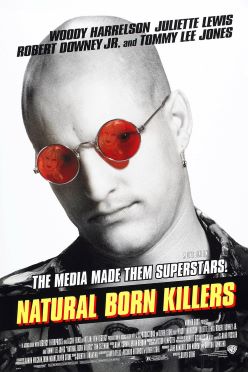
Behind the film
- Year
- 1994
- Director
- Oliver Stone
- Writers
- David Veloz, Richard Rutowski, Oliver Stone
- Genres
- Crime, Prison, Mystery, Rape and revenge
- Production
- Regency Enterprises, Warner Bros. Entertainment
- Country
- United States
- Cast
- Robert Downey Jr., Woody Harrelson, Juliette Lewis, Tom Sizemore, Tommy Lee Jones, Rodney Dangerfield, Ed White, Richard Lineback
About the film
Contains story spoilers.
Natural Born Killers makes the representation of violence part of the violence it depicts. Oliver Stone's 1994 film follows a murderous couple through a world where criminal acts, television images and public fascination feed one another. Its energy comes from the difficulty of finding a stable position outside that exchange. The killers present themselves as a story, a reporter turns that story into a product, and institutions supposedly containing them become performers in the same spectacle. The movie's aggressively changing visual language makes that instability felt: the audience is repeatedly offered a new surface through which to interpret the same disturbing conduct.
Mickey and Mallory Knox embark on a killing spree that attracts journalist Wayne Gale's attention. Detective Jack Scagnetti pursues them, although his own behaviour exposes violence beneath his official role. After their capture, Gale arranges a televised interview with Mickey in prison. The broadcast helps ignite a riot, during which Mickey reunites with Mallory and the couple escape with Gale. They kill the reporter after a final interview, treating his camera as the witness they will leave behind. A later scene finds them still free, travelling with children. The film refuses to make notoriety lead neatly to accountability; the people who helped produce the spectacle are swallowed by the story they thought they could manage.
Woody Harrelson and Juliette Lewis give the central relationship an intensity that complicates the usual division between a criminal's private life and public reputation. Mickey and Mallory can be absorbed in each other while treating strangers as expendable. That coexistence does not make affection an excuse for what they do. It exposes how a recognisable romantic bond can become part of the appeal through which an audience overlooks other people's suffering. The film makes the couple vivid enough to demonstrate that danger rather than solving it with a reassuring lack of charisma. Their apparent intimacy and their brutality belong to the same unsettling presentation.
Robert Downey Jr.'s Wayne Gale gives the exchange a professional intermediary. He does not simply discover an existing public interest; his programme helps organise and amplify it. The reporter's claim to stand outside the violence becomes increasingly difficult to maintain because his access, excitement and ambition depend on it continuing to command attention. The character therefore makes a distinction between recording an event and manufacturing its cultural importance difficult to keep intact. His involvement is especially revealing when the circumstances cease to obey the format he has arranged. A presenter accustomed to controlling a story encounters people who regard his control as another thing they can exploit.
The mixture of colour, black and white, animation and television-like imagery denies the film an even visual temperature. A change of format can make a moment seem like memory, fantasy, advertisement or report without allowing any one of those forms to become a secure account. That approach gives the satire its speed, but it also makes the viewing position uncomfortable. The film attacks a culture of spectacle through an unusually forceful spectacle of its own. Its formal contradiction is worth keeping visible: understanding the target does not automatically settle whether a particular image estranges the audience from violence or intensifies its fascination with it.
Tom Sizemore's Scagnetti and Tommy Lee Jones's prison warden widen the problem beyond the celebrated couple. Authority here does not supply a simple moral perimeter around criminality. The men charged with pursuit and confinement bring appetites and abuses of their own, making institutional power another channel through which violence is expressed and justified. This is a deliberately exaggerated fictional construction, rather than evidence that every investigator or prison official behaves this way. Within that construction, however, the contrast is crucial. It prevents the story from reducing its social criticism to a claim that everything would be orderly if only two unusually dangerous people were removed.
The prison interview brings the film's different systems into one crowded setting. Confinement, journalism, celebrity and performance converge, with the camera promising access that is inseparable from the risk it encourages. A supposedly contained conversation becomes a route through which events escape the people administering it. The sequence gives the movie's shifting formats a practical consequence: the distinction between a spectator and a participant can collapse when the spectacle becomes the basis for action. Gale's eventual status as another victim does not purify the earlier coverage. It exposes the limits of believing that being the person who narrates a dangerous story makes you immune to it.
Stone's screenplay, credited with David Veloz and Richard Rutowski from Quentin Tarantino's story, turns the road-crime narrative toward a question about collective appetite. The final image of continued domestic life is disturbing because the central characters have not been contained by the moral ending a conventional pursuit might promise. Their story can continue to be consumed, just as their camera can outlast the reporter who thought he owned its perspective. Natural Born Killers leaves the relationship between condemnation and attraction unresolved. Its force lies in making the audience confront that relationship while recognising that the film itself is caught inside the images it uses to do so.