
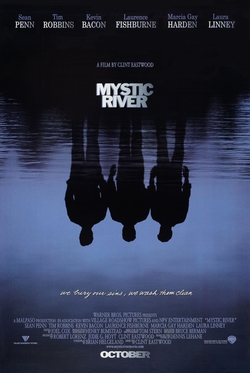
Behind the film
- Year
- 2003
- Director
- Clint Eastwood
- Writers
- Brian Helgeland
- Genres
- Mystery, Crime thriller, Drama, Neo-noir
- Production
- Village Roadshow Pictures, Malpaso Productions
- Country
- United States, Australia
- Cast
- Sean Penn, Tim Robbins, Kevin Bacon, Laurence Fishburne, Marcia Gay Harden, Laura Linney, Emmy Rossum, Tom Guiry
About the film
Contains story spoilers.
Mystic River puts a murder investigation inside a neighbourhood where everyone already has a story about everyone else. That makes the familiar detective question, who killed this young woman, unusually dangerous. A theory can become a verdict before the police have finished their work because the people involved believe they understand each other. Childhood, family connections and reputation supply a second record alongside the official evidence. Clint Eastwood directs Brian Helgeland’s adaptation of Dennis Lehane’s novel, with Sean Penn, Tim Robbins and Kevin Bacon playing the three men around whom those records collide. The Boston setting gives their relationships a physical shape: familiar streets keep bringing them back into contact, while the years between childhood and adulthood have made honest conversation harder. They share a past without sharing the same memory of what it meant.
That past begins with Dave Boyle’s childhood abduction and sexual abuse. Jimmy Markum and Sean Devine were with him when he was taken, but they could not follow him into that experience. As adults, Jimmy runs a shop and retains criminal connections, Sean works as a police detective, and Dave carries the damage of what happened. Jimmy’s daughter Katie is murdered, bringing all three men into the same investigation. Dave returns home injured that night and gives an account his wife Celeste increasingly doubts. Katie’s secret relationship with Brendan Harris adds another family history to the case. Jimmy pursues answers through his own connections while Sean and Whitey Powers investigate. The parallel searches create the film’s central pressure: a bereaved father wants immediate certainty, while a detective has to establish what can actually be proved.
Penn’s Jimmy occupies the space between a devastated parent and a man accustomed to exercising power. Those identities feed each other. Grief can make his determination understandable without making his methods trustworthy, and the film asks the audience to hold both thoughts at once. A neighbourhood’s respect is a practical resource for him; people will act, speak and withhold information because of who he is. The police cannot simply start with a clean page when Jimmy’s version of events is circulating alongside theirs. Katie also matters as more than the source of his anguish. Her desire for a future with Brendan implies a life that would have carried her beyond her father’s control. Her murder stops that possibility, and the investigation pulls her unfinished plans back into the adult conflicts surrounding her. Jimmy’s love for her does not mean that he knew every part of her life.
Dave presents a different problem for a crime drama. His difficulty explaining himself is easy to read as suspicious, especially once another violent event demands a suspect. Robbins plays a man whose discomfort can make other people retreat precisely when he needs someone to listen. The film places the viewer in that uncomfortable gap between noticing disturbing behaviour and deciding what it proves. Celeste, played by Marcia Gay Harden, has to live within the uncertainty rather than observe it from the safety of a case file. Her fear for her husband and fear of him become entangled. Sean and Whitey can compare stories against evidence, but a spouse is also comparing the present against years of intimacy. That does not give her an infallible understanding. Here, knowing someone closely can make a frightening explanation feel more convincing, because there is so much emotional material available to support it.
The tragedy turns on the difference between discovery and punishment. Jimmy kills Dave after forcing a confession; the actual killers are Silent Ray and John O’Shea, and Dave’s violence that night concerned a different man. The resolution of Katie’s case arrives too late to undo Jimmy’s decision. Sean can identify the error, but knowledge has no power to restore Dave. A conventional mystery promises that explanation will put the world back in order. Mystic River separates those outcomes. The police may solve the central crime while the neighbourhood absorbs another killing into its continuing life. Annabeth’s response to Jimmy and Celeste’s isolation expose how family loyalty can protect one person while abandoning another. The final parade and Sean’s pointed gesture leave an unsettled relationship between what is known and what will be acknowledged.
Eastwood’s film works through that uncertainty at the level of form as well as plot. The concentration on faces and conversations allows a small shift in confidence to carry the weight of an accusation. Jimmy’s visible force, Dave’s faltering speech and Sean’s professional restraint produce three different ways of occupying the same scenes. Tom Stern’s cinematography and Eastwood’s own score belong to a drama interested in the weight of place and memory, rather than a puzzle that can be stripped down to a list of clues. The river becomes a destination for violence and a presence beside everyday life; the neighbourhood continues around what it conceals. The ending leaves the surviving characters in public, among other families, rather than giving them a private space where everything can be settled. That choice returns the story to its opening concern: people can inhabit the same streets, witness the same events and still live with profoundly different versions of the truth.