
Behind the film
- Year
- 1988
- Director
- Hayao Miyazaki
- Writers
- Hayao Miyazaki
- Runtime
- 1h 26m
- Genres
- Fantasy, Drama anime and manga, Fantasy anime and manga, Children's
- Production
- Studio Ghibli
- Country
- Japan
About the film
Contains story spoilers.
Hayao Miyazaki’s 1988 animated film centres on sisters Satsuki and Mei Kusakabe, who move with their father Tatsuo into an old country house. Their mother Yasuko is receiving treatment in a nearby hospital, and the family has chosen a home that makes visits easier. The setting places ordinary practicalities beside childhood discovery: the girls adjust to unfamiliar rooms, a new school, and neighbours while watching for signs of their mother’s progress. Their father is warm and encouraging, but work and hospital visits mean that the sisters often have to make sense of the new place together.
The house seems uninhabited and slightly mysterious at first. In its dark corners and floorboards, the sisters find small soot-like creatures that scatter away when noticed. Their elderly neighbour, Granny, explains that the soot sprites appear in empty houses and will move on now the family has arrived. Satsuki and Mei are unsettled for a moment, then curious. The film treats the house as a place with its own habits rather than a haunted threat, and that tone helps the girls take the strangeness in stride while they unpack and learn the household routine.
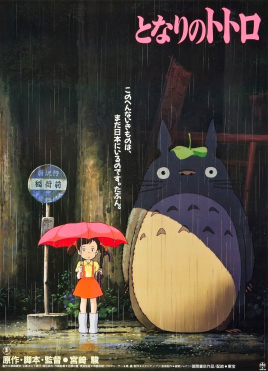
Mei is four and quick to follow whatever catches her attention; Satsuki, older and more capable, tries to keep an eye on her. One day, Mei chases small forest creatures through the garden and into the roots of an enormous camphor tree. There she finds Totoro, a large grey forest spirit asleep in a hollow. Her first encounter is brief and private. Satsuki initially doubts the story, but eventually meets Totoro herself on a rainy evening while the sisters wait for their father at a bus stop. The giant creature’s quiet presence feels as natural to this countryside as the rain and trees around him.
The sisters’ encounters with Totoro do not form a quest with instructions or a prize at the end. They experience a sequence of shared wonders: a nighttime visit in which the spirits help seeds sprout, a ride through the sky on a spinning top, and the arrival of the Catbus, whose body is a many-legged vehicle that moves rapidly through the fields. The events are woven between school, meals, chores and family visits. That pattern lets magic enter without requiring the household to stop being a household; Satsuki and Mei remain children with responsibilities and worries, even when the forest opens into something impossible.
Satsuki’s everyday care for Mei gradually becomes more visible. Their father is loving, but the family’s move and the mother’s illness leave the elder sister watching her sibling and managing more of the day. Satsuki is not portrayed as a miniature adult who always knows the right thing to do. She can be impatient and tired, and uncertainty about Yasuko’s health presses on her. Mei responds to that same uncertainty in a younger way, treating closeness as something she can reach by acting immediately. The sisters’ different ages shape what they understand and how they cope, without turning either one into the problem.
A message from the hospital raises concern about Yasuko’s condition and unsettles the children’s expectations for her return. Mei decides to walk to the hospital alone with corn for her mother, but she disappears along the way. Satsuki searches the surrounding paths and fields, first calling for her sister and then asking for help. The loss of Mei’s familiar presence turns the countryside from an expansive place to explore into a maze where distance suddenly matters. Satsuki’s composure gives way to fear, and she turns to the forest spirit she once hesitated to believe in.
Totoro responds by calling the Catbus, which carries Satsuki across the landscape and helps her find Mei. The vehicle then takes the sisters to the hospital, where they see their mother from outside and learn she is recovering. They leave the corn for her, and the film closes on the family’s reassurance that Yasuko will return home. The resolution is small in scale: no illness is miraculously cured on screen, and the adults have not been removed from the children’s lives. What changes is that the sisters reach one another during a frightening afternoon and can once again imagine the family together.
The hand-drawn animation gives equal care to domestic movement and extraordinary creatures. Wind travels through grass, branches and laundry; the girls run with the uneven urgency of children, and the creatures have weight and texture even when they move unlike animals in the human world. Joe Hisaishi’s score shifts between buoyant melodies and gentler passages that leave room for the sounds of rain and rural life. Miyazaki builds the film from attention to ordinary experience, so the forest spirits feel like neighbours in a place the girls already know through walking, waiting, worrying and playing. Its story is organised around returns to familiar places rather than a chain of escalating obstacles. The house, the road, the bus stop and the path by the tree each gather new meaning as the sisters become more comfortable, then more worried, and finally reassured. Even the Catbus’s impossible speed is made understandable through its destination display and eager movement. Small visual details let children’s perception carry the scene without an adult explaining what it means.