
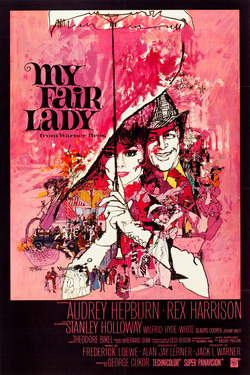
Behind the film
- Year
- 1964
- Director
- George Cukor
- Writers
- Alan Jay Lerner
- Genres
- Musical, Romance, Drama, Romantic comedy
- Production
- Warner Bros. Entertainment, Warner Bros. Pictures
- Country
- United States
- Cast
- Audrey Hepburn, Rex Harrison, Stanley Holloway, Wilfrid Hyde-White, Gladys Cooper, Jeremy Brett, Theodore Bikel, Mona Washbourne
About the film
Contains story spoilers.
At Covent Garden, phonetics professor Henry Higgins listens to flower seller Eliza Doolittle and writes down her Cockney speech. She takes his attention for an accusation and protests that she has done nothing wrong; Colonel Pickering, another language scholar, helps defuse the scene. Higgins then boasts that he could teach Eliza to pass as a duchess at an embassy ball. For him, the challenge is a demonstration of how sound shapes social judgment. For Eliza, who wants a position in a flower shop, lessons could offer a route to better work. The difference between those aims drives the comedy and the conflict.
The next morning, Eliza arrives at Higgins’s home ready to pay for instruction. Pickering offers to cover expenses if Higgins succeeds, and the two men treat the wager as an intellectual diversion. Higgins’s housekeeper, Mrs Pearce, has to manage the practical consequences of bringing Eliza into the household and of her teacher’s demanding methods. Eliza’s father, Alfred Doolittle, also appears, using concern for his daughter as a pretext to ask Higgins for money. Higgins is entertained by Alfred’s rhetorical agility and recommends him to a wealthy American interested in morality, a suggestion that will later unsettle Alfred’s working life.
Eliza’s training is difficult and exhausting. Higgins drills her pronunciation and expects fast progress, while she struggles to master sounds that have long marked her as working class. At the point when the experiment seems ready to fail, she makes a breakthrough and celebrates the change in her speech with Higgins and Pickering. Her new accent, however, is not the same thing as secure independence. The men can measure her vowels, but the film asks whether their test recognizes the labor she has done or simply rewards them for having designed it. Their household’s servants, watching the lessons from the edges, register both the noise and the human cost.
Ascot becomes the first public trial. Dressed for the races, Eliza initially behaves with the polish Higgins has taught her, but her excitement over a horse carries her back into emphatic Cockney speech. The result is an awkward social collision rather than a clean success. She also meets Freddy Eynsford-Hill, who becomes taken with her and later courts her with an enthusiasm that does not necessarily answer what she needs. At the embassy ball, Eliza dances with a prince and is examined by Zoltan Karpathy, Higgins’s former pupil. Karpathy concludes that she is Hungarian royalty, giving Higgins his public victory while leaving Eliza’s effort largely unacknowledged.
After the ball, Higgins and Pickering congratulate one another and barely attend to Eliza. Their carelessness reveals the flaw in the wager: they have prepared her for a social performance without deciding what life follows it. Eliza throws Higgins’s slippers at him and leaves. Freddy waits outside, but his declarations do not solve her problem; she cannot simply return to the old work she has left behind, and romance is not a substitute for a livelihood. When she encounters Alfred again, she finds that Higgins’s recommendation has led to an inheritance and an impending marriage, changing her father’s circumstances too.
Eliza finds shelter with Higgins’s mother, who rebukes her son for his treatment of his pupil. Higgins comes to see Eliza there, but the two quarrel about her future and his assumptions that she will return. Alone at home, he listens to recordings of her voice made during the lessons, a reminder that he has preserved the sound of her work while failing to recognize her choices. Eliza slips quietly into the room behind him. The ending leaves their relationship open rather than spelling out a romantic settlement: what matters is that she has walked out, made him confront her absence and chosen to return without the film specifying what the relationship will become. The film’s lavish costumes and formal settings turn speech into visible social theater, while Eliza’s practical aim keeps the story grounded in work and agency.
George Cukor directs Alan Jay Lerner’s adaptation of the stage musical, making language a subject that can be heard as well as discussed. Audrey Hepburn’s physical performance and Marni Nixon’s substantial contribution to Eliza’s singing give her transformation different kinds of expression, while Rex Harrison’s conversational musical delivery keeps Higgins’s personality present within the numbers. Rehearsal is followed by public choreography: Ascot organizes spectators into an almost ceremonial society, and the embassy ball makes a gown and a practiced voice part of the same social performance. The scale of those settings helps explain why Eliza can master the test without finding a secure place afterwards.
Eliza’s father complicates the story’s ideas about class. Alfred enjoys the freedom of having few respectable obligations, then finds himself changed by the money Higgins’s recommendation brings him. He complains that the new status imposes expectations he never wanted, while Eliza has deliberately sought the chance to earn a different kind of living. Their paths are not identical, but together they reveal how class labels can restrict people even when those labels appear to offer advancement. Higgins treats the change in Eliza’s voice as proof of his expertise; Eliza’s suggestion that she might teach his methods to someone else challenges his assumption that the knowledge belongs to him alone. What she has learned can become a resource she chooses how to use.