
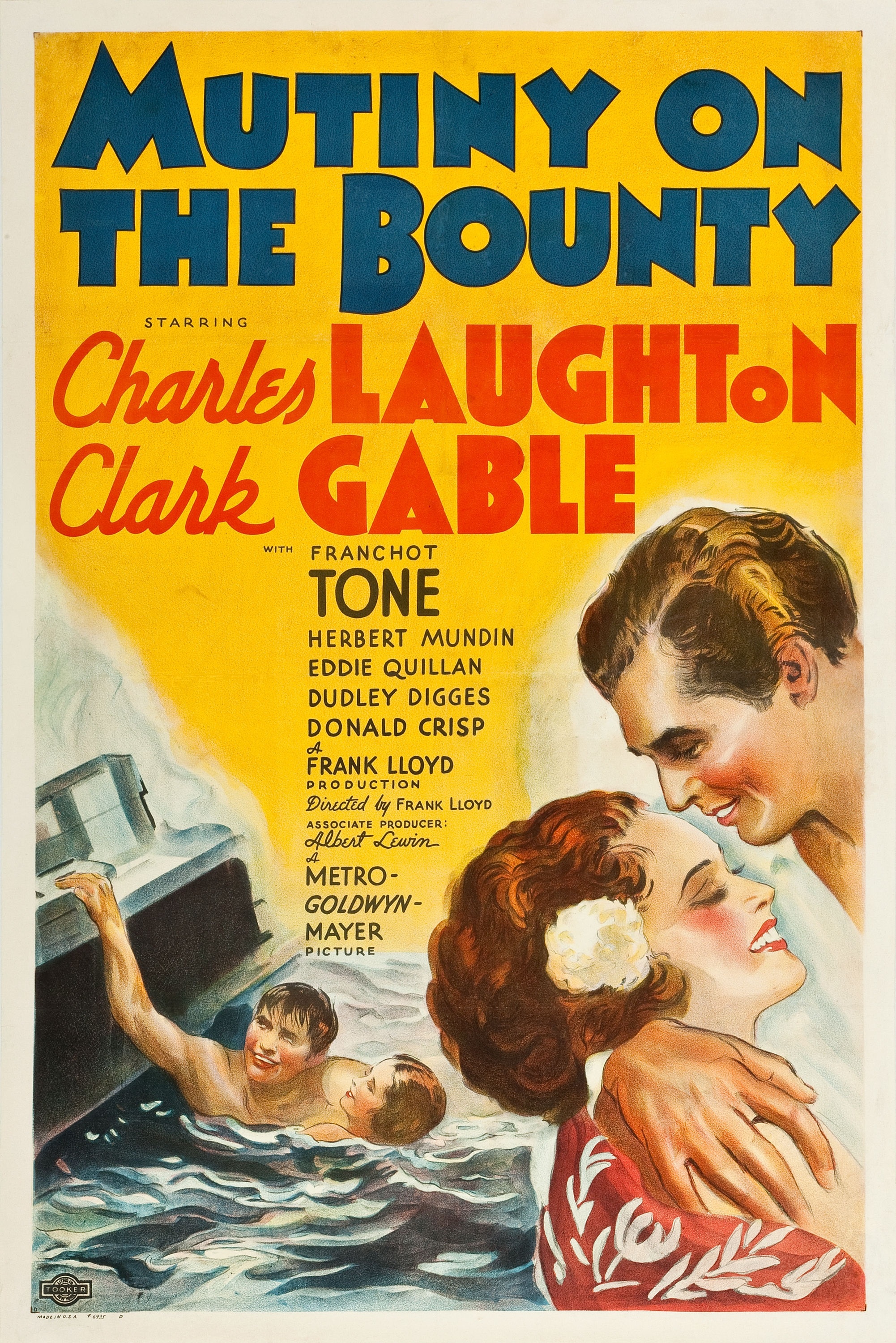
Behind the film
- Year
- 1935
- Director
- Frank Lloyd
- Writers
- Talbot Jennings, Jules Furthman, Carey Wilson
- Genres
- Trial, Adventure, Historical
- Production
- Metro-Goldwyn-Mayer
- Country
- United States
- Cast
- Charles Laughton, Clark Gable, Franchot Tone, Movita Castaneda, Mamo Clark, Donald Crisp, Henry Stephenson, Spring Byington
About the film
Contains story spoilers.
Mutiny on the Bounty makes a ship into a world where authority has immediate consequences and leaving is rarely a practical option. That enclosure gives every disagreement unusual weight. A command affects food, work, punishment and the possibility of surviving the voyage, making power visible in the arrangements of ordinary life. The film concentrates its conflict around two men who offer incompatible accounts of leadership. Bligh expects obedience to confirm his position, while Christian increasingly treats the crew’s suffering as something that cannot be justified by position alone. Their opposition gives the adventure a clear dramatic shape, but the consequences of resistance extend beyond either personality. A challenge to cruelty also becomes a challenge to the structure that authorises it.
In 1787, the Bounty leaves Portsmouth under Captain Bligh to collect breadfruit in Tahiti for the West Indies. His punishments and treatment of the crew create conflict with officer Fletcher Christian, while midshipman Roger Byam tries to reconcile duty with friendship. Tahiti offers relationships and a different experience of life, but the return voyage restores Bligh’s harsh control. Christian eventually leads a mutiny, placing the captain and his supporters in an open boat. Bligh brings them to land, while the Bounty returns to Tahiti. Byam, who did not join the rebellion, stays behind when Christian departs with other crew members and their families. In the film, Bligh returns commanding the Pandora, arrests Byam and brings him to England for trial. Byam is condemned, then pardoned after others intervene, allowing him to resume his naval career. Christian reaches Pitcairn Island and burns the Bounty, ending its voyage by making a return to the former world impossible.
Byam makes the conflict harder to resolve than a direct choice between liking one man and disliking another. His position ties loyalty to inherited expectations about service, honour and identity. Friendship gives him another kind of obligation, but that obligation does not automatically supply an acceptable account of rebellion. The film uses him to ask what conscience requires when a person recognises an injustice without endorsing every response to it. That is a substantial distinction. Objecting to cruelty and accepting a mutiny are not the same decision, even when they emerge from the same conditions. Byam’s uncertainty gives the audience a way to consider both the necessity of resistance and the seriousness of the boundary it crosses.
Bligh’s command raises a question about the difference between effective leadership and humane leadership. Technical competence can coexist with conduct that makes a community miserable, leaving achievement an incomplete defence of authority. The film’s account of him gains force from that distinction: being able to accomplish something difficult does not settle how the people involved should be treated. A leader can interpret endurance as proof that his methods work, while those enduring them understand the same experience as evidence of abuse. The ship’s isolation makes that disagreement especially dangerous because there is little distance between a judgment and its enforcement. Power can turn its own account of events into a practical fact before anybody else has an opportunity to answer.
Tahiti offers a contrast that changes how the crew can imagine their lives. An alternative world makes the arrangements aboard ship seem less inevitable, and that possibility gives return a heavier meaning. The island is presented through the adventure’s romantic vision, which should be understood as part of the film’s construction rather than a complete account of the people living there. Its dramatic purpose is to make another life feel imaginable. The relationships formed there give escape a destination beyond simply avoiding punishment. At the same time, the voyage’s colonial purpose remains part of its world: the official task connects distant places through an economy in which some people’s needs are treated as means to serve others.
The trial transfers the conflict from immediate experience to an institution’s interpretation of that experience. A person’s presence in a rebellion can become easier to classify than the choices or constraints that shaped it. That makes judgment another exercise of authority, especially when the people deciding did not share the conditions under which the accused acted. Byam’s position asks whether law can distinguish complicity from circumstance and whether an official account can make room for testimony about cruelty. The film’s historical material is heavily dramatised, so its sequence belongs to this particular version of the story. Its continuing dramatic interest lies in who gets to explain an act of resistance and which explanations carry the power to determine another person’s future.
The final separation gives freedom an irreversible cost. Different people can leave the same crisis through different routes, and no single outcome can restore every relationship or institution to its earlier form. Christian’s alternative future depends on a decisive break, while Byam’s depends on being permitted to re-enter the world that judged him. That contrast leaves rebellion connected to more than the moment of taking control. It concerns the lives that become possible afterwards and the losses required to make them possible. Mutiny on the Bounty turns a seafaring adventure into a drama of responsibility, leaving the question of rightful authority inseparable from how that authority treats the people entrusted to it.