
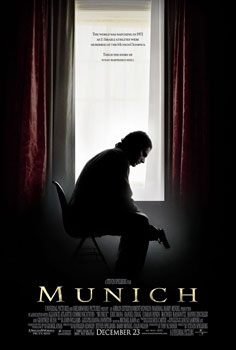
Behind the film
- Year
- 2005
- Director
- Steven Spielberg
- Writers
- Tony Kushner, Eric Roth
- Genres
- Spy, Drama, Political thriller
- Production
- Amblin Entertainment, The Kennedy/Marshall Company, Alliance Atlantis
- Country
- United States, France, Canada
- Cast
- Eric Bana, Daniel Craig, Ciarán Hinds, Mathieu Kassovitz, Ayelet Zurer, Geoffrey Rush, Michael Lonsdale, Mathieu Amalric
About the film
Contains story spoilers.
Munich begins at the 1972 Olympics, where Black September militants break into the Olympic Village, kill two Israeli athletes and take nine others hostage. The siege unfolds through news coverage and fragmented scenes, giving the catastrophe a public, televised dimension before the film turns to its secret aftermath. Two weeks later, Avner Kauffman, a young intelligence officer and former bodyguard, is summoned to meet Prime Minister Golda Meir and senior officials. They offer him a covert assignment: leave his pregnant wife behind, surrender his ordinary identity and lead a mission against men accused of masterminding the killings.
Avner’s team is assembled for practical skills, not shared experience as professional assassins. Steve drives; Robert, a Belgian toymaker, understands explosives; Hans forges documents; and Carl handles cleanup. Avner himself has little field experience, and the operation is structured so that the government can deny a direct connection. Their source is Louis, a French informant whose family controls access to names and locations. The film gives this intelligence network a tangible, precarious quality: each lead must be bought, negotiated, checked and acted on, while the people supplying it may have their own motives and the team has no clear institutional safety net.
The early missions move across European cities. In Rome, the team shoots Wael Zwaiter; in Paris and Cyprus, they use bombs against Mahmoud Hamshari and Hussein Abd Al Chir. In Beirut, Avner joins Israeli commandos in an attack on a guarded compound, where three targeted men are killed. The operations are presented as sequences of preparation and uncertainty rather than effortless spycraft: the group studies routines, positions explosives and waits for a moment when civilians might be caught in the blast. Their arguments about collateral harm and the legitimacy of the targets interrupt any simple feeling of control. Avner’s brief visits to his wife and newborn daughter offer a competing image of the life he has put aside.
A safe house in Athens exposes how unstable the team’s arrangements have become. Louis places Avner’s group in the same building as Palestinian rivals, and they must conceal themselves by claiming other political identities. Avner speaks with Ali, a PLO member, about their homelands and who has the right to belong there; their conversation makes the conflict more than a sequence of targets on a list. The mission continues, but the story increasingly measures each hit against what it does to the people carrying it out. When Carl is killed by a contract assassin, the team pursues her to a Dutch houseboat and kills her, drawing them further into a logic of retaliation.
The danger spreads through the group. Hans is found dead on a park bench, and Robert dies in an explosion at his workshop. The surviving men track Ali Hassan Salameh in London and later Spain, but attempts to reach him fail; guards interrupt the Spanish operation. Avner and Steve also begin to disagree over whether Louis has exposed them. These losses strip away the fantasy that careful planning can keep violence contained. The film’s map of temporary rooms, rented cars and hidden weapons gradually becomes a map of vulnerability, as the team’s movements are watched and the safety of their families becomes part of the calculation.
Avner’s return to Israel does not settle him. He is uncomfortable when young soldiers treat him as a hero, then moves with his family to Brooklyn, where flashbacks and paranoia keep the operation present in daily life. His phone conversation with Louis’s father makes plain that the family knows who he is, even if the official mission was designed to deny his identity. Avner later meets Ephraim in New York and asks him to share a meal; Ephraim refuses. The final image places the World Trade Center in the skyline, but the film’s closing tension stays with the unresolved encounter between Avner and the institution that recruited him. Munich uses a fictionalized central agent to examine how a revenge mission changes the people asked to carry it out; its recreated covert events should be read as dramatic storytelling, not a complete historical record.
Steven Spielberg directs Eric Bana as Avner from a screenplay by Tony Kushner and Eric Roth, allowing the thriller’s suspense to turn inward as the assignment continues. Early scenes concentrate on whether the team can complete a task without being discovered. Later, Avner checks the spaces where he is supposed to rest, bringing the alertness of an operation into domestic life. Meals shared by the team briefly offer ordinary conversation and solidarity, but those routines cannot prevent disagreement or loss. The change in what feels dangerous gives the long journey its character movement: competence grows alongside a fear that no successful mission will provide a lasting sense of safety.
The reconstruction of the Olympic catastrophe returns in fragments rather than remaining entirely within the opening. Those images connect Avner’s private distress to an event he did not personally witness, keeping memory and imagined experience in uneasy proximity. The final conversation with Ephraim brings the question of belonging into an everyday invitation to eat together. Avner seeks a human acknowledgment from the institution for which he has worked, and the refusal leaves their relationship unresolved. The distant New York skyline widens that unease without supplying an explanation that can settle the conflict. This is a dramatized account organized around the consequences of retaliation, with its covert episodes serving a character story rather than certifying a complete historical record.