
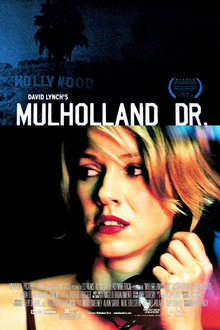
Behind the film
- Year
- 2001
- Director
- David Lynch
- Writers
- David Lynch
- Genres
- Mystery, Thriller, Lgbtq-related, Crime thriller
- Production
- StudioCanal, Canal+ S.A.
- Country
- United States
- Cast
- Naomi Watts, Laura Harring, Justin Theroux, Ann Miller, Robert Forster, Angelo Badalamenti, Mark Pellegrino, Melissa George
About the film
Contains story spoilers.
Mulholland Drive opens with Los Angeles spread beneath a dark hillside road, making the city look both available and impossibly distant. A woman survives a car crash after the men driving her threaten her life, then moves downhill without a dependable memory of who she is. The beginning supplies the shape of a mystery, but David Lynch makes its setting as important as its unanswered questions. The roads, apartments, restaurants and studios seem capable of hiding an entire second life behind a familiar surface. An accident interrupts one apparent plot, leaving the survivor to enter another before she understands the first.
Betty Elms arrives with a much more hopeful relationship to that landscape. She is an aspiring actress from Canada, staying in her aunt's apartment and expecting a chance to begin the life she has imagined. Finding the frightened stranger there gives her a problem she can immediately help solve. The woman takes the name Rita from a film poster, an improvised identity that already connects the investigation to cinema. Naomi Watts makes Betty's eagerness feel unusually complete, while Laura Harring's uncertainty gives the partnership an uneven balance. One woman appears to know exactly what her future should be; the other cannot establish even the facts of her past.
Their efforts to follow the money and blue key in Rita's bag take them into a city that offers clues without stable explanations. A name remembered in a diner leads toward an apartment and a disturbing discovery, changing the search from an absorbing adventure into something that threatens both women. Elsewhere, an account of a nightmare draws another man behind the same diner, where the imagined fear becomes an encounter. Lynch allows these different routes to share a location without explaining every connection. The result gives an ordinary business the weight of a recurring landmark inside a mental landscape as well as a physical one.
Adam Kesher's struggle to cast his film introduces another form of lost control. The director is told which actress he must choose, and refusal begins to undermine the professional and personal authority he assumes he has. The pressure arrives through meetings that can be absurd in their details while remaining threatening in their consequences. Justin Theroux gives Adam the irritation of someone who expects resistance to have a practical limit, only to discover that the people controlling his situation do not share that expectation. The entertainment industry becomes a system where the appearance of choice can survive after the decision has effectively been taken away.
Betty's audition offers a striking change of scale and behaviour. A scene that seemed awkward during rehearsal becomes intimate and unsettling when she performs it with another actor, revealing an ability her bright everyday manner has not fully suggested. That shift matters beyond proving she is talented. The film has been teaching the audience to read people through apparently obvious qualities, then shows how quickly a performance can alter those qualities. Her relationship with Rita also grows closer, joining care, attraction and the desire to inhabit someone else's uncertainty. The search no longer concerns a stranger she can help and then leave behind.
Club Silencio makes the relationship between performance and feeling explicit without providing an easy explanation of everything that preceded it. The host insists on the recorded nature of what the audience hears, yet the singer's performance moves Betty and Rita even when its apparent source collapses. An illusion can be identified as an illusion and still produce a real response. The blue box discovered around this encounter becomes the threshold for a change in the story. Its opening does not merely reveal a hidden document or an answer to the earlier crime; it changes the identities and relationships through which the audience has been understanding the film.
The later passages follow Diane Selwyn, a struggling actress whose resemblance to Betty invites connections the film does not translate into a single final instruction. Camilla, who resembles Rita, occupies a very different position in Diane's life, and memories of desire, rejection and professional humiliation lead toward a hired killing. The blue key now carries a more specific and terrible implication. Diane's guilt and terror overwhelm her, ending in suicide, but the images afterward continue to resist a neatly closed division between fact and fantasy. Reading the earlier world as a wishful reconstruction can illuminate the relationships without explaining away every disturbing image that remains.
Angelo Badalamenti's music and the film's deliberate shifts between brightness and darkness help make that instability emotional rather than simply a puzzle to decode. Watts' change from Betty's eager confidence to Diane's depleted presence is especially important: the altered world is carried through a body and a voice, not just a rearranged list of names. Hollywood appears as a place where desire can become performance, where a role can promise a new self, and where another person's success can sharpen private disappointment. Mulholland Drive gives enough connections to invite careful attention, while preserving the unease that comes from discovering how convincingly a wished-for life can be imagined.