
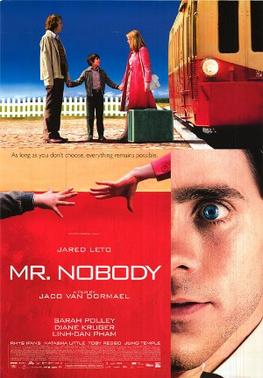
Behind the film
- Year
- 2009
- Director
- Jaco Van Dormael
- Writers
- Jaco Van Dormael
- Genres
- Drama, Science fiction, Romance, Fantasy
- Production
- Pan-Européenne, Caviar Films
- Country
- Canada, France, Germany, Belgium
- Cast
- Jared Leto, Sarah Polley, Diane Kruger, Linh Dan Pham, Rhys Ifans, Natasha Little, Toby Regbo, Juno Temple
About the film
Contains story spoilers.
In 2092, humanity has made old age reversible, leaving 118-year-old Nemo Nobody as the last person still facing death. A journalist records his memories while a psychiatrist tries hypnosis, but Nemo describes contradictory lives rather than one settled past. Each account circles back to the railway platform where nine-year-old Nemo must decide whether to stay in England with his father or board a train to Canada with his mother. The film follows both imagined outcomes, then shows smaller decisions splitting them again. Nemo explains his knowledge through a story about the Angels of Oblivion, who normally erase children’s memories of the future before birth. He says they missed him, leaving him aware of possibilities other people cannot see.
In the Montreal path, Nemo meets Anna at school. At the beach she invites him to swim with her friends, and he insults them; in another version he admits he cannot swim, and the two grow close. Their parents begin a relationship, making the teenagers step-siblings, and the pair fall in love before the adults separate. Anna leaves for New York with her father. Years later, she and Nemo recognize each other at a station, but their reunion does not become an easy reunion romance: Anna says she is not ready, asks him to call, and suggests a lighthouse meeting. Nemo loses her number and waits there day after day. Another strand lets them marry and have children, but a car accident ends that domestic future.
Staying with his father places Nemo in England, where he cares for the disabled man and writes a science-fiction story about a trip to Mars. He falls for Elise, who is attached to Stefano, and the film branches around whether Nemo can win her over. In one line, she eventually marries Nemo but dies in an explosion on their wedding day. He fulfils an old promise by taking her ashes to Mars; on the journey home he meets Anna, then the spacecraft is destroyed by asteroids. In another, Elise and Nemo raise three children, but her depression strains their marriage until she leaves to pursue Stefano. These outcomes give the same teenage attraction different costs: grief in one, a long and painful separation in another.
A motorcycle crash creates another interruption in the England story. Nemo is hospitalized and cannot respond, yet he remains aware of what is happening around him; he imagines his fingers moving across the typewriter as he continues the Mars tale in his head. His parents briefly reunite at his bedside, a small moment the boy registers while the adults treat it as temporary. The film does not use the episode to settle which version is real. Instead, it folds Nemo’s invented story and the adult branches into the same stream of consciousness, so an accident in one future can sit beside a childhood memory that would otherwise seem unrelated.
After Elise rejects him, Nemo makes a different kind of vow: he will marry the first girl who dances with him. That is Jean, and they become wealthy, raise two sons and build the orderly life Nemo thought he wanted. He grows bored, transfers his assets to Jean and leaves. From then on he uses coin tosses to make decisions, including claiming to be the person for whom a chauffeur is waiting. The choice takes him to a hotel where assassins kill him, then wonder if they have the right man. The Jean life is another consequence of trying to escape a difficult decision by handing it to chance.
The adult Nemo also wakes in a patterned, unreal world and follows clues to a ruined house, where a video message from his 118-year-old self explains that this is a universe in which Nemo was never born. The older man says he is experiencing the story from its ending and must stay alive until a precise time. Old Nemo tells the journalist that they are both inventions of the child trying to decide between his parents. The boy takes a third option and leaves them both for an unknown future. Near death, old Nemo recalls Anna at the lighthouse and says her name; the universe contracts and time runs backward. The other Nemos revive, his parents reunite, and the film returns to the boy with Anna, skipping stones in reverse.
Van Dormael gives the branches different camera languages. Adult Anna scenes repeat the framing used for the teenage pair, while Elise’s relationship is filmed handheld with one of the couple often out of focus. Jean’s scenes keep key moments outside the frame; the coma life is blurred, and the widower’s camera moves separately from him. The never-born world is unusually flat and clean. The edits also pivot on images and sounds shared across ages, so one strand can arrive before its cause is fully clear. Van Dormael said he wanted viewers to recognize a life from its first shot, and that design helps orient the audience without turning the branches into a neat, chronological puzzle.