
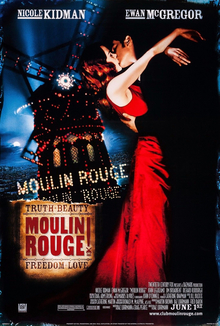
Behind the film
- Year
- 2001
- Director
- Baz Luhrmann
- Writers
- Baz Luhrmann, Craig Pearce
- Genres
- Romance, Musical, Drama, Melodrama
- Production
- Angel Recording Studios, Bazmark
- Country
- Australia, United States
- Cast
- Nicole Kidman, Ewan McGregor, Jim Broadbent, Richard Roxburgh, John Leguizamo, Jacek Koman, Caroline O’Connor, David Wenham
About the film
Contains story spoilers.
Moulin Rouge! opens in 1900 with Christian, a young writer in Paris, beginning to type the story of a woman he loved. The film then returns to 1899, when he arrives in Montmartre seeking the bohemian artists whose work he admires. He meets Henri de Toulouse-Lautrec and a troupe trying to complete a stage show called Spectacular Spectacular. Christian’s writing helps them finish it, and they bring him to the Moulin Rouge in hopes that his talent will convince proprietor Harold Zidler to hire him. The club is at once a theatre, a business and a place where performers depend on wealthy patrons.
Satine is the Moulin Rouge’s star performer and courtesan, and Zidler plans to use her attention to secure investment from the Duke of Monroth. The Duke may finance the club’s conversion into a theatre, but expects control over Satine in return. When she meets Christian, she mistakes him for the Duke and tries to seduce him. Their private meeting becomes comic when she discovers he is the writer she has heard about, and the real Duke interrupts. Christian and the troupe improvise the premise of their show, convincing the Duke to invest on the condition that the club and Satine are placed under his control.
As the production develops, Christian and Satine fall in love. She initially denies her feelings, aware that the club’s future depends on the Duke and that her own role is part of Zidler’s bargain. The Duke becomes increasingly suspicious of the time she spends rehearsing with Christian. Zidler urges Satine to end the relationship and arranges for her to spend a night with the Duke. Her collapse before the meeting leads to a doctor’s diagnosis of consumption, giving the romance an urgency that the theatrical plot cannot contain. The show’s success might save the Moulin Rouge, but it cannot remove the danger of the Duke’s financial power or Satine’s illness. The Duke’s offer makes that pressure concrete: the club’s continued existence depends on his money, but accepting it means transferring power over Satine and the production itself to a patron who expects obedience.
Satine tries to push Christian away by saying their relationship threatens the production. He writes a song for the show that gives their private love a place on stage. At rehearsal, Nini hints to the Duke that Spectacular Spectacular reflects the real triangle between himself, Satine and Christian. The Duke demands that the play end with the courtesan marrying the maharaja rather than the poor sitar player. Satine promises to spend the night with him, but cannot go through with his demand. Le Chocolat intervenes when the Duke attempts to assault her, and Christian decides they should leave the club together.
Zidler finds Satine preparing to go with Christian and tells her the illness is fatal, while the Duke has threatened Christian’s life. To protect Christian, Satine performs the role of a woman who has chosen the Duke, leaving Christian devastated. On opening night, Christian denounces her before the audience and walks away, but Toulouse-Lautrec calls out from above the stage and Satine sings their secret song. Christian changes course, and the company thwarts the Duke and his bodyguard as the performance reaches its conclusion. The fictional show and the real relationship have become difficult to separate, with the Duke’s financial investment giving him a power over the ending he wants to see.
The production’s theatrical design is visible even before Christian meets Satine. The opening passes through a miniature, digitally assembled Paris and into the writer’s room, moving from a monochrome image toward saturated color. Inside the club, the elephant-shaped set gives Satine a private chamber that is also part of the attraction sold to patrons. Toulouse-Lautrec and the performers make the show a collaborative workplace, while Zidler’s financing arrangement exposes how precarious that work is. The score repurposes familiar songs as fragments of conversation and emotional bargaining, so a performance can carry the plot forward rather than interrupt it. Christian’s writing and the group’s rehearsals let the film stage romance twice: as the couple’s private attachment and as a story the club is trying to sell to an audience. The opening and closing use the same musical theme, so Christian’s finished account circles back to the moment he began writing.
After the audience applauds, Satine collapses behind the curtain and dies in Christian’s arms. Six months later, the Moulin Rouge has closed and fallen into disrepair. Christian finishes typing their story, preserving the life they shared in the form he knows best. Baz Luhrmann’s rapid cutting, saturated color, elaborate sets and pop-song medleys create a deliberately heightened version of Paris rather than a historically restrained one. The songs are rearranged into new dramatic contexts, and the play-within-the-film mirrors the lovers’ conflict. This visual and musical rush makes the club feel exhilarating while keeping its economic bargain visible beneath the spectacle. Nicole Kidman’s Satine moves between performing confidence for customers and confronting a future she cannot bargain into safety. Ewan McGregor’s Christian initially treats love as a principle that should overcome practical objections, while Jim Broadbent’s Zidler knows what the club owes. Luhrmann and Craig Pearce’s screenplay makes those positions collide within the same production, so a theatrical ending can change without saving the person who performs it.