
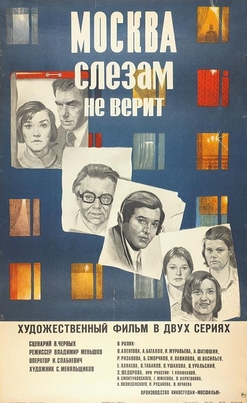
Behind the film
- Year
- 1980
- Director
- Vladimir Menshov
- Writers
- Valentin Chernykh
- Runtime
- 2h 29m
- Genres
- Romance, Comedy drama
- Production
- Mosfilm
- Country
- Soviet Union
- Cast
- Vera Alentova, Irina Muravyova, Raisa Ryazanova, Aleksey Batalov, Yuri Vasiliev, Natalya Vavilova, Oleg Tabakov, Innokenty Smoktunovsky
About the film
Contains story spoilers.
Vladimir Menshov’s Moscow Does Not Believe in Tears is built around a leap of twenty years. Its first half follows Katerina, Lyudmila and Antonina as they arrive in Moscow and share a dormitory, a temporary home where ambition, money and romance become daily subjects. The three women want different things: Lyudmila is drawn to wealth and status, Antonina to a steady partnership, while Katerina is quieter and more focused on work and study. Their friendship makes the city feel navigable even when their choices take them in different directions.
The friends' different expectations give the first half a conversation about what a city might offer. Lyudmila regards confidence as a way to enter rooms where opportunity already exists. Antonina places more faith in the person she knows than in an impressive social position. Katerina's interest in education requires sustained effort that cannot be performed in a single evening. The apartment they briefly borrow makes those possibilities look deceptively close together. Its comfort can be used as a disguise, but occupying someone else's space does not grant their resources or freedom. The friends' closeness allows these approaches to coexist without turning them into identical ambitions.
Katerina's later authority changes what she can do, while also changing what other people assume about her. Being responsible for a large workplace requires decisions, confidence and the ability to deal with competing demands. Those qualities do not automatically give her an easier way to speak about her private needs. Vera Alentova preserves that difference between public competence and personal reserve. The same woman who can direct other people's work finds it difficult to describe what she wants from a relationship. Material independence is therefore given a concrete value without becoming a promise that every part of life will fall into place once the practical problems are solved.
In 1958, Katerina, Lyudmila and Antonina share a Moscow workers' dormitory. Lyudmila stages a party in an apartment Katerina is minding, where Katerina meets cameraman Rudolf. When she becomes pregnant, he refuses responsibility; she raises daughter Aleksandra while working and studying. Antonina marries Nikolai, and Lyudmila marries hockey player Sergei. Twenty years later, Katerina directs a factory, Antonina has a settled family, and Lyudmila has divorced Sergei after his drinking damaged their marriage. Katerina meets Gosha, a skilled worker, and conceals her senior position because his pride depends on a man earning more than his partner. Rudolf's reappearance exposes that position, and Gosha leaves. Her friends come to help; Nikolai finds him drinking alone and persuades him to return. The reunion ends with dinner and Katerina's admission of how long she has been waiting, leaving their difference in outlook to be addressed beyond this first renewed encounter.
The film’s two-part structure lets time function as a character without turning the later section into a simple verdict on the women’s youth. The opening’s dormitory rooms and crowded social gatherings suggest how little private space the women possess; the later Katerina has a substantial apartment and authority at work, but still has to negotiate loneliness and the expectations of men around her. The leap doesn’t flatten these differences into a success chart. It asks how choices made under pressure settle into habits, and how a person can achieve what she once pursued yet still want companionship. That contrast is clearest in how the film uses thresholds: the dormitory gives the friends a shared space, while Katerina’s later apartment reflects the privacy she earned but also the solitude she has not chosen. Rooms can signify material advancement without resolving emotional need. The formal jump therefore changes more than the women’s ages; it changes the scale at which each of them can make decisions.
Katerina’s career gives the story a specific tension: her rise offers security and respect, but it also disrupts the conventional romantic arrangement Gosha expects. The film does not treat her concealment as a clever solution. It creates the very wound she hoped to avoid, because a relationship that depends on hiding her life cannot remain equal. Gosha’s own practical warmth is appealing, but his assumptions are real obstacles. Their reunion does not erase that imbalance; it leaves them at the beginning of a negotiation in which affection alone cannot make social attitudes disappear.
The friendship between the three women keeps the film from reducing its plot to a choice between career and romance. Antonina’s family life is not portrayed as a lesser path, and Lyudmila remains part of the group even though her early calculations did not produce a perfect outcome. Their conversations carry the evidence of years: they can tease one another while understanding the private disappointments underneath. This continuity is a quieter form of achievement than Katerina’s title at the factory, and the film returns to it whenever an individual life seems too narrow to explain on its own.
Menshov’s performers make the time jump legible through posture and tempo rather than explanation alone. Vera Alentova’s Katerina changes from a young woman measuring each possibility to someone accustomed to making decisions for many people, while retaining a reserve that makes vulnerability hard to announce. The Moscow of dormitory corridors, workplaces, apartments and evening visits is not merely a backdrop; each setting shows what kinds of privacy and influence are available to its characters. The ending’s modest dinner invitation fits that scale. After decades of grand hopes and hard-earned independence, the film closes on the possibility of sharing an ordinary evening.