
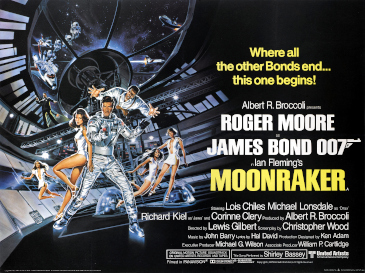
Behind the film
- Year
- 1979
- Director
- Lewis Gilbert
- Writers
- Christopher Wood
- Runtime
- 2h 06m
- Genres
- Science fiction action, Adventure, Spy, Action
- Production
- Eon Productions, United Artists
- Country
- France, United Kingdom, United States, Australia
- Cast
- Roger Moore, Lois Chiles, Michael Lonsdale, Richard Kiel, Corinne Cléry, Bernard Lee, Desmond Llewelyn, Toshiro Suga
About the film
Contains story spoilers.
Lewis Gilbert’s Moonraker begins with a shuttle disappearing from an aircraft carrying it to Britain. M assigns James Bond to investigate the missing craft and its manufacturer, Hugo Drax, a wealthy aerospace entrepreneur whose operation spans Earth and orbit. Bond’s first trip is interrupted by an attack from Jaws, who throws him from a plane; Bond survives the fall, while the assassin lands in a circus tent. The film signals its mixture of danger and comic timing early, treating an impossible survival as part of the adventure’s playful grammar.
At Drax’s California complex, Bond meets Dr. Holly Goodhead, an astronaut, and sees how private wealth has created its own sealed world of technology and privilege. He also survives an attempt on his life inside a centrifuge. Drax’s pilot Corinne helps Bond locate blueprints for a glass vial, then pays for that help when Drax discovers her betrayal. In Venice, Bond traces the vial to a secret biological laboratory and learns it contains a toxin deadly to humans but harmless to plants and animals. The investigation points to Rio, then the Amazon, and ultimately Drax’s space station.
Holly is more than a guide through the scientific side of the plot. Bond eventually deduces she is a CIA agent investigating Drax independently, and their interests overlap without making her a passive reward. The film’s locations keep changing the terms of the investigation: California gives Bond access to the company’s machinery, Venice turns a glass workshop into a hidden laboratory, Rio places him among crowds and public celebration, and the Amazon moves the story into an isolated environment where Drax can operate with fewer witnesses.
Drax’s plan is to disperse the toxin around the globe, wiping out human life while preserving plants and animals. He has sent carefully selected young people to an orbital station so they can repopulate Earth after the atmosphere clears. Bond and Holly infiltrate the operation by posing as shuttle pilots, while Jaws—who has become Drax’s henchman—eventually turns against him after discovering that Drax considers him and Dolly disposable. A space battle follows; the station is destroyed, Drax is ejected into space, and Bond and Holly eliminate the remaining toxin globes before returning to Earth. Jaws and Dolly are recovered by the marines.
The movie’s scale is its organizing principle. A missing shuttle is not simply a mystery but the first object in a chain that leads from corporate manufacturing to a hidden orbital habitat. Each new setting enlarges the picture’s visual vocabulary: glass, canals, jungle water, shuttle interiors and open space. The movement across those spaces can feel like a series of attractions, but the objects carry the plot forward. The vial is small enough to hide in a pocket, yet it connects a factory, a laboratory and a plan that could alter the entire planet. The technology is treated in the same tactile way as other Bond clues: a vial has a measurable physical form, while the space station turns an abstract plan into rooms, equipment and launch procedures. This helps the film keep an audience oriented as it moves between thriller investigation and science-fiction spectacle. It also makes Drax’s private ownership visible: he does not merely fund the machines but assumes that the people inside them belong to his design.
Moonraker arrived during a moment when space travel had become a visible public subject, and the film turns aerospace engineering into a Bond-scale fantasy of private power. Drax’s station is a self-contained environment where he tries to decide who is allowed to inherit the world. Its clean design contrasts with the crowded and changeable places Bond passes through on Earth. The plot’s threat is not just destruction; it is a man’s attempt to treat human life as a resource to be sorted by his own standards.
Roger Moore plays Bond with a relaxed surface that helps the film accommodate tonal shifts, while Michael Lonsdale’s Drax is composed enough to make his grand scheme feel like an extension of ordinary business. Lois Chiles gives Holly a practical competence that makes her presence in the story feel earned. Richard Kiel’s Jaws begins as an overwhelming physical threat, but his relationship with Dolly gives the antagonist’s machinery a comic crack. Their alliance with Bond at the climax is an unusual turn that depends on Drax’s own arrogance.
The international locations and elaborate effects carry the story’s expanding scale. The changes of setting keep the spy plot from settling into one kind of adventure; the shifts between Venice, Rio and the Amazon alter its scale and visual texture. The space scenes extend the series’ theatrical scale into weightlessness, where the characters must move through a designed environment unlike any city or jungle. The final image of Bond and Holly’s intimacy transmitted back to their superiors brings the film’s two scales together: world-saving spectacle and the private relationship that the adventure has made possible.