
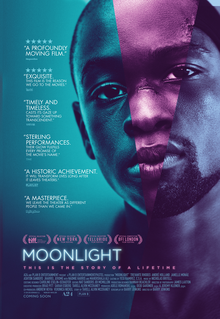
Behind the film
- Year
- 2016
- Director
- Barry Jenkins
- Writers
- Barry Jenkins
- Runtime
- 1h 51m
- Genres
- Drama, Lgbtq-related, Coming-of-age
- Production
- A24, Plan B Entertainment
- Country
- United States
- Cast
- Alex R. Hibbert, Ashton Sanders, Trevante Rhodes, Jaden Piner, Jharrel Jerome, André Holland, Mahershala Ali, Naomie Harris
About the film
Contains story spoilers.
Moonlight tells Chiron’s life in three chapters, each using the name others give him at a different age: Little, Chiron and Black. The first begins in Liberty City, Miami, where the withdrawn child hides from bullies in an abandoned crack house. Juan, a local drug dealer, finds him and takes him home to stay with Juan’s girlfriend Teresa before bringing him back to his mother, Paula. Juan and Teresa offer a kind of refuge, but Chiron’s home life remains shaped by his mother’s addiction and by the pressures of a neighborhood where he is already singled out as different.
Chiron returns to Juan and Teresa, and Juan begins to give him practical advice about growing up. The child asks what an insult used against him means; Juan explains that it is meant to hurt gay people and tells him there is nothing wrong with being gay. Chiron then asks whether Juan sells drugs and whether his mother uses them. Juan answers honestly, and the boy leaves without resolving the contradiction between this protective adult and the harm connected to his business. Paula’s anger and dependence create another unstable bond: she can be loving, but her drug use often displaces care and turns toward Chiron as blame.
The middle chapter moves to Chiron’s adolescence. Juan has died, but Teresa remains a steady presence. At school, Chiron avoids Terrel, a bully who is increasingly intent on humiliating him. Kevin, Chiron’s childhood friend, reconnects with him and the two talk on a beach at night. They kiss and share a brief intimate moment, giving Chiron an experience of being wanted without ridicule. The scene is quiet rather than declarative; for a boy who rarely has language for desire or safety, the closeness matters because it offers a way to be seen that differs from the school’s rules of masculinity.
The next day Terrel pressures Kevin into attacking Chiron in front of other students. Kevin hesitates but eventually punches him, and the other boys continue the beating. A principal asks Chiron to identify the attackers, but he refuses, convinced that reporting them will not protect him. He later walks into class and strikes Terrel with a chair, an act that leads to his arrest. The chapter ends with Chiron’s attempt to resist power using the only force he believes will be understood, while Kevin watches from a distance. What happened between them the night before is never discussed in public.
In the final chapter, Chiron is an adult who goes by Black and has built a guarded life as a drug dealer in Atlanta. His muscular appearance and expensive car make him look like someone who has learned to project control, but the film leaves room to see how much of that identity is armor. Paula calls from a treatment center and asks him to visit. An unexpected call from Kevin invites him back to Miami. Before making that journey, Chiron sees her and, after years of anger, tells her how her behavior shaped his childhood. Paula apologizes for failing to love him as he needed, and they begin a tentative reconciliation that neither erases the past nor makes it simple.
Chiron then travels to Miami. At the diner where Kevin works as a cook, their reunion is cautious: Kevin asks about the confident figure Chiron has become, and Chiron does not readily explain the life he has built. Kevin speaks about his son and the ordinary obligations that have given him purpose after prison. Chiron admits he now deals drugs, which disappoints Kevin, then asks why he called. Kevin plays a song that recalls their adolescence, and they go to his apartment. Chiron reveals he has not been intimate with anyone since their encounter as teenagers; Kevin comforts him, and the film returns to the image of Little on a moonlit beach.
The ending does not convert Chiron’s return to Miami into a neat cure. His visit to Paula and his time with Kevin make different forms of connection possible, but the film does not claim that he has settled every conflict around identity, masculinity or intimacy. Kevin’s home has a lived-in domestic texture, and Chiron’s silence there feels different from the silence he used as a child to endure school and family. The closing image folds the adult story back into childhood, suggesting that the boy he was remains present within the protective persona he has built.
Barry Jenkins gives the film a triptych structure and casts three actors as Chiron at different ages: Alex R. Hibbert, Ashton Sanders and Trevante Rhodes. Their performances do not imitate one another so much as carry the same hesitancy through different bodies and defenses. James Laxton’s close, mobile camera stays near faces and gestures, while the Miami locations make the story specific without turning the neighborhood into a mere backdrop. Nicholas Britell’s score, shifting textures and chapter transitions help the film move through time without relying on explanatory narration. Adapted from Tarell Alvin McCraney’s play, the screen story centers on small encounters—a question at a kitchen table, a beach conversation, a meal served by Kevin—where Chiron’s guarded life briefly opens.