
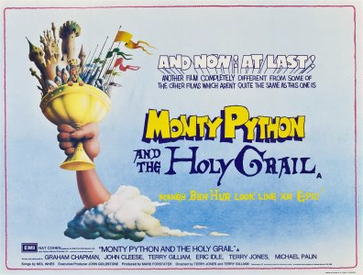
Behind the film
- Year
- 1975
- Director
- Terry Gilliam, Terry Jones
- Writers
- Graham Chapman, John Cleese, Terry Gilliam, Terry Jones, Eric Idle, Michael Palin
- Genres
- Fantasy, Adventure, Period drama, Comedy
- Production
- Python (Monty) Pictures
- Country
- United Kingdom
- Cast
- Graham Chapman, John Cleese, Terry Gilliam, Terry Jones, Eric Idle, Michael Palin, Neil Innes, Connie Booth
About the film
Contains story spoilers.
Monty Python and the Holy Grail gives King Arthur a world that looks ready for an epic and then refuses to behave like one. There are castles, mist, mud, swords and declarations of noble purpose, but they coexist with people who will not accept the roles a legend has assigned them. Arthur expects recognition as a king; a passer-by may be more interested in questioning how kingship works. The discrepancy is the film's organising idea. Its humour does not require the medieval setting to vanish whenever a joke begins. Instead, the characters persist in a serious quest while language, logic and the machinery of the movie keep opening holes in their seriousness.
Arthur recruits knights and receives a command from God to find the Grail. French soldiers defeat their attempt to enter a castle, including a disastrous wooden-rabbit plan. Splitting up brings encounters with sexual temptation, disputed heroism and a wedding Lancelot attacks after misunderstanding a plea for help. Reunited, they confront a killer rabbit, escape an animated monster when its animator dies, and face a bridgekeeper's questions. Arthur and Bedevere reach another French-held castle and prepare an assault. Meanwhile, modern police have been investigating a historian's murder by a knight. They arrive, arrest the surviving leaders and shut down the filming. The sacred object never becomes the reward a conventional quest would deliver.
The coconut sound accompanying imaginary horses establishes how that world works. The image tells us the men are on foot, while their movements and the accompanying sound insist on another version of the journey. We are invited to cooperate with the fiction and notice its construction at the same time. Arthur generally treats his own situation as perfectly legitimate, so Graham Chapman's performance provides a stable centre for the contradictions around him. The others do not need to share his confidence for the quest to continue. An argument can obstruct him as effectively as a fortification, and his status provides no automatic way to make either obstacle yield. The king's frustration becomes part of the landscape rather than a temporary interruption to noble progress.
The film also makes a habit of exposing the distance between a claim and the reasoning offered to support it. A witch trial can assemble a chain of confident statements without producing a sensible conclusion. A knight can lose the physical means to continue fighting while maintaining that his position has barely changed. A threatening order can derive its force from an arbitrary demand rather than a meaningful purpose. These encounters resemble miniature systems that have become detached from what they are supposed to accomplish. Characters continue following their rules because the rules give them a position to occupy. Arthur's own certainty is vulnerable to the same treatment, especially when somebody outside the hierarchy refuses to recognise its assumptions.
The knights' separate adventures let the film test several varieties of heroic self-description. Courage, purity and martial prowess are titles rather than guarantees of good judgement. Robin's relationship to bravery is undermined by the people accompanying him, while Lancelot's readiness to act becomes dangerous because he does not pause to understand the situation. The contrast matters: hesitation is not always the failure a heroic story says it is, and decisive violence is not automatically a rescue. The Pythons repeatedly play different people across these encounters, allowing a familiar performer to acquire a new costume, accent or social role without becoming a reassuringly consistent ally. The resulting world feels crowded with incompatible expectations rather than organised around one righteous campaign.
Terry Gilliam's animation lets the film change its visual rules as abruptly as it changes the terms of an argument. A threat can enter as a drawn creature and then disappear because something has happened to the person producing the drawing. The joke moves responsibility outside the fictional world: the knights survive through a failure in the apparatus presenting their danger. The modern investigation performs a related disruption over a longer distance. Once police enter the quest, the characters' grand preparations become evidence of ordinary disorder rather than the beginning of a climactic victory. Their story cannot control the framework in which somebody else interprets it. Even the camera is vulnerable to being interrupted rather than allowed to finish the legend.
Gilliam and Terry Jones directed the 1975 film, with the six principal Pythons supplying its writing and performances. Its locations and costumes provide enough weight for the absurdity to push against, while the episode-based journey allows each new encounter to invent a different obstruction. The lack of a triumphant ending is therefore consistent with the rest of the enterprise. A quest that has repeatedly challenged authority, logic and the conventions of filmmaking does not finally become obedient to them in its last scene. Arthur's purpose remains clear to him, but clarity is never sufficient to make the world cooperate. The film follows that conviction through a succession of interruptions, until interruption itself becomes the ending.