
Behind the film
- Year
- 2003
- Director
- Patty Jenkins
- Writers
- Patty Jenkins
- Runtime
- 1h 49m
- Genres
- Female buddy, Biographical, Drama, Crime
- Production
- DEJ Productions, Media 8 Entertainment
- Country
- Germany, United States
- Cast
- Charlize Theron, Christina Ricci, Bruce Dern, Lee Tergesen, Annie Corley, Scott Wilson, Pruitt Taylor Vince, Marco St. John
About the film
Contains story spoilers.
Monster asks what changes when a person already known through a criminal label is given a story before that label becomes the whole account. The question is uncomfortable because understanding can be confused with excusing, while refusing understanding can make a human life appear to have contained nothing except its final judgement. The film works within that tension. It brings attention close to Aileen's hopes, vulnerability and attachment without supplying a harmless outcome for the violence that follows. A relationship gives her future an imaginable shape, but imagining that future does not make the acts used to pursue it acceptable or the people harmed by them less real.
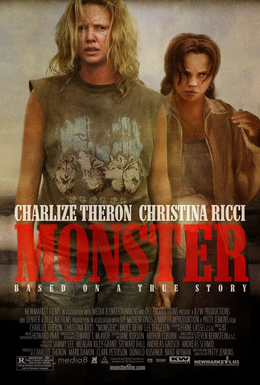
Patty Jenkins wrote and directed the 2003 biographical crime drama. Charlize Theron plays Aileen Wuornos and Christina Ricci plays Selby Wall, with Bruce Dern as Thomas and Lee Tergesen as Vincent Corey. Selby is a fictionalised character, so the film should be approached as a dramatization rather than a complete record of Wuornos's life or an exact transcript of relationships. That distinction matters most when intimate conversations appear to explain decisions. Drama can make a person's situation intelligible through selected encounters, but intelligibility is a constructed effect; it does not turn every scene, motivation or statement into verified biography.
Aileen meets Selby and begins imagining a life together. After a client rapes and attacks her, she kills him. Attempts to find other work fail, and she returns to sex work, committing further killings that cannot all be understood as self-defence. Selby learns what has happened and eventually leaves. Police arrest Aileen, and a recorded conversation helps establish her responsibility without implicating Selby. Aileen is convicted and sentenced to death. The film ends with her execution recorded in its closing account, bringing the promised escape to a conclusion that neither intimacy nor explanation can undo.
The relationship matters because it gives ordinary wishes an urgency that can otherwise be lost behind the crime narrative. Wanting company, a place to stay and a future with another person are recognisable needs, and the film makes them part of its protagonist's immediate world. That recognition does not ask the audience to approve how she later acts. It makes the distance between a hope and its pursuit more painful. A person can want something modest and still cause devastating harm while trying to preserve it. The emotional scale of the wish cannot become a measure that reduces the seriousness of what is done to others.
Work and money shape the couple's imagined independence. A new life needs more than affection to remain possible, and the attempts to obtain conventional employment expose the difference between wanting a change and being able to make one. The film uses that difficulty to place pressure around decisions without establishing pressure as a complete explanation for murder. Economic exclusion can limit choices while responsibility for an act remains consequential. Keeping both facts in view makes the account more demanding than either a simple condemnation of an inhuman figure or a narrative in which hardship automatically absolves everything that follows from it.
The first killing creates a distinction the later crimes increasingly undermine. Violence in response to an immediate assault cannot supply a permanent justification for treating other people as the same threat. Aileen's account of what she is doing becomes something the film asks the audience to assess, rather than simply adopt. That separation is essential to its moral structure. Closeness to a character can make fear understandable, but fear does not establish the guilt of somebody else. The later encounters expose the harm in allowing a previous violation to determine what every subsequent person is assumed to deserve, with victims paying for an explanation they did not create.
Selby's dependence and incomplete knowledge complicate the romantic promise. Shared plans can conceal unequal responsibility for how those plans are sustained, and secrecy can make one person's account disproportionately powerful. As knowledge changes, the relationship cannot continue on the same imagined terms. That does not mean its earlier affection was unreal; it means affection cannot guarantee safety or make another person's actions acceptable once they become known. The final separation brings the couple's private world into contact with the public consequences of the killings. An intimate bond has limits that the desire to protect it cannot simply erase.
The title's bluntness sits against a film that supplies circumstances and relationships rather than allowing a single word to do all the explanatory work. Monster does not become a documentary by drawing on a real case, nor does giving Aileen a human account make her violence a form of redemption. Its drama comes from keeping those distinctions difficult. The hope of another life remains recognisable while the life being built around it becomes destructive. A reader can approach the film through that conflict: not an invitation to turn a killer into an uncomplicated victim, but an account of how vulnerability, longing and responsibility can exist within the same person without cancelling one another.