
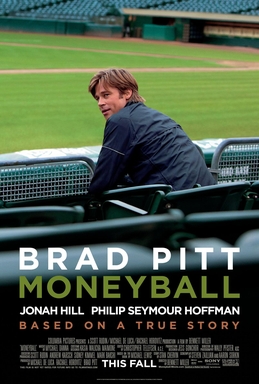
Behind the film
- Year
- 2011
- Director
- Bennett Miller
- Writers
- Steven Zaillian, Aaron Sorkin
- Genres
- Biographical, Sport, Drama
- Production
- Scott Rudin Productions, Michael De Luca Productions, Columbia Pictures
- Country
- United States
- Cast
- Brad Pitt, Jonah Hill, Philip Seymour Hoffman, Robin Wright, Chris Pratt, Stephen Bishop, Kerris Dorsey, Arliss Howard
About the film
Contains story spoilers.
After Oakland loses the 2001 playoffs and several prominent players leave, general manager Billy Beane faces another season with limited funds. He hires Peter Brand, an economist who believes traditional scouting overlooks useful players. They build a roster around overlooked statistical value, despite resistance from scouts and manager Art Howe. Beane trades players to make his plan harder to ignore, and the Athletics recover from a poor start. Their bid for a twentieth consecutive victory nearly collapses before Scott Hatteberg hits the winning home run. Oakland wins its division but loses in the first playoff round, leaving Beane dissatisfied. Boston offers him a lucrative job, while Brand tries to show that he has achieved more than he recognizes. Beane ultimately stays in Oakland. The film adapts Michael Lewis's book, with Peter Brand a fictionalized character rather than a literal portrait of the real assistant general manager.
Moneyball makes a technical argument accessible by attaching it to a recognizable inequality. A team with fewer resources cannot simply imitate the purchasing habits of a richer one and expect the same result. It has to reconsider what it is buying and why that thing has a particular price. The film uses baseball as a setting in which judgments about value become visible, but the underlying pressure does not depend on detailed sporting knowledge. An established way of seeing can be comfortable for the people whose authority rests on it. Challenging that way of seeing means challenging those people, which makes an apparently analytical disagreement immediately personal.
Brad Pitt gives Beane a combination of ease and dissatisfaction that makes him difficult to reduce to a straightforward reformer. He can speak persuasively and move through the institution with confidence, yet remains uncomfortable with the standards by which his own life has been judged. The performance keeps private disappointment close to professional determination. A new method offers an answer to the team's disadvantage, but also a way to question an older verdict about who Beane was supposed to become. That connection gives the numbers an emotional dimension without making them a cure for every problem. Better evidence can change a decision while leaving the person making it vulnerable to familiar doubts.
Jonah Hill's Brand brings a different relation to authority. His ideas have force before he has the social confidence to present them with ease, creating an effective contrast with Beane's fluency. Their partnership allows thought and persuasion to become distinct forms of work. A convincing explanation does not automatically become policy; someone must carry it into conversations where other people have reasons to resist. Hill gives Brand's hesitation a useful specificity, making the analyst neither a magical outsider nor a joke about inexperience. The film's pleasure includes watching a shared vocabulary develop between people who approach the same problem from different positions, and seeing how that vocabulary changes what they can attempt.
The disagreements inside Oakland keep the institution from becoming a single obstacle with one opinion. Philip Seymour Hoffman's Howe has his own responsibilities and incentives, making obedience to Beane's plan a less simple matter than accepting a clever idea. The scouts also have identities bound up with what they believe experience enables them to see. Miller lets these competing claims occupy the same professional world. That is important to the drama: the difficulty of change does not disappear once an argument sounds reasonable. Authority, habits and practical control remain distributed among people who must work together. A plan can therefore be intellectually clear and organizationally difficult at the same time.
The players give the argument a human scale. Being classified as unsuitable, damaged or past one's best is something a person has to live with, not merely a category in a table. The film asks us to notice the distance between such labels and the contribution someone might still make. Its interest in statistics need not erase individuality, because reassessing a player can also mean seeing beyond a limiting first impression. That tension keeps the premise from becoming a simple contest between numbers and people. The question is which evidence receives attention, and whose possibilities disappear when one kind of judgment is treated as complete. The sporting world becomes a place where overlooked capacity can acquire practical value.
Miller's restrained presentation gives conversations and empty spaces time to carry the uncertainty. The drama often exists around games rather than inside the spectacle of playing them, making preparation, waiting and judgment part of the sporting experience. Family scenes create another measure of value beside professional success, one that cannot be settled by the league table. The film leaves room for achievement to be real without feeling sufficient to the person responsible for it. Moneyball's most interesting pressure is therefore the gap between improving a system and knowing when to accept what that improvement means. Winning matters, but the movie asks how easily a person can recognize progress when the old definition of success continues to demand more.