
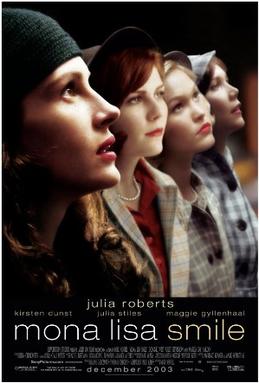
Behind the film
- Year
- 2003
- Director
- Mike Newell
- Writers
- Lawrence Konner, Mark Rosenthal
- Genres
- Romance, Drama, Coming-of-age, Comedy
- Production
- Revolution Studios
- Country
- United States
- Cast
- Julia Roberts, Kirsten Dunst, Julia Stiles, Maggie Gyllenhaal, Ginnifer Goodwin, Dominic West, Juliet Stevenson, Marcia Gay Harden
About the film
Contains story spoilers.
Katherine Watson arrives at Wellesley expecting to teach art history, but her students already know the course material. She challenges them to look beyond memorized answers and toward lives they might choose for themselves. Betty Warren, newly married and sharply critical of Katherine, turns the classroom into a public argument about women’s roles. Joan Brandwyn considers applying to Yale law school, while Giselle Levy and Connie Baker encounter different forms of intimacy and insecurity. The film’s resolution does not give every woman the same answer: Joan declines law school, Betty separates from her husband, and Katherine leaves after refusing a constrained return arrangement. Its central conflict is choice under social pressure. That teaching method makes interpretation itself the subject, inviting viewers to notice how inherited answers can pass as neutral knowledge.
The classroom is the film’s principal stage for competing ideas. Katherine’s lessons are less about supplying a new doctrine than changing what counts as a valid response. When she asks students to interpret art rather than repeat approved judgments, the exercise becomes a model for the choices outside class. The device gives the movie a clear structure: each lesson reframes the social world, and each student’s response reveals a different relation to expectation. That clarity is also a simplification. The film organizes a complicated institution around one teacher’s influence, making a persuasive classroom drama rather than a full portrait of every student or historical condition. The conflict feels strongest when neither woman can fully control the story others tell about her.
Betty’s opposition is more interesting when treated as a strategy for control than as mere villainy. She uses certainty and ridicule to protect the life she has publicly chosen, while Katherine’s presence threatens the stability of that performance. Their conflict gradually shifts as Betty’s private reality diverges from her public image. The change does not erase the harm she causes, but it gives her a credible arc from policing another woman’s choices to reconsidering her own. Kirsten Dunst’s composed delivery and Julia Roberts’s measured confidence make their exchanges feel like battles over who gets to define a successful life. The material pressures are not abstract; they determine how much independence a character can risk without losing security.
Joan’s storyline prevents the film from presenting education as a simple cure for social limits. She earns the opportunity to pursue law, yet decides that marriage is the future she wants. Katherine respects the decision even while the audience can see the narrow range of options around it. That tension is crucial: the movie’s feminist argument depends on women being allowed to choose, but it also asks whether a choice is fully free when institutions and culture have already made some futures easier to imagine than others. Joan’s decision is not framed as failure; it is the film’s most direct test of whether autonomy means selecting the same path as the teacher. The camera’s measured compositions echo the discipline expected of students, then allow small gestures to disturb that order.
The supporting relationships widen that debate beyond the lecture hall. Giselle’s frankness, Connie’s romantic uncertainty and Betty’s marriage show that different women can encounter the same social code in markedly different ways. The film links public respectability to private compromise without making every character’s experience identical. Its ensemble structure keeps returning to the contrast between what is said in front of others and what is admitted in confidence. That pattern gives the campus a social texture: reputation is not background decoration but a force that shapes who can speak, what counts as scandal and which kinds of ambition receive approval. Their performances keep the debate grounded in character rather than turning each woman into a simple position in an argument.
Mike Newell’s direction gives the period setting a polished, orderly look that the story can then unsettle. Classrooms, dorm rooms and formal gatherings are composed spaces, but the visual neatness contains arguments and anxieties. The film’s production design makes tradition attractive enough to understand, rather than depicting it only as a caricature. This creates a useful friction with Katherine’s lessons: the world she challenges has beauty and belonging as well as constraint. The aesthetic does not resolve the debate; it helps explain why students might value the security it offers even when its rules restrict their possibilities. The ensemble’s overlapping secrets make public composure feel like work, not a natural state.
Mona Lisa Smile ultimately refuses a single victory speech. Katherine’s influence is real, but the students’ futures diverge, and her own decision to leave carries both principle and loss. That ending can feel less triumphant than a conventional inspirational teacher story, yet it suits a film interested in agency rather than conversion. The movie’s historical setting is stylized and its central classroom is a dramatic construction, but its conflict remains legible: how does a person distinguish a chosen life from a role made comfortable by expectation? The answer varies by character, which is why the film’s strongest scenes are exchanges rather than declarations. The final departure is consequently both a refusal and a cost, leaving the question of influence deliberately unresolved.