
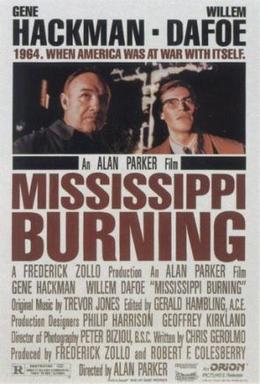
Behind the film
- Year
- 1988
- Director
- Alan Parker
- Writers
- Chris Gerolmo
- Genres
- Drama, Crime
- Production
- Orion Pictures
- Country
- United States
- Cast
- Gene Hackman, Willem Dafoe, Frances McDormand, Brad Dourif, R. Lee Ermey, Gailard Sartain, Stephen Tobolowsky, Michael Rooker
About the film
Contains story spoilers.
Mississippi Burning puts an investigation inside a town where the people charged with enforcing the law help make the truth dangerous. The two visiting agents may have federal authority, but the residents have to live with the consequences of speaking after those agents leave. That unequal exposure gives the detective story its central pressure. A witness is not simply someone who possesses useful information; a witness is someone who can be punished for allowing that information to matter. The film turns the search for three missing civil rights workers into a contest over whether fear will continue to govern public life. Its thriller structure follows the investigators, while the stakes extend far beyond them. In 1964, FBI agents Alan Ward and Rupert Anderson arrive in fictional Jessup County to investigate three civil rights workers who have disappeared while registering Black voters. Local officials frustrate interviews, and the agents find the activists’ burned car. After violence silences a witness, Anderson forms a bond with Deputy Pell’s wife, who reveals the bodies’ location. The inquiry shifts toward federal civil-rights charges; the film ends with convictions for most perpetrators and Mrs. Pell beginning again after her home is vandalized.
The partnership is built around a difference in method rather than a simple contest between right and wrong. Ward trusts procedure, reporting lines and admissible proof; Anderson reads the town through his Southern past and the social codes that make official testimony dangerous. Their conflict gives the investigation a dramatic engine, but the film does not pretend that instinct is a substitute for institutions. Anderson’s improvisations produce leads while also crossing ethical lines, and Ward’s formal discipline remains necessary when the case reaches court. The tension lets the story ask what an investigator owes to truth when the rules are being used to protect violence.
Parker’s visual design makes obstruction feel physical. Night roads, smoky interiors, courthouse spaces and closed rooms create a town where information is always controlled by someone else. The agents arrive as outsiders, yet the camera gradually distinguishes the private terror experienced by residents from the public confidence of men who dominate civic life. Peter Biziou’s photography gives faces and gestures strong contrast, while the recurring heat and darkness make the town feel close and airless. These choices turn atmosphere into structure: every interview seems to take place inside a boundary that the investigators did not set.
The film’s central pair receives more narrative agency than the Black community whose struggle creates the case. That choice is part of the work’s point of view and a limit viewers should keep in view. Black residents appear under severe threat, but the detective plot often routes their experience through the decisions of Ward and Anderson. The closing image of an integrated congregation at a desecrated grave briefly redirects attention toward those whose names and labor have been marginalized by the investigation’s thriller machinery. It cannot undo the imbalance, but it makes the question of who gets remembered part of the ending rather than leaving it outside the frame.
Mrs. Pell’s arc is quieter than the agents’ procedural duel, and its scale matters. She begins inside a household where loyalty is enforced by fear; the revelation she gives Anderson is at once an act of moral clarity and a risk to her survival. Frances McDormand plays the character through watchfulness and strain, so her choice feels like a change in what she can bear rather than a sudden transformation into a heroic witness. The final damage to her home refuses an easy reward. Freedom is shown as a decision she must continue living through, not a prize delivered by the FBI.
The violence in the story is purposeful but also spectacular. Cross burnings, beatings and threats give the audience direct access to brutality, while the investigation’s staged scare against Cowens borrows the Klan’s own theatrical language. That reversal is dramatically effective and morally uneasy: the government uses coercion and deception to secure testimony even as it claims to restore law. The film is strongest when it lets that contradiction remain visible. A tidy triumph would erase the compromises that accompany the convictions, and the uneasy tactics make the victory feel partial rather than cleansing.
Because the case draws on real murders, the fictional detectives and county should not be mistaken for a documentary reconstruction. The film changes names and events, and its invented Mrs. Pell takes on a role that the actual investigation did not assign to a conspirator’s wife. That transformation creates an intimate route into the plot, but it also changes the audience’s sense of where the decisive truth came from. Reading the drama as historical fiction keeps both layers legible: the real violence that grounds its urgency and the screenwriter’s inventions that shape its suspense.
The performances keep the procedural scale tied to individual temperaments. Hackman’s Anderson is patient, watchful and capable of sudden force; Dafoe’s Ward is controlled without being cold, and their friction gradually becomes a working alliance. Dourif makes Pell’s local authority menacing because it is performed as ordinary familiarity before it becomes overt violence. The ensemble gives the town a network of faces rather than one abstract enemy, though that network remains organized around the agents’ investigation. Parker’s brisk shifts from interview to threat to courtroom consequence preserve momentum while allowing the ending to retain its unresolved moral weight.