
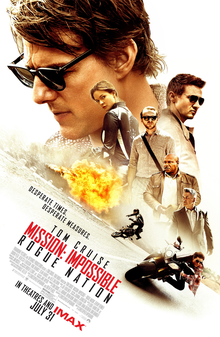
Behind the film
- Year
- 2015
- Director
- Christopher McQuarrie
- Writers
- Christopher McQuarrie
- Runtime
- 2h 11m
- Genres
- Thriller, Action
- Production
- Skydance Media, Bad Robot Productions
- Country
- United States, People's Republic of China, Hong Kong, United Kingdom
- Cast
- Tom Cruise, Rebecca Ferguson, Jeremy Renner, Simon Pegg, Ving Rhames, Sean Harris, Alec Baldwin, Simon McBurney
About the film
Contains story spoilers.
The IMF is dismantled while Ethan Hunt investigates the Syndicate. Undercover MI6 operative Ilsa Faust helps him escape captivity, then becomes an uncertain ally. Ethan reconnects with his teammates and retrieves encrypted data, which turns out to provide access to funds rather than a simple list of agents. The team exposes MI6 chief Atlee's role in creating the unauthorised organisation later seized by Solomon Lane. Lane abducts Benji to force a bargain, but Ethan destroys the data and claims to have memorised it, drawing the enemy into pursuit. Ilsa defeats Vinter, while Ethan's team traps Lane in a glass cell. Hunley then presents the operation to a Senate committee as a coordinated success, securing the IMF's restoration and becoming its new secretary.
The film's central problem is institutional rather than purely physical. A person may be correct about a threat while lacking the official standing needed to make others respond. Dismantling the IMF changes the practical value of its members' expertise: capabilities remain, but the permission and support attached to them disappear. That creates different kinds of responsibility within the group. Acting independently may be necessary, yet independence makes it harder to distinguish a genuine public purpose from a personal fixation. The story's recurring question of trust therefore extends beyond friendship. It asks what evidence should persuade an institution when the people supplying it have already been marked as unreliable.
Ilsa Faust complicates the familiar pattern of an ally whose allegiance is immediately clear. She is an MI6 operative embedded with the Syndicate, so her interventions can protect Ethan while also jeopardizing her cover. The film gives her technical competence and a private objective rather than making her simply a helper for Hunt. Her choices are strategic and sometimes opaque even to him, which makes each reunion feel like a negotiation. The dynamic stays strongest when neither character can safely assume that the other controls the whole plan. Their partnership depends on reading behavior under pressure, not on a complete confession of motives.
Lane provides a quiet counterweight to Ethan’s physical energy. He is measured, patient, and skilled at turning another person’s attachment into leverage. His control often appears through the structure of a trap: a data file that conceals a financial instrument, a captive who forces a bargain, or an apparent route out that leads into surveillance. The contrast does not make Lane omnipotent; it creates a contest between two forms of planning. Ethan’s team works in fragments and improvisations, while Lane tries to define the available choices in advance. The suspense comes from watching the team find a route through those constraints.
Christopher McQuarrie shapes the action around a clear practical problem. Ethan’s exposed position means he cannot simply call in a large force, and the team’s limited resources make surveillance, disguises, and timing essential. The film’s set pieces each test a different form of control: an opera performance places the characters among musicians and security details, an underwater operation turns breath and seconds into obstacles, and later pursuits force a rapid adjustment between vehicles and urban space. The varied sequences are connected by the same question: can the plan survive contact with an opponent who has anticipated the team’s next move?
The famous opening with Ethan clinging to an airborne transport aircraft establishes a useful bargain with the audience: physical danger will be visible and specific. The action is staged so the body, vehicle, and surrounding environment remain connected, giving the stunt a practical shape rather than reducing it to a flash of impact. The underwater sequence shifts the pressure away from speed and toward breath, duration, and precision. Even when the film moves from one country to another, its tension depends on legible tasks: reach a particular object, avoid detection, keep a teammate alive, or get out before the system resets.
The ensemble prevents the story from becoming a solo endurance display. Benji’s improvisational humor and technical ability supply a different energy from Luther’s calm expertise; Brandt’s institutional caution carries the weight of decisions he cannot explain to his colleagues. Their separated positions create dramatic irony because the audience sees the team working toward a shared purpose even when they cannot safely speak openly. Ving Rhames, Simon Pegg, and Jeremy Renner give the group distinct rhythms, while Rebecca Ferguson’s Ilsa can move between the film’s action and deception without disappearing into either role.
The resolution separates making a mission succeed from making its success institutionally acceptable. An agency needs a usable account of what happened, while the people doing the work have navigated uncertainty, improvised arrangements and loyalties that do not fit a clean public explanation. That distance suits a story about intelligence organisations and unofficial action. Renewed authority can give the team room to operate without proving that authority will always recognise a danger promptly. The film's satisfaction rests in their working relationship: people with different skills can depend on one another before every larger structure catches up. It remains an achievement to earn that confidence, even when another assignment will soon test it.