
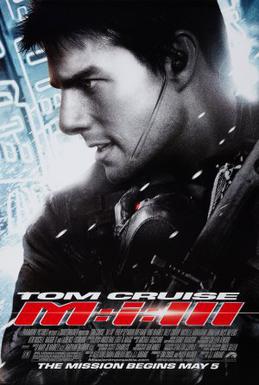
Behind the film
- Year
- 2006
- Director
- J. J. Abrams
- Writers
- J. J. Abrams, Alex Kurtzman, Roberto Orci
- Genres
- Action, Thriller, Spy, Adventure
- Production
- Paramount Pictures, Cruise/Wagner Productions, China Film Group Corporation
- Country
- United States
- Cast
- Tom Cruise, Philip Seymour Hoffman, Ving Rhames, Michelle Monaghan, Billy Crudup, Maggie Q, Jonathan Rhys Meyers, Keri Russell
About the film
Contains story spoilers.
Mission: Impossible III makes Ethan Hunt’s private life part of the mission before he has chosen to reveal that mission to the person sharing it. Tom Cruise’s agent has withdrawn from field operations and is training others, with Julia believing a much less dangerous account of his work. J. J. Abrams’s 2006 film, written with Alex Kurtzman and Roberto Orci, builds its pressure around the effort required to maintain both lives. Ethan wants the stability of a relationship and the ability to answer an urgent call from the IMF. Those desires cease to be separable once Philip Seymour Hoffman’s Owen Davian recognises that threatening a loved person can reach Ethan more effectively than threatening the agency. The action has an international scale, but the villain’s leverage is intimate.
A mission to rescue trainee Lindsey Farris ends with her death from an implanted explosive. Ethan’s team then captures Davian in the Vatican, but he escapes during an attack on the transport convoy. Julia is abducted, and Ethan is forced to obtain an object called the Rabbit’s Foot. In Shanghai he discovers that Musgrave is the insider manipulating the operation. Davian’s apparent execution of Julia is a deception involving a masked substitute; she is alive. Ethan kills Davian during their fight, then relies on Julia to help disable his own implanted explosive through a desperate electrical intervention. Julia fights off their attackers and revives him. The story ends with the couple acknowledging his real work before leaving together.
Hoffman’s Davian differs from a villain whose power depends on a spectacular headquarters or a long statement of ambition. His manner gives the impression that violence is an ordinary business tool. He can direct a threat at Ethan without raising his voice or treating the threat as a performance for the room. That emotional economy makes the relationship between them unusually unequal. Ethan’s urgency is visible, while Davian gives little indication that an exchange has cost him anything. Even capture does not fully reverse that balance. The prisoner can describe a future attack on Ethan’s life while the agent is holding him under guard. The scene turns physical control into something less reassuring: Ethan can secure a body without securing the consequences that body can set in motion.
The team’s work provides another kind of control. Luther, Declan and Zhen contribute capabilities that let an operation unfold through coordinated tasks rather than a single heroic improvisation. Ving Rhames brings continuity and familiarity to Luther, giving Ethan someone who can recognise the strain beneath his professionalism. The Vatican sequence makes the film’s identity games particularly concrete. Masks, timing and separate positions allow the team to manage what an observer believes is happening. The later deception involving Julia uses that same principle against Ethan. A technique associated with the heroes’ ingenuity becomes a way to injure their judgement. The film asks its characters to make decisions under pressure while knowing that the face in front of them may be evidence arranged by someone else.
Julia’s role keeps the secret-life premise from being only an explanation for Ethan’s distress. Michelle Monaghan plays someone who has built a relationship with a real person while being excluded from a central part of his circumstances. His wish to protect her also means controlling what she is allowed to know. The crisis eventually makes that control impossible. Julia’s nursing background matters in the final struggle, but so does her willingness to act amid a situation she has not been prepared to understand. Ethan has to give instructions, depend on her and accept his own vulnerability. The action places their trust in a practical form. He cannot conclude the mission by keeping her outside it; survival requires him to stop treating her solely as the person to be rescued.
The Rabbit’s Foot connects the international operation without receiving a fully explained function. Its exact nature remains unspecified, so the film’s tension comes from possession, leverage and the people willing to betray others for it. That keeps the audience beside Ethan’s immediate problem rather than asking for a detailed understanding of a weapon. The agency’s hierarchy adds a separate uncertainty about who is giving a reliable order and which account of the mission is being concealed. Laurence Fishburne’s Brassel and Billy Crudup’s Musgrave occupy positions that can shape Ethan’s freedom to act, while Benji’s technical help can turn a fragment of information into a route forward. An individual agent’s competence does not remove his dependence on people whose access to the system is different from his own.
Abrams’s film uses changes of speed and scale to sustain that dependence. An elaborate impersonation can demand calm precision, then a bridge attack can replace those plans with immediate survival. Shanghai’s height and distance turn movement through the city into a problem the team must calculate while Ethan is being pushed towards an emotional deadline. The opening places him in a situation of extreme helplessness before the film shows how he reached it, giving earlier scenes a pressure they would not carry in simple chronological order. By the end, the secret has become a shared fact between Ethan and Julia. The film resolves their immediate danger without suggesting that his profession has become ordinary. Its distinctive focus is the cost of promising a private life while working within a world built on hidden identities, competing loyalties and people who know exactly where to aim a threat.