
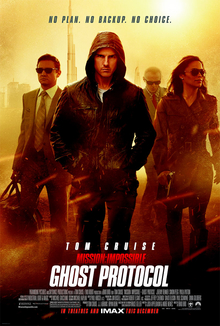
Behind the film
- Year
- 2011
- Director
- Brad Bird
- Writers
- Josh Appelbaum, André Nemec
- Runtime
- 2h 13m
- Genres
- Action, Thriller, Spy
- Production
- Paramount Pictures, Bad Robot Productions, Skydance Media
- Country
- United States
- Cast
- Tom Cruise, Jeremy Renner, Simon Pegg, Paula Patton, Michael Nyqvist, Anil Kapoor
About the film
Contains story spoilers.
A Kremlin bombing implicates the IMF, leaving Ethan Hunt and his colleagues disavowed. They pursue Kurt Hendricks, who wants nuclear war, through an exchange of stolen launch codes in Dubai and a satellite connection in Mumbai. Ethan’s team includes technician Benji, agent Jane and analyst Brandt, whose field skills conceal guilt about failing to protect Ethan’s wife Julia. Hendricks launches a missile toward San Francisco, but the agents restore a sabotaged broadcast system and Ethan disables it before detonation. Russian pursuer Sidorov recognises their innocence. Afterwards, Ethan tells Brandt that Julia’s death was staged to protect her; Ethan already knew she was alive. Julia acknowledges him from a distance as he prepares for another assignment. The successful mission clears their names without removing the personal compromises their work demands.
Brad Bird builds the movie around people forced to work without the familiar machinery of a secure agency. Ghost Protocol removes credentials, backup and the comfort of believing a superior will repair a failed plan. Ethan can still improvise, but his colleagues must take responsibility for their own risks. The film gives each one a different competence rather than treating them as interchangeable helpers: Jane reads people and fights, Benji brings technical expertise, and Brandt understands intelligence but hides what he knows about field work. The ensemble therefore feels necessary to the mission. The film keeps the group small enough that each person’s success or mistake changes the plan, giving the action a strong sense of shared exposure.
The Dubai sequence makes that group design visible through space. The Burj Khalifa exterior turns a clean glass tower into an obstacle with height, wind and unreliable equipment, while the operation inside depends on two simultaneous meetings and mistaken identities. The suspense comes from Ethan’s physical exposure and from the team’s inability to control every variable. When the adhesive gloves fail, the stunt problem is not detachable spectacle; it interrupts the assignment itself. Reflections suit a story about impersonation: a surface can suggest a view while hiding what is happening beyond it. The film’s long exterior shots give the building scale, then cut back to the team’s compact control room, where every technical adjustment has an immediate human consequence.
Jeremy Renner’s Brandt brings a controlled manner into an environment that constantly tests control. His reserve creates a useful contrast with Ethan’s readiness to act and Benji’s more vocal responses. The film allows silence to suggest several possibilities before asking the viewer to settle on one. That gives an ensemble member significance beyond a specialised job: a teammate’s emotional distance can affect how others interpret the whole operation. Renner’s performance makes polished professionalism look effortful rather than automatic. The difference matters in a story built around cooperation, where capability can be recognised more quickly than the private reasons someone hesitates to use it.
Paula Patton gives Jane a concentration that can feel both reliable and volatile. Professional focus does not exclude strong emotion, and the performance keeps that overlap visible. Simon Pegg’s Benji offers another response to pressure, using verbal energy where other teammates might retreat into composure. Their contrasting rhythms help the group feel human rather than merely efficient. Humour comes partly from the recognition that competence does not oblige everyone to look equally comfortable. The ensemble can be convincing precisely because each person carries difficulty differently. That variety also lets the action register as an experience shared among people, rather than a display in which everyone has already mastered the same fearless manner.
Bird’s direction keeps humour close to practical failure. Benji’s technical confidence cannot prevent equipment from malfunctioning, and a disguise only works until an opponent sees the pattern. The scenes repeatedly move between planning and improvisation: a device that solves one problem can create another, while a nearly silent exchange may communicate more than a briefing. Paul Hirsch’s editing gives enough information to follow each operation, then cuts among agents separated by walls, floors or crowds. Michael Giacchino’s score drives the action but leaves room for dry exchanges that distinguish this team. The balance gives the film a playful texture without making the threat feel weightless.
The film’s different environments give each operation a particular physical question. Height demands a different kind of attention from a crowd, while a moving system can turn a route into an obstacle. The spectacle stays readable because the viewer is usually given a practical objective before the situation becomes complicated. That arrangement invites anticipation: once a space has been understood, a change within it can become alarming without extensive explanation. Bird’s direction makes architecture part of the action rather than treating a famous location solely as scenery. Scale has an emotional use, allowing one exposed body or one uncertain movement to feel consequential inside an enormous setting.
The quieter ending gives the film a scale smaller than its public crisis. A spy story can resolve an immediate threat while leaving relationships shaped by distance, secrecy and the demands of continued service. That difference prevents success from becoming a claim that every cost has been recovered. The personal world has its own limits, which physical daring cannot simply overcome. Ghost Protocol’s playful momentum remains compatible with that restraint: the team can enjoy renewed trust without possessing an uncomplicated life outside the mission. The balance gives its closing mood a warmth grounded in connection, while preserving the uncertainty that makes a further assignment feel possible.