
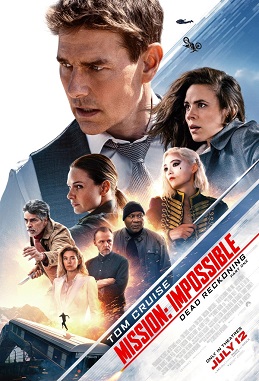
Behind the film
- Year
- 2023
- Director
- Christopher McQuarrie
- Writers
- Christopher McQuarrie, Erik Jendresen
- Runtime
- 2h 43m
- Genres
- Action, Spy
- Production
- Paramount Pictures, Skydance Media
- Country
- United States
- Cast
- Tom Cruise, Ving Rhames, Simon Pegg, Rebecca Ferguson, Hayley Atwell, Vanessa Kirby, Henry Czerny, Esai Morales
About the film
Contains story spoilers.
An artificial intelligence known as the Entity escapes into cyberspace after causing a submarine disaster. Governments race to obtain a two-piece key that may reveal how to control it, while Ethan Hunt decides the AI must be destroyed. He and his team cross paths with Grace, a thief who takes part of the key, and Gabriel, an operative tied to Ethan’s past. Pursuit carries them through Rome and Venice, where Gabriel kills Ilsa Faust. The action converges aboard the Orient Express as the completed key changes hands and the train becomes a runaway danger. Ethan and Grace save the passengers; Paris rescues them and reveals the key opens a chamber in the sunken submarine. Grace offers to join the IMF, while Ethan escapes with the key to continue the unfinished mission.
Christopher McQuarrie’s Dead Reckoning Part One gives the Mission: Impossible series a threat that cannot be understood as a single person with a weapon. The Entity’s reach through digital systems changes the shape of espionage: information can be manipulated, identities imitated and institutions made uncertain from within. That premise lets the film connect its physical action to a contemporary fear about invisible power. Yet it does not turn the human characters into spectators. Their decisions still matter because no system, however intelligent, removes the need to choose what risks are acceptable and whom to trust.
Ethan Hunt’s defining trait is less technical brilliance than the conviction that people are not expendable pieces in an operation. Tom Cruise plays that conviction as something physical: Ethan moves toward danger when another person is at risk, even when the rational calculation would tell him to preserve the mission. The film places this impulse under pressure by surrounding him with competing claims about security and necessity. His refusal to treat colleagues as disposable gives the action its moral centre, while also creating the practical complication that every rescue can alter the mission’s shape.
Hayley Atwell’s Grace brings a different kind of uncertainty to the team. She is skilled, observant and accustomed to protecting herself, but she enters a world where every alliance may have a hidden price. Atwell gives her resourcefulness without making her immediately trustworthy or immediately suspect. That balance is important: the film’s interest is not simply whether Grace is good, but how trust can be built when people are forced into cooperation under pressure. Her presence also changes the team’s rhythm, making Ethan respond to someone whose survival instincts do not automatically align with his own code.
The returning IMF colleagues keep the scale of the threat connected to friendship. Ving Rhames and Simon Pegg give Luther and Benji a long-established ease with Ethan, while Rebecca Ferguson’s Ilsa carries a more independent relationship to duty. Their histories do much of the emotional work that exposition cannot. A glance or a hesitation can register years of loyalty, disagreement and shared risk. The team is not simply a set of specialists assembled to solve a puzzle; it is a group whose personal commitments shape how each member interprets the mission.
The film’s action is built around tangible space and visible effort. Even when digital deception complicates the story, the set pieces depend on bodies moving through real environments with clear obstacles. Airports, streets, palaces and trains become systems of their own, each with routes, thresholds and points where control can be lost. That physical legibility helps the movie maintain suspense amid a dense conspiracy. A viewer can track where someone is, what they are trying to reach and how quickly circumstances are closing in. The large-scale spectacle works because its immediate geography remains understandable.
The Entity also shifts the series’ usual relationship between deception and performance. Disguises and misinformation have long belonged to spy fiction, but a system capable of generating convincing signals threatens the assumption that appearances can be checked against a stable record. The film responds by making human judgment more important, not less. Characters must interpret motives, take responsibility for uncertainty and act without perfect information. This is a useful thematic fit for Ethan, whose decisions have always involved a degree of faith in other people. The new antagonist makes that faith harder to practise, but also reveals why it matters.
As the first half of a two-part story, Dead Reckoning Part One deliberately leaves central questions open. Its ending is a continuation point, not a complete account of what happens to the Entity or the people pursuing it. That structure gives the film room to build pressure across several locations and relationships while holding back a final resolution. The title makes the uncertainty explicit: a reckoning is still ahead. Within this chapter, the satisfying unit is the team’s effort to secure a chance at understanding the threat, not a claim that the threat has already been defeated. The film balances that serial openness with set pieces that have their own local stakes and clear physical objectives. It also lets character loyalties evolve without pretending that one chapter can settle every relationship.