
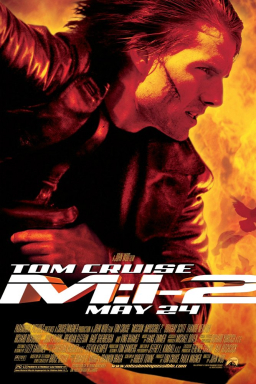
Behind the film
- Year
- 2000
- Director
- John Woo
- Writers
- Robert Towne
- Runtime
- 2h 6m
- Genres
- Action, Thriller, Spy
- Production
- Paramount Pictures, Cruise/Wagner Productions
- Country
- United States, Germany
- Cast
- Tom Cruise, Thandiwe Newton, Dougray Scott, Ving Rhames, Richard Roxburgh, John Polson, Brendan Gleeson, Rade Šerbedžija
About the film
Contains story spoilers.
Mission: Impossible II sends Ethan Hunt after Chimera, a fictional engineered virus, and Bellerophon, its cure. Scientist Vladimir Nekhorvich warns the IMF that Biocyte intends to profit from the disease and treatment; rogue agent Sean Ambrose steals the cure and seeks the virus. Ethan recruits Nyah Nordoff-Hall, Ambrose’s former lover and a professional thief, to get close to him while Luther Stickell and pilot Billy Baird provide support. Nyah discovers the disease’s dormant period and later infects herself to keep the last sample out of Ambrose’s hands. Ethan attacks Biocyte, then retrieves the cure in a later operation at Bare Island, where a mask swap deceives Ambrose. He kills Ambrose in a final fight, Luther administers Bellerophon to Nyah, and the IMF clears her record. The pair begin a vacation in Sydney. The fictional biotech crisis puts a deadline on a spy operation already entangled with personal loyalties.
The film is built around a mirror between Ethan and Ambrose. Both are skilled agents who can use masks, timing and physical performance to control what other people believe. Ambrose’s threat comes not only from his betrayal of the IMF but from his ability to imitate Ethan convincingly. Their conflict asks which man can be trusted when appearance is part of the job. This makes identity a structural device: disguises are not occasional tricks but part of how the plot distributes information and uncertainty.
Nyah’s role gives the mission an emotional and ethical center. She is recruited because her past relationship with Ambrose makes infiltration possible, but the same history makes her participation dangerous. Her choices are not simply a tool for Ethan; she makes decisions that affect whether the virus can be used and whether she will survive. Thandiwe Newton gives Nyah a composed intelligence that differs from Ethan’s visible physical confidence. Her role shows the cost of turning intimacy into an intelligence asset, particularly when the operation treats personal trust as something to be simulated.
The film’s biotech plot is deliberately legible in broad terms: a dangerous agent, a cure with a limited window, and a company whose incentives are corrupt. Ambrose’s control of the remedy allows him to bargain for corporate power as well as money. Chimera represents a weaponized threat and Bellerophon the means to contain it, while Nyah’s infection puts the abstract race against time into one person’s body. A recovery operation becomes a rescue when the person carrying the danger is also someone Ethan has promised to protect. Its moral question is about who controls dangerous knowledge and how much risk can be placed on one operative.
John Woo’s direction gives the spy story a more openly romantic and operatic texture. The images favor clean silhouettes, expressive pauses and kinetic movement, setting the film apart from a purely procedural thriller. Ethan’s physical sequences—the opening climb, the motorcycle chase and the final hand-to-hand struggle—are presented as showpiece moments that combine clarity with heightened style. The mission is still built from messages, disguises and timed operations, but the action is allowed to feel like a display of character as well as a solution to a tactical problem. Slow motion and carefully held poses interrupt the speed of the chase, turning a split-second decision into a visible gesture. The film often lets movement carry the emotional register: Hunt and Ambrose can be opponents in a fight and doubles in a disguise, while Nyah’s quiet resolve contrasts with the spectacle surrounding her.
Teamwork remains an important counterweight to Ethan’s solitary image. Luther provides technical support, Billy pilots the escape aircraft, and the IMF director sets the operation in motion. Their roles are not equally visible in every scene, yet the mission depends on coordination. Nyah’s infiltration and Ethan’s direct attacks operate on separate tracks that have to meet at Biocyte. The story’s organization makes the team’s work a series of handoffs: information collected in one place changes what can be attempted in another.
The film uses international settings as stages for changes in control rather than as a travelogue. The mission passes through Seville and Sydney, moving from briefing to infiltration and then to the biotechnology company’s facilities. Each location reframes the action: public spaces permit surveillance and disguise, while the corporate site concentrates the conflict around restricted access and the virus samples. The global movement suits an IMF thriller, and the locations shape both access and escape: enclosed corporate spaces restrict movement, while the island and mainland provide the physical route into the chase.
The ending resolves the immediate danger while keeping its emphasis on the people involved. Nyah survives, Ambrose is dead, and Ethan reunites with the woman whose former relationship was used to draw her into the mission. Ethan’s success is therefore measured not only by acquiring a cure but by ensuring Nyah is treated as a person with a future after the operation. Woo’s romantic framing gives that resolution a melodramatic finish, and the holiday offers a return to the unassigned time interrupted by the mission briefing.