
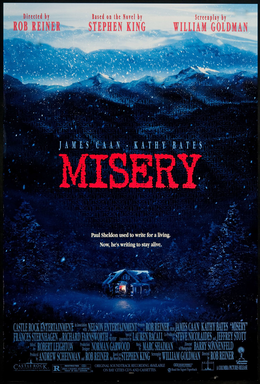
Behind the film
- Year
- 1990
- Director
- Rob Reiner
- Writers
- William Goldman
- Genres
- Thriller, Horror, Drama, Psychological horror
- Production
- Castle Rock Entertainment, Embassy Pictures
- Country
- United States
- Cast
- James Caan, Kathy Bates, Lauren Bacall, Richard Farnsworth, Frances Sternhagen, Graham Jarvis, J. T. Walsh, Rob Reiner
About the film
Contains story spoilers.
Writer Paul Sheldon crashes his car in a blizzard and is rescued by nurse Annie Wilkes, who calls herself his number-one fan. Once she discovers that his latest novel kills off her beloved heroine, Annie confines Paul and forces him to write a replacement. When he learns she has hidden his disappearance and plans to keep him captive, Paul searches for a way to survive. Their struggle ends with Annie dead and Paul recovering, though the final encounter shows how the experience still haunts him. The film’s careful geography gives suspense a physical scale: even a brief change in Paul’s mobility alters what he can know and attempt.
The cabin is designed as a pressure chamber. Paul’s world becomes a narrow circuit of room, bed, wheelchair and locked exits, so routine objects acquire threat or possibility according to who controls them. This spatial restriction makes the film’s suspense unusually legible: escape is not an abstract wish but a repeated calculation of distance, access and timing. The audience learns to inspect the set alongside Paul, treating a doorway or small object as a change in the balance of power. Reiner’s controlled staging keeps that geography clear even as the situation grows unstable. The room’s ordinary furniture keeps the threat grounded in recognizable space, avoiding a maze-like setting that would make danger feel abstract.
The horror also depends on a clash of authorship. Paul writes stories for a living, while Annie insists that she has the authority to decide what those stories should become. Her devotion is therefore not passive admiration; it is an attempt to seize control over a fictional character and the living writer who created her. That conflict gives the typewriter special force. It is at once Paul’s work tool, the means by which his captor directs him, and an object that can change hands as the struggle shifts. The movie turns creative labor into a material contest over who may end a story. This makes the captivity story resonate with the act of writing itself, where a character’s fate belongs to the author but also invites a reader’s attachment.
Kathy Bates’s Annie is frightening because she can move rapidly between care and threat without announcing a stable boundary between them. She presents herself as devoted, but her affection is possessive and conditional. Bates makes the character’s moods feel like changes in weather: the room may remain still while the emotional forecast turns. James Caan plays Paul with a more contained strategy, allowing resistance to appear through attention and timing rather than bravado. Their asymmetry is essential. Annie controls the space and immediate conditions, while Paul’s chief resource is his capacity to observe, anticipate and keep thinking. Bates’s performance resists reducing Annie to a constant snarl; the instability between kindness and control is what keeps her behavior difficult to predict.
The film’s adaptation choices make the story notably intimate. William Goldman keeps most of the drama concentrated around two central performances and the objects that mediate their conflict. That focus lets it transform a novel about a writer held captive into a screen thriller grounded in blocking, glances and sudden changes in access. The narrow cast does not make the world feel empty; it makes absence itself a source of unease. People outside the cabin matter because they may know where Paul is, yet their distance cannot immediately alter his confinement. Rather than opening into a broad police procedural, the film protects its two-hander structure and keeps the audience close to Paul’s limited knowledge.
The attack on Paul's ankles gives the captor's claimed care a horrifying physical contradiction. The person who supplies treatment deliberately worsens the injuries that make him dependent on her. In the film, Annie uses a sledgehammer; the scene belongs to this adaptation's design, and differs from the novel's injury. Its force comes from more than graphic violence. Movement has already been established as Paul's practical resource, so the act changes the meaning of every possible route out. The room can remain visually familiar while his relationship to its distances becomes radically different. An ordinary trip across the floor now carries the consequences of someone else's decision about his body.
The suspense escalates through repeated tests of whether Paul can act without Annie noticing. Each attempt teaches him something about the limits of his freedom, but success is never simply cumulative: the captor’s response can make yesterday’s opening unusable. This pattern avoids treating escape as a single clever trick. It frames survival as sustained attention under stress, with the victim required to manage both physical pain and the emotional unpredictability of the person controlling care. The film’s tension comes from that imbalance more than from mystery about Annie’s motives. Repetition becomes a suspense tool: familiar rooms return, but a shifted position or newly noticed detail changes their meaning.
Misery’s final movement connects survival with the return of artistic independence, but it avoids presenting recovery as effortless. Paul can leave the immediate danger and resume writing, yet the last encounter suggests that fear has changed how he experiences attention from readers. That ending suits the film’s central concern: stories can create attachment, but the relationship between creator and audience has boundaries that must hold. Annie’s violence makes those boundaries frighteningly literal. The film remains a taut study of captivity and authorship because the same question runs through its suspense and its creative conflict: who gets to decide what happens next? The closing unease does not erase the relief of survival; it gives that relief a credible emotional residue.