
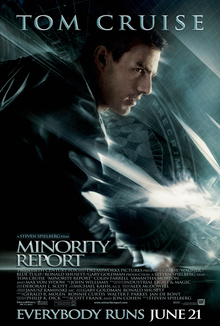
Behind the film
- Year
- 2002
- Director
- Steven Spielberg
- Writers
- Scott Frank, Jon Cohen
- Genres
- Science fiction, Action, Dystopian, Thriller
- Production
- 20th Century Studios, DreamWorks, Amblin Entertainment
- Country
- United States
- Cast
- Tom Cruise, Colin Farrell, Samantha Morton, Max von Sydow, Kathryn Morris, Lois Smith, Peter Stormare, Neal McDonough
About the film
Contains story spoilers.
Steven Spielberg’s Minority Report imagines a Washington, D.C., where three precognitive people help police stop murders before they happen. Their visions are interpreted by PreCrime officers, who arrest the named killer and place that person in suspended animation. Chief John Anderton, played by Tom Cruise, believes in the system’s promise: no one has to become a victim if the state can intervene in time. The opening introduces his procedural competence as he assembles images from a vision and directs a raid. Yet the order of those images, and the fact that the precogs can see different outcomes, quietly introduce uncertainty into a system that presents its judgments as absolute.
Anderton carries private grief as well as public authority. His young son Sean disappeared years earlier, and his marriage to Lara has broken under the loss. He uses a drug called neuroin and spends long hours at work, where a visiting Justice Department agent, Danny Witwer, audits PreCrime before its proposed expansion. Witwer is interested in how the system works and who controls it, while Anderton sees the audit as an intrusion. Their conflict intensifies when a new vision predicts that Anderton himself will murder a stranger called Leo Crow. The chief flees before his colleagues can arrest him, becoming the hunted subject of the method he helped administer.
To evade the iris scanners that identify citizens across the city, Anderton undergoes black-market eye replacement surgery. The sequence makes technological surveillance bodily: his old eyes remain recognizable to the system, and his new ones must heal while he keeps moving. He seeks out Dr. Iris Hineman, a geneticist involved in the research that enabled PreCrime. Hineman explains that the precogs sometimes produce a dissenting vision, a minority report, but such contradictions are suppressed because they would expose the prediction system’s fallibility. Anderton learns that Agatha, the most powerful precog, may retain the vision he needs, and returns to the facility to remove her from the pool.
Once Agatha is outside the system, PreCrime shuts down temporarily. Anderton carries her through a city built around constant identification, seeking information while evading the officers whose work he once directed. She is not a passive source of answers: her fragmented memories arrive through images and insistence, and Anderton must learn how to interpret them. They track Crow to a hotel room, where photographs of missing children include Sean. Crow claims he kidnapped the boy and provokes Anderton to kill him. Anderton raises his gun, but refuses to complete the action. Crow then engineers his own death, making the event resemble the prediction while demonstrating that the vision did not dictate Anderton’s choice.
Meanwhile, Witwer investigates the unexplained death of Anne Lively, whose drowned body appears in one of Agatha’s visions. He discovers that the record of the vision has disappeared. PreCrime director Lamar Burgess, an old mentor to Anderton, kills Witwer after realizing the agent is nearing the truth. Lara eventually frees Anderton from the facility and helps him reach a public gathering where the system is being celebrated. There, the separate mysteries meet: Anne was Agatha’s mother, and Burgess arranged her murder to prevent her from reclaiming her daughter, whose abilities were essential to PreCrime.
The crime depended on exploiting the system’s rule for handling an echo: if a predicted murder is prevented, the same person can be killed moments later in a way that looks identical, and technicians dismiss the second vision as a repetition. Burgess used that blind spot to hide the actual killing. He also arranged Crow’s appearance as Sean’s supposed killer so Anderton would be driven into the very murder predicted for him. The chase has therefore exposed two different limits: predictions can be manipulated by people who understand the machinery, and a person can still refuse the action the vision appears to show.
The final confrontation takes place at the celebration for PreCrime’s national launch. Agatha’s precognition indicates that Burgess will kill Anderton, and the director sees the same future. Rather than shoot the man who has uncovered him, Burgess kills himself, refusing the predicted murder and exposing the system’s claim of certainty. PreCrime is shut down, its prisoners are released, and the precogs are allowed to live in privacy. Anderton and Lara reconcile and expect another child. The ending offers a hopeful outcome, while keeping the central ethical question in view: preventing violence does not automatically justify removing choice or due process.
Spielberg stages the future as a world of glossy surfaces and invasive interfaces. Anderton handles projected images with sweeping hand gestures, while targeted advertisements call to passers-by using their identities. The city’s conveniences and surveillance use the same infrastructure, making the police chase feel embedded in everyday life. Janusz Kamiński’s desaturated photography gives the film a cool, high-contrast look that leans toward noir rather than a bright utopia. John Williams’s score also draws on suspense and classical textures, giving the technology a sense of mystery. Those choices make the future strange but legible: the machines are recognizable tools, and their danger comes from the institutions using them.