
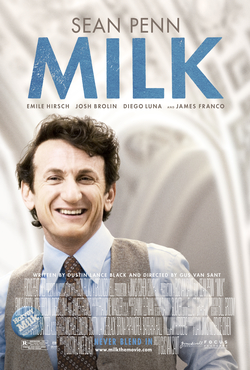
Behind the film
- Year
- 2008
- Director
- Gus Van Sant
- Writers
- Dustin Lance Black
- Genres
- Biographical, Drama, Lgbtq-related
- Production
- Focus Features
- Country
- United States
- Cast
- Sean Penn, Emile Hirsch, Josh Brolin, Diego Luna, James Franco, Alison Pill, Victor Garber, Denis O'Hare
About the film
Contains story spoilers.
The film opens with Harvey Milk recording a message for the possibility that he may be killed, then moves backward to his fortieth birthday in New York, where he meets Scott Smith. Their decision to leave for San Francisco gives the story a personal beginning before the political one: Milk is a middle-aged insurance agent who feels that his life has narrowed, while Scott offers the idea that a new place might allow them to live openly. In the Castro, they open a camera shop that becomes a meeting point as the neighborhood changes. The shop is a business, a home base and a practical answer to a question the film keeps asking: how can people who have been isolated find one another and act together? Sean Penn’s performance becomes more expansive as Milk finds an audience, with his readiness to joke offering a way into difficult political conversations. That public warmth is also something his closest relationships have to share with an increasingly demanding cause.
Milk's first route into politics comes from conflict with nearby merchants and city rules, but his organizing soon reaches further than the shop. He builds relationships with people who become part of his campaign network, including Cleve Jones, and pushes back against a cautious political establishment that he believes will not protect the community. Scott manages his first campaigns, but the work takes over their shared life and strains their partnership. The film does not treat activism as a simple source of inspiration: the effort asks for long hours, public exposure and difficult choices about where to spend emotional attention. When Milk runs unsuccessfully for supervisor, he learns how local election rules can shape whether a scattered community has any chance to elect someone who represents it. Milk's storefront is not a metaphor detached from daily work: customers, volunteers and neighbors pass through, and those repeated contacts give the campaign a reachable base.
After San Francisco shifts from at-large elections to district representation, Milk wins a seat on the Board of Supervisors in 1977. The change gives residents of the Castro a more direct political voice, and Milk's campaign turns that opening into a wider coalition. His office is shown as another kind of organizing room: he argues for a city gay-rights ordinance, counters political attacks and tries to turn public visibility into durable protections. Meanwhile, his relationship with Scott has ended, and his later connection with Jack Lira cannot withstand the demands of political life. The film follows those costs alongside public milestones, keeping Milk's private relationships within the same crowded schedule as speeches, volunteers and negotiations. The district election makes representation tangible, but the film also shows how a seat can bring new demands rather than free Milk from the need to persuade.
Dan White, another supervisor and a former police officer and firefighter, first appears as a colleague whose conservatism does not prevent a certain personal warmth. He invites Milk to his child's christening and later seeks Milk's help blocking a proposed psychiatric facility in his district, hoping to trade support for a citywide rights measure. Milk refuses to support White’s attempt to block the facility because he believes doing so would harm vulnerable young people. White interprets that decision as a betrayal and votes against the rights ordinance. Their relationship becomes political and personal at once, with White's disappointment tightening into grievance while Milk sees the consequences of treating the two men's requests as equivalent. White's family ceremony and request over the hospital create a personal familiarity that makes their later disagreement feel more complicated than a clash between fixed caricatures.
The California campaign against Proposition 6 draws the film's local organizing into a statewide fight over whether gay and lesbian teachers can be barred from public schools. Milk and his supporters travel, call voters and build alliances beyond San Francisco. The measure's defeat is a victory, but the film does not make it a clean resolution: the same week, White's proposal for a supervisor pay raise fails, he resigns, and then asks to return. Mayor George Moscone declines to reinstate him after Milk argues against it. The sequence presents the political chain that precedes the final violence without reducing it to a single cause; the choice is shown as one event among decisions, resentments and the public power White has lost. The Proposition 6 campaign connects school employment to broader questions of public belonging, asking allies outside the Castro to decide whether exclusion is acceptable even when it does not affect them personally.
On November 27, White enters City Hall through a basement window to avoid the metal detector, asks Moscone for his former seat and kills him after the mayor refuses. He then goes to Milk's office and kills him as well. The recording that opened the film gives this outcome a frame, but the final movement also returns attention to the community built around the camera shop and campaigns. Gus Van Sant interweaves the acted scenes with archival material and reconstructed television imagery, giving the civic setting a texture that feels more public than a conventional private-life biopic. Dustin Lance Black’s screenplay organizes the historical material as a dramatized account of political and personal change. The final candlelight gathering turns attention from the killers’ offices back toward the people whose collective work has carried the story. The ending's archival texture places the office killings within public memory, while the cassette framing gives the film a voice that can continue after the speaker is gone.