
Behind the film
- Year
- 1945
- Director
- Michael Curtiz
- Writers
- Ranald MacDougall, James M. Cain, William Faulkner, Albert Maltz
- Runtime
- 1h 51m
- Genres
- Drama, Film noir
- Production
- Warner Bros. Entertainment, Warner Bros. Pictures
- Country
- United States
- Cast
- Joan Crawford, Jack Carson, Zachary Scott, Ann Blyth, Eve Arden, Moroni Olsen, Butterfly McQueen, Bruce Bennett
About the film
Contains story spoilers.
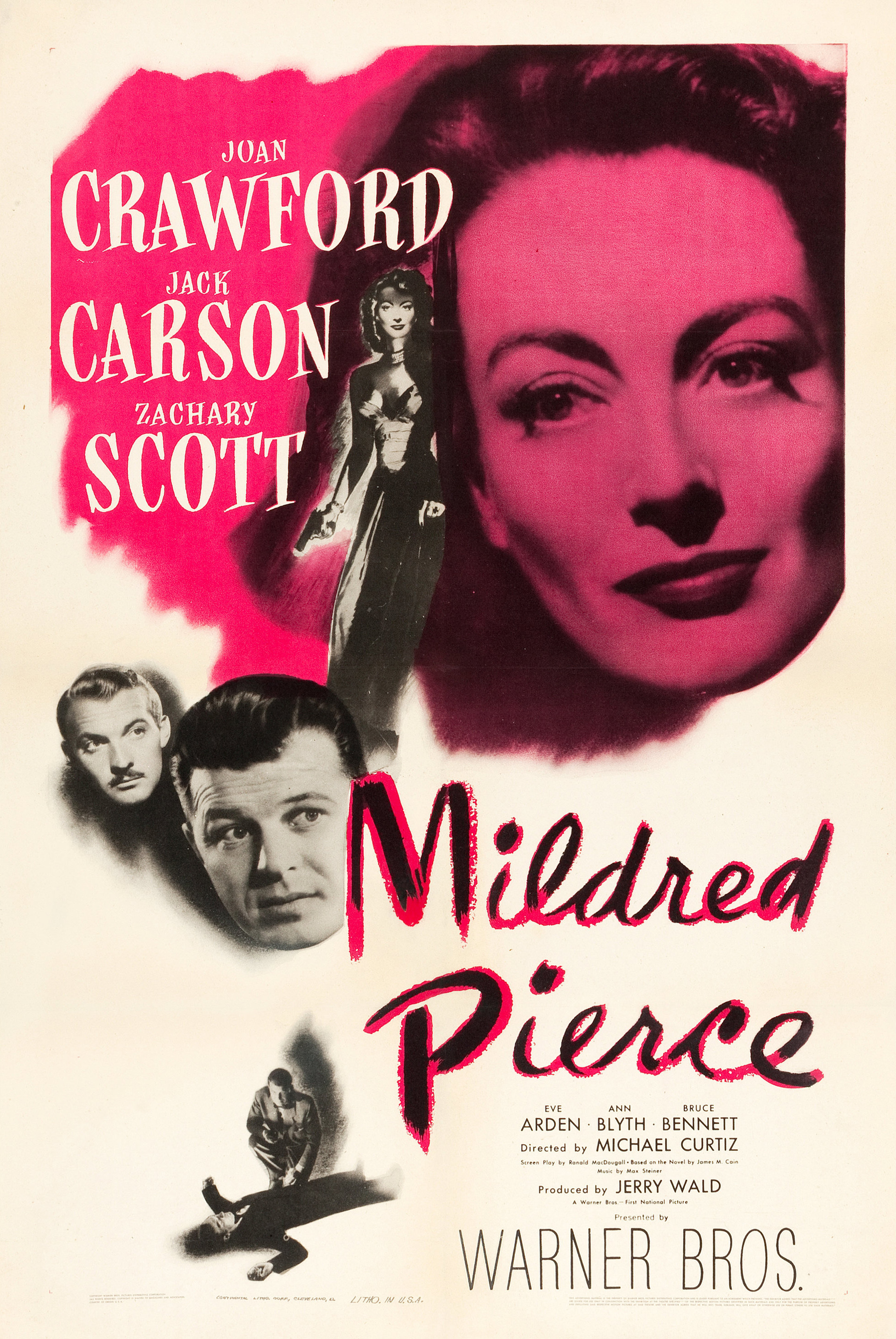
Michael Curtiz's Mildred Pierce is a 1945 drama adapted from James M. Cain's novel, with Joan Crawford as a mother whose business success cannot secure her daughter's affection. Ann Blyth plays Veda, Zachary Scott is Monte Beragon, Jack Carson is Wally Fay and Eve Arden is Ida Corwin. The film begins with Monte's murder at a beach house, placing the family story inside a police investigation. Mildred's account then moves back four years. The audience learns how she became a restaurateur while knowing that the prosperity ahead will lead to a death and an attempt to conceal responsibility.
Mildred initially earns money through the domestic skills available to her, baking and waiting tables before opening a restaurant. Her practical education takes place through work: she learns the business while serving other people and turns that knowledge into an enterprise of her own. Her daughters attach very different meanings to this effort. Kay is the younger, less demanding child; Veda regards her mother's occupation as a social embarrassment. When Kay dies of pneumonia, Mildred pours still more attention into Veda. The loss narrows an already unequal relationship, leaving the surviving daughter's demands at the centre of a household financed by labour she despises.
The restaurant expands into a chain, but money does not end the family's struggle over status. Veda wants the advantages of Mildred's earnings without the association with service and food preparation. Monte offers a different attraction: an established family name and a style of leisure that Mildred's business can support. The marriage therefore connects her commercial achievement to the social standing her daughter craves. Around these relationships, the beach house provides an elaborate physical setting for the eventual crime. Anton Grot's interiors contain stairways and interlocking rooms, making the building a place where movement, separation and uncertainty can sustain the murder mystery.
Ida supplies a working woman's perspective alongside the mother's increasingly costly devotion. Her conversations with Mildred include jokes, blunt advice and an invitation to recognise how much Veda is taking from her. The friendship gives the restaurant world a voice beyond its value to the family. Veda's contempt also becomes more explicit as Mildred succeeds: the daughter attacks her mother's background and treats earned money as inferior to money obtained through manipulation. In a pregnancy scam involving a wealthy family, Veda is willing to exploit the very respectability she claims to prize. Mildred's ability to run a business does not give her comparable command over this intimate conflict.
The adaptation required a substantial rebuilding of Cain's story. Producer Jerry Wald wanted a murder at the beginning and a mystery around it; Ranald MacDougall contributed the flashback structure. Neither device is simply an illustration of the novel's opening. Eight studio writers worked on versions of the screenplay, including William Faulkner, while objections from the Production Code administration complicated the project. The resulting film spends its early stretch establishing crime and suspicion before arriving at the domestic material that begins the book. That arrangement changes how ordinary family events register: an argument over money or an indulgence toward Veda also becomes possible evidence in an investigation.
Crawford came to the role after leaving MGM and moving to Warner Bros. in 1943. Mildred offered a mature central character with a business, a sexual life and a troubled relationship with her child. Her performance also occupied a different visual world from the brightly illuminated studio glamour she had known. Ernest Haller's shadows, partial lighting and unusual camera angles gave the character's surroundings an unsettled quality. Crawford later connected those lighting choices to Mildred's psychology. The mixture of a woman's domestic drama and film noir was thus present in the image as well as the plot, keeping emotional vulnerability visible within a polished star presentation.
Curtiz and Haller vary the film's appearance as its circumstances change. The beach-house prologue uses diagonal light, looming shadows and flickering firelight, while Mildred's earlier suburban life receives plainer framing and illumination. The contrast lets the same story move between everyday effort and heightened danger. Its last view of women at work also complicates the apparent escape from the investigation: cleaners scrub the Hall of Justice floors at dawn. Their labour continues after the central characters have reached their resolution. From restaurant kitchens to that public building, work remains part of the film's environment even when the mystery has displaced it from the immediate foreground.
Mildred eventually confesses to killing Monte, but the police establish Veda's responsibility. Veda had been having an affair with him and shot him after he refused to marry her. Her final appeal again turns toward her mother, whom she blames for what she has become. This time Mildred does not continue protecting her. Leaving Veda behind at the station, she rejoins Bert outside. The solution reveals why the opening account cannot be treated as a transparent report: Mildred's determination to shield her daughter has shaped what she is willing to admit.