
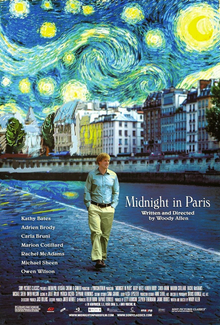
Behind the film
- Year
- 2011
- Director
- Woody Allen
- Writers
- Woody Allen
- Runtime
- 1h 34m
- Genres
- Romantic comedy, Fantasy, Time-travel, Magic realist
- Production
- Mediapro, Television of Catalonia
- Country
- United States, Spain
- Cast
- Owen Wilson, Rachel McAdams, Marion Cotillard, Kathy Bates, Corey Stoll, Michael Sheen, Adrien Brody, Léa Seydoux
About the film
Contains story spoilers.
Midnight in Paris begins by letting the city speak before its characters start explaining what they want from it. Streets, cafés, monuments and changing weather make Paris feel like somewhere a person might inhabit, even as Gil Pender treats it as the entrance to a more meaningful life. He earns a comfortable living writing Hollywood screenplays but wants to finish a novel. His fiancée Inez sees that ambition as a distraction from the future they already have available. They are visiting with her parents, whose expectations reinforce the gap between his desire to start again and her confidence that he should return to the work that pays.
Owen Wilson makes Gil’s enthusiasm conversational rather than grand, which matters when the film surrounds him with people who regard his wishes as impractical. Inez’s friend Paul supplies a different kind of confidence: he can turn a walk through a museum or a discussion of wine into a demonstration of his own expertise. Michael Sheen plays that certainty against Gil’s awkward resistance, while Rachel McAdams gives Inez an impatience that extends beyond a disagreement about sightseeing. Gil wants rain, wandering and time to write. She wants him to participate in the holiday they are actually taking. Their arguments expose how little their imagined married lives resemble one another.
The extraordinary part arrives through an ordinary wrong turn. Alone at midnight, Gil accepts a ride in an old car and finds himself at a party where the people around him belong to the Paris he has been reading about. The film allows his disbelief to catch up gradually with their names, clothing and conversation. Meeting Fitzgerald or Hemingway turns cultural admiration into an immediate social problem: Gil still has to speak, explain himself and admit that he has a manuscript. Their presence gives his literary ambitions an audience, but it also makes his habit of postponing those ambitions harder to defend. A future novelist cannot remain satisfied with merely recognising famous writers.
These encounters work as comic portraits within a fantasy, with the performers supplying distinct ways of taking up space. Corey Stoll’s Hemingway speaks with an intensity that makes even casual conversation feel like a test. Kathy Bates gives Gertrude Stein the authority of someone willing to discuss the work rather than flatter the person presenting it. Adrien Brody’s Dalí finds material for his own imagination in a predicament that Gil expects to sound impossible. The dialogue keeps moving between Gil’s nervous explanations and the artists’ absorption in their own interests. Entering their company does not make him the centre of their world, although it briefly lets him believe that he has finally found his proper surroundings.
Adriana makes that belief more intimate. Played by Marion Cotillard, she lives among the artists Gil idolises but has her own dissatisfaction with the era he considers ideal. Their attraction offers him the possibility of belonging to the past through a relationship rather than a sequence of encounters. It also reveals how easily he can turn another person into part of a desired setting. Her preferences and ambitions exist beyond the role he wants her to play. When a carriage takes them further back into the Belle Époque, the change in transport feels consistent with a world where historical periods can be entered through streets and evenings, without machinery explaining the journey.
In the earlier Paris, Adriana is delighted by the surroundings that Gil experiences as a fascinating excursion. The artists they meet have their own preferred past, making the pattern visible through conversation rather than a lesson imposed from outside. Gil can recognise in Adriana the same longing that has been directing him, and he can see that there is always another period available to make the current one look disappointing. Their disagreement becomes a decision about where to live. She wants to remain there; he begins to understand why remaining in his own fantasy would prevent him from doing anything about the life waiting outside it.
Writing helps him notice that life more clearly. The novel’s imagined relationship contains problems that he has been unwilling to recognise in his engagement, and a discussion of his characters makes his avoidance difficult to sustain. When Inez admits her affair with Paul, their separation brings an already visible incompatibility into the open. Gil’s decision to stay in Paris is therefore more concrete than wishing he had been born in another decade. He will have to work, make choices and live with a city after its promise has become familiar. The film keeps the move hopeful while allowing it to involve uncertainty, rather than supplying a completed successful career.
The final meeting with Gabrielle gives that hope a modest shape. Their shared pleasure in Paris and its rain is enough to begin a conversation in the present, without either of them needing to be a celebrated figure from a book. Throughout the film, warm night interiors and leisurely movement through the city make Gil’s escapes attractive; the humour leaves room to see the wish underneath them. The ending preserves that attraction while changing what he does with it. Paris remains a place capable of stirring his imagination, but it can also become somewhere to finish a piece of writing, meet another person and accept an evening without asking it to belong to a better century.