
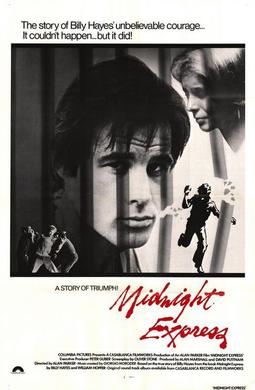
Behind the film
- Year
- 1978
- Director
- Alan Parker
- Writers
- Oliver Stone
- Genres
- Biographical, Drama, Prison, Independent
- Production
- Columbia Pictures
- Country
- United States, United Kingdom
- Cast
- Brad Davis, Randy Quaid, John Hurt, Paul L. Smith, Irene Miracle, Paolo Bonacelli, Bo Hopkins, Franco Diogene
About the film
Contains story spoilers.
Midnight Express makes imprisonment a change in the meaning of time. Alan Parker's film places an American traveller inside a system he cannot reliably read, where the prospect of release can give way to a longer sentence and dependence on other people is inseparable from risk. Its emphasis is intensely subjective: the environment becomes threatening through the narrowing of Billy Hayes's choices. That design gives the drama its physical force, but it also places a limit on its authority. A screen adaptation of one person's ordeal cannot stand in for a balanced account of a country or all the people within its institutions.
Caught trying to smuggle hashish out of Turkey, Billy receives a prison sentence that initially offers an end he can count toward. A prosecution appeal replaces that prospect with thirty years. Relationships with fellow prisoners provide advice and possible escape routes, but attempts to get out fail. Violence and a breakdown lead to his transfer to an asylum ward. After a visit from his girlfriend restores his determination, he tries to bribe a guard for a hospital transfer. The guard attacks him; Billy kills him during the struggle, takes his uniform and leaves through the entrance. The film turns a sequence of frustrated hopes into a final physical breach, while substantially reshaping the real Hayes's account for dramatic purposes.
The promise of movement is continually measured against the restrictions of a confined setting. Doors and corridors appear to offer routes, yet passage through them depends on other people's decisions. A changed sentence can alter the character's world without changing the walls around him, making legal language as consequential as a locked gate. This allows suspense to grow through information as well as physical danger. The viewer has to follow what Billy believes he can expect, then experience the collapse of that expectation. Confinement becomes particularly oppressive when a deadline that seemed dependable proves subject to a power he cannot influence.
Alan Parker’s direction makes confinement a sensory condition. Tight framing, harsh surfaces and sudden physical violence keep the viewer close to Billy’s limited field of knowledge. The film does not offer a neutral institutional overview; it organizes experience around his fear, anger and increasingly narrowed choices. This perspective creates force, but it also matters ethically: a protagonist’s trauma cannot stand in for a whole nation or prison culture. The film’s broad national caricatures have drawn criticism, and its story should be approached as a highly shaped adaptation rather than documentary evidence. Separating dramatic intensity from factual authority lets the film’s craft be discussed without endorsing its stereotypes.
Oliver Stone’s screenplay converts a memoir into a pressure-built prison drama. It selects episodes that intensify Billy’s loss of control and connects them through reversals: hope of release followed by renewed punishment, a seeming safe relationship shadowed by dependence, a plan that creates danger of its own. This is efficient melodrama, but it compresses legal and historical context. The adaptation’s organizing idea is not a procedural account of how a case works; it is the transformation of time into an antagonist. Days and years become less a calendar than an accumulating weight on the body and on Billy’s sense of self. That emphasis shapes what the movie leaves outside the frame.
Brad Davis anchors the design by changing the character’s physical presence as the story progresses. Early confidence gives way to guarded attention, then to a brittle, exhausted intensity. John Hurt’s Max offers a distinct survival strategy built from cynical calculation, while Randy Quaid’s Jimmy embodies a more openly volatile response to confinement. The supporting cast helps make prison feel like a social world rather than a single villain’s lair, although the limited point of view keeps that world filtered through Billy’s needs. Performance and framing therefore work together: relationships matter most when they alter his immediate possibilities, not when they supply a comprehensive account of the institution.
The prison scenes’ tonal shifts are central to the film’s impact. Moments of black humor or routine do not provide lasting relief; they make the next threat feel more invasive because ordinary behavior continues beside cruelty. Sound and editing reinforce that instability, moving from controlled exchanges to abrupt bursts of force. The picture’s intensity is often discussed through its notorious scenes, but its cumulative method is more revealing: repeated small humiliations teach the audience to anticipate danger before a character names it. That anticipation is a formal achievement, while the film’s national imagery remains a product of its dramatic viewpoint and period conventions. Those conventions deserve scrutiny rather than passive repetition.
As a late-1970s prison film, Midnight Express uses a personal ordeal to build an indictment of power exercised without meaningful recourse. Its energy comes from the mismatch between a young man’s impulsive act and consequences that become nearly impossible to reverse. The movie’s final movement offers release, but does not erase the years of confinement or damage accumulated along the way. Viewers can recognize the vivid direction, performances and escalation while keeping its limitations in view: this is a sensationalized screen adaptation, not a balanced account of Turkey, its people or the legal case. The film remains forceful precisely when its viewpoint is understood as a constructed and contested one.