
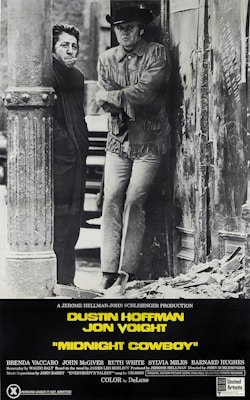
Behind the film
- Year
- 1969
- Director
- John Schlesinger
- Writers
- Waldo Salt
- Genres
- Buddy, Drama, Lgbtq-related
- Production
- United Artists
- Country
- United States
- Cast
- Jon Voight, Dustin Hoffman, Sylvia Miles, Brenda Vaccaro, John McGiver, Barnard Hughes, Jennifer Salt, Ruth White
About the film
Contains story spoilers.
Joe Buck arrives in New York wearing the future he has imagined for himself. His cowboy clothes announce confidence, masculinity and a marketable identity; he assumes wealthy women will recognize the appeal immediately. The city does not cooperate. A first encounter with Cass ends with Joe giving her money rather than collecting it, making the misunderstanding practical before it becomes philosophical. John Schlesinger's Midnight Cowboy follows a man whose image of himself has been assembled from promises that other people do not seem to recognize. The crowded streets contain plenty of potential customers, but abundance offers him no reliable way to understand what anybody wants.
Rico Rizzo, nicknamed Ratso, initially treats Joe as another possible source of cash. He offers an introduction that turns out to be a fraud, sending Joe to a religious fanatic instead of a useful manager. Joe's anger would make an ordinary friendship unlikely. Need changes the terms: when money and accommodation run out, Rico offers space in the condemned building where he is squatting. Their proposed business arrangement becomes a form of companionship before either can comfortably acknowledge it. Rico knows more about surviving the city, but that knowledge has not bought him security. Joe has physical presence and an apparently saleable costume, but neither gives him the judgment he expected to acquire simply by arriving.
The film keeps interrupting Joe's present with images of the life he has left. Memories of his grandmother and Annie come in uneasy fragments, including violence that makes his cheerful reinvention harder to take at face value. These passages are not a straightforward explanatory speech about why he behaves as he does. They break into his experience as something he has not fully put behind him. Jon Voight can therefore let confidence and bewilderment exist together: Joe performs the cowboy while carrying memories that the performance cannot organize. New York is not the first place where other people have imposed degrading terms on him, even if he initially treats it as the place where those terms can be reversed.
Winter makes the partnership increasingly precarious. Joe and Rico steal, improvise and wait for opportunities that seldom pay. The apartment offers a place to return to but little protection from cold, and Rico's cough begins to change the pace of their lives. Florida becomes his imagined answer, a place of warmth, ease and attention. The fantasy scenes give that hope a brightness missing from the rooms they actually occupy. Joe's difficulties acquiring money and Rico's difficulties remaining physically active now belong to the same problem. A small practical success for one may mean food or shelter for both, making their shared routine more consequential than the commercial arrangement they originally described.
An invitation to a party briefly gives Joe access to another version of the city. The lights, drugs and strangers produce spectacle rather than a dependable welcome. Shirley offers a paid encounter and the prospect of another client, so his career seems at last to be finding a direction. He returns to discover that Rico is seriously ill. The opportunity to continue pursuing his original ambition now competes with somebody else's immediate need. Joe obtains money through a violent encounter with another man and buys tickets south. On the bus he abandons the cowboy clothes and begins talking about ordinary work. Rico dies before the promised new life can begin, leaving Joe to hold his friend as the journey continues.
Dustin Hoffman's Rico moves through the film with a body's limitations continually visible. His limp, cough and defensive manner are not separate from the way he negotiates with people; they shape how quickly he can retreat, what he can pretend and how much energy he can spend on a scheme. His complaints can sound like demands for control in circumstances where very little is his to control. Voight's Joe initially occupies space more confidently, but does not know what to do with that advantage. Their exchanges gain intimacy through irritation rather than polished declarations of affection. The name Rico wants to be called matters because even an apparently casual nickname can keep him trapped inside somebody else's contempt.
The supporting encounters give Joe's expectations repeated, distinct tests. Sylvia Miles's Cass overturns his assumptions about who should pay whom. John McGiver's Mr. O'Daniel responds to him through a private religious fixation rather than the professional role Joe was promised. Brenda Vaccaro's Shirley can find him amusing and desirable without fulfilling the grander identity he has built around that desire. Waldo Salt's adaptation of James Leo Herlihy's novel lets these scenes remain awkward transactions, full of misunderstandings and shifts in power. A person may offer attention and still not offer security. Joe repeatedly has to learn that being noticed, being wanted and being cared for are different experiences, although his costume was supposed to make all three arrive together.
Adam Holender's city images and the film's restless editing let public movement sit beside private isolation. Advertisements, passing faces and noisy streets surround the two men without providing a place for them. John Barry's music and the recurring song Everybody's Talkin' give travel an emotional momentum that the practical journey cannot sustain. No lyrics are needed to understand the contrast: the music can suggest forward motion while the men keep returning to the same fragile room. The bus ending finally carries them toward Rico's imagined escape, but physical arrival cannot solve the problem that set them moving. Joe's gesture of holding him belongs to a quieter scale than the future he dressed for. The relationship has become real even as the life they hoped to share becomes impossible.