
Behind the film
- Year
- 1927
- Director
- Fritz Lang
- Writers
- Thea von Harbou
- Genres
- Silent, Drama, Science fiction, Dystopian
- Production
- UFA
- Country
- Germany, Weimar Republic
- Cast
- Brigitte Helm, Alfred Abel, Gustav Fröhlich, Rudolf Klein-Rogge, Fritz Rasp, Theodor Loos, Heinrich George, Erwin Biswanger
About the film
Contains story spoilers.
Fritz Lang’s Metropolis imagines a city built vertically around a rigid social order. Joh Fredersen rules from the New Tower of Babel, surrounded by elevated roads, aircraft and monumental buildings; far below, workers keep the machines running in shifts. The contrast is not simply between rich and poor neighbourhoods. The upper world treats the city as a designed system, while the people who operate it are reduced to interchangeable hands. The 2010 restoration returns much of the film’s original structure, including rediscovered material that clarifies relationships and the pressure behind the conflict.
Fredersen’s son Freder lives among the city’s privileged pleasures until he encounters Maria leading a group of workers’ children through the gardens. Her presence gives him a first glimpse of the people whose labour sustains his world. He follows her into the depths and sees workers operating a giant machine whose failure injures and kills them. In his hallucination, the machine becomes Moloch, an ancient devouring idol fed by human bodies. Freder returns to his father and asks him to see what is happening, but Fredersen responds by tightening control and sending the loyal assistant Josaphat away from the workplace.
Freder takes a worker’s clothes and enters the exhausting shift himself. The labour is repetitive and exacting: workers must keep their bodies aligned with gauges and dials, and a lapse can cause disaster. He tries to relieve one man and collapses under the strain. Meanwhile, Fredersen’s spy, the Thin Man, follows him, and the two worlds begin to overlap. Josaphat refuses to disappear quietly and becomes Freder’s ally. The film’s social picture is clear but not simple: Freder’s sympathy is genuine, yet individual rescue cannot change the system that makes workers’ suffering routine. The worker he relieves is identified by a number, making this exchange of clothes an encounter with a system that has replaced names with functions.
Maria speaks to workers in catacombs beneath the city, telling the story of the Tower of Babel as a warning about builders and planners who fail to understand one another. Her proposed mediator is a heart capable of connecting the mind that plans with the hands that build. Fredersen wants to undermine her influence, so he asks inventor Rotwang to give his machine-human Maria’s likeness. Rotwang agrees, but he has a private motive rooted in Hel, the woman he loved before Fredersen married her. The restored scenes make that past more present and help explain the imitation as personal revenge as well as political manipulation.
Rotwang kidnaps the real Maria and transfers her appearance to the machine. Fredersen wants the false Maria to discredit the speaker; Rotwang intends to destroy the city and harm Freder. The double is presented to Fredersen, while Maria remains imprisoned. Freder sees his father and the false Maria together and, misunderstanding what he has seen, falls into delirium. In parallel, the false Maria performs for wealthy men at Yoshiwara and exhorts workers to revolt. Her roles are contradictory: the same image is used to inflame desire above ground and anger below it, while the actual Maria cannot correct either audience.
The workers follow the false Maria’s call and destroy the machines, unaware that machinery controls the systems keeping their homes safe. Water floods the underground city and threatens the children left behind. The genuine Maria escapes, and Freder and Josaphat help her guide them to safety. When workers discover the children are missing, they blame Maria and seize the false one, burning her at a stake. The fire reveals the mechanical body. Recognition does not repair the damage or reconcile the classes; it shows that someone manipulated their anger and that their children were endangered by the uprising.
Rotwang, deluded by grief and fixation, sees Maria as Hel and chases her onto the cathedral roof. Freder follows, and their fight ends with Rotwang falling to his death. Below, Fredersen and Grot, guardian of the Heart Machine, meet as workers and masters look on. Freder brings their hands together, embodying the mediator Maria described. The ending offers symbolic reconciliation rather than a political program: the city’s hierarchy has not been redesigned, and no practical settlement is shown. The gesture asks for recognition across the divide even as the structures that produced it remain standing.
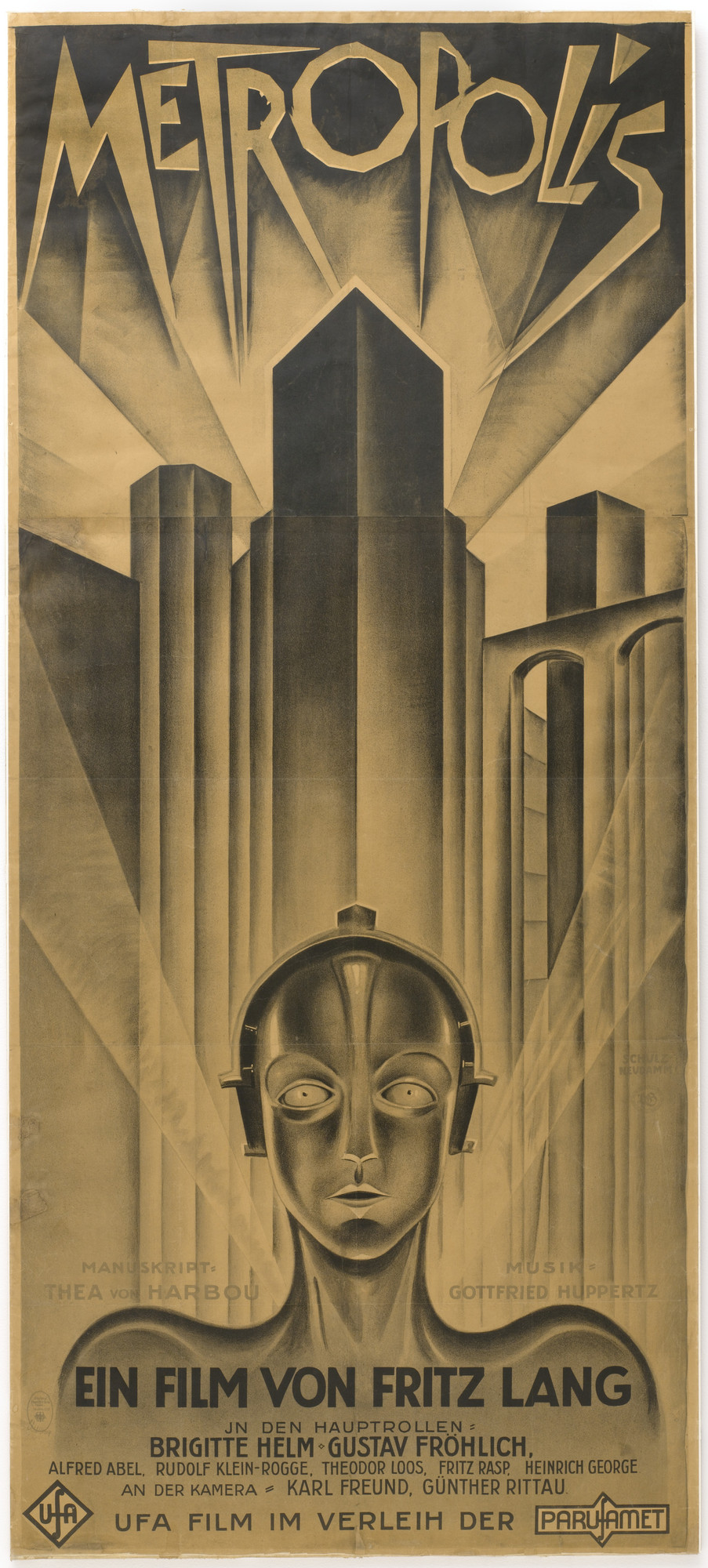
Lang’s silent images make architecture carry much of the exposition. The skyline layers towers and roads into a dense collage, while underground sets reduce workers to ordered rows and rhythmic movement. The film shifts between monumental compositions and close human faces, then gives the robot’s transformation into Maria an elaborate metallic spectacle. Biblical imagery, especially Maria’s Babel story and Freder’s visions, turns modern industry into myth without losing the story’s concrete stakes. The restored cut’s recovered footage makes the plot’s links more continuous, but its contrast remains clear: a city that can build wonders has failed to connect those who design it and those who sustain it.