
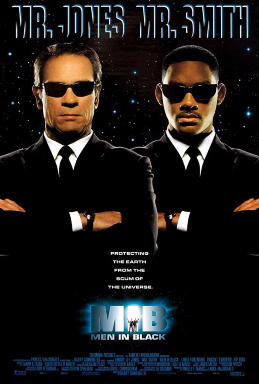
Behind the film
- Year
- 1997
- Director
- Barry Sonnenfeld
- Writers
- Ed Solomon
- Runtime
- 1h 38m
- Genres
- Action, Science fiction, Buddy, Buddy cop
- Production
- Amblin Entertainment, Columbia Pictures
- Country
- United States
- Cast
- Tommy Lee Jones, Will Smith, Linda Fiorentino, Vincent D’Onofrio, Rip Torn, Tony Shalhoub
About the film
Contains story spoilers.
Men in Black makes its first joke out of how little the public understands about its own surroundings. A seemingly routine border patrol encounter turns into an alien incident that Agent K handles with professional impatience. Once it is over, the witnesses lose their memories of what they saw. That mixture of extraordinary events and ordinary administrative work defines the agency K belongs to. Earth is a place where extraterrestrials can live under cover, provided someone keeps track of them and prevents their disputes from spilling into public life. The suit and sunglasses make the agents recognizable to us while leaving everyone inside the story unsure whether anything happened.
James Edwards enters this hidden world through his work as a New York police officer. Chasing a suspect across the city, he encounters abilities no human should possess and hears a warning he cannot yet understand. K takes an interest in his reactions and invites him to a recruitment exercise. The other candidates approach the tests like conventional military assessments; James questions what the images actually show and solves an awkward written exercise in his own fashion. His willingness to reconsider the apparent problem matters as much as his physical ability. Taking the job means giving up his public identity, and James becomes Agent J rather than simply adding another badge to his existing life.
The headquarters gives J a crash course in an entirely different version of New York. Alien travellers pass through an operation that resembles an arrivals hall, while unusual weapons, disguised residents and the neuralyzer make secrecy an everyday procedure. K does not introduce these discoveries with much ceremony. His weary matter-of-fact delivery repeatedly collides with J’s disbelief, creating a partnership in which one man has become accustomed to wonders the other can barely process. Rip Torn’s Z runs the organisation with the brisk manner of someone supervising a difficult shift. The environment is strange, but its employees still need instructions, equipment and a reason to get through the day.
Elsewhere, a spacecraft crashes onto a farm, and its occupant kills Edgar and wears his skin as a disguise. Vincent D’Onofrio gives this impostor a body that looks increasingly uncomfortable inside its stolen shape: stiff movements, disturbed proportions and an appetite for sugar betray the creature beneath. The Bug is pursuing something far more valuable than a way to blend in. Two deaths bring the agents to a morgue, where medical examiner Laurel Weaver is already finding evidence that her work no longer fits ordinary anatomy. A dying alien leaves a clue about a galaxy on Orion’s belt. The words seem to point upward, but their meaning depends on something much closer.
The investigation moves through a city whose commonplace surfaces keep concealing another layer. Tabloid stories can contain reliable information, and a small dog can turn out to be a knowledgeable alien informant. Frank helps the agents understand that a galaxy need not occupy the vast physical space J assumes it must. The object is carried on the collar of a cat named Orion, putting a threat of planetary destruction beside something that could be held in a hand. An Arquillian ship demands its return and is prepared to destroy Earth to stop the Bug obtaining it. The agents’ local detective work has become the deciding factor in a conflict most of humanity cannot even see.
The Bug takes Laurel and heads for the old World’s Fair structures, which conceal a means of escaping the planet. J’s understanding of the city helps him work out the destination. When the creature sheds its human disguise, the final confrontation changes scale again, confronting the partners with the thing Edgar’s body could only partially contain. K lets himself be swallowed as part of a dangerous attempt to recover a weapon, leaving J to keep the creature distracted outside. Laurel is essential to ending the fight rather than merely being rescued from it. Once the galaxy is recovered, the crisis can be resolved without the public learning how close it came to destruction.
K’s retirement gives the partnership an unexpectedly personal ending. He has been preparing J to take over, and the same memory-erasing technology used to preserve the agency’s secrecy allows him to return to an ordinary life. J must perform the procedure that removes their shared experience from his mentor’s memory. That choice reveals a cost behind the organisation’s efficiency: its employees can protect people without being able to remain part of their lives. Laurel becomes J’s new partner, continuing the work rather than restoring his former identity. The film’s final pull away from Earth then turns the entire universe into something small enough to be part of an alien game.
Barry Sonnenfeld keeps changing the relationship between the familiar and the grotesque. A clean institutional room can contain an impossible creature, while an ordinary neighbourhood can suddenly become the setting for science-fiction horror. The contrasting performances carry that effect: Tommy Lee Jones rarely changes his tone to accommodate an absurd discovery, while Will Smith gives J the quick responses of someone still trying to understand the rules. Their rhythm makes the exposition part of the comedy rather than a pause before it. Danny Elfman’s music adds another layer of restless movement. The hidden city is busy, eccentric and occasionally dangerous, but it also has the inconvenience and routine of a place people have to manage.