
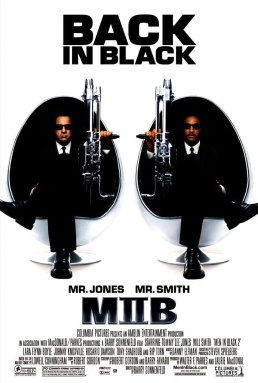
Behind the film
- Year
- 2002
- Director
- Barry Sonnenfeld
- Writers
- Robert Gordon, Barry Fanaro
- Runtime
- 1h 26m
- Genres
- Action, Science fiction, Buddy cop, Comedy
- Production
- Amblin Entertainment, Columbia Pictures
- Country
- United States
- Cast
- Tommy Lee Jones, Will Smith, Rip Torn, Lara Flynn Boyle, Johnny Knoxville, Rosario Dawson, Tony Shalhoub, Patrick Warburton
About the film
Contains story spoilers.
Five years after K retires and has his memory erased, J discovers that the alien Serleena is searching for the Light of Zartha, a force hidden on Earth. J tracks down K in Truro, restores his memory, and follows the veteran’s clues through a pizzeria, a locker-sized alien civilization and a video store. They learn that Laura, whom J has been seeing, is the Zarthan princess who is herself the Light. K persuades J to let her leave Earth rather than keep her close, and the partners defeat Serleena after her pursuit reaches the agency. K then uses the giant neuralyzer hidden in the Statue of Liberty’s torch to erase the public’s memories of the attack. The ending reveals that the whole human world is itself a tiny exhibit in a much larger alien locker.
Barry Sonnenfeld’s sequel treats memory as the series’ most useful piece of technology and its most intimate cost. The neuralyzer can make a witness forget an impossible event, but it also turns identity into something the agency can edit. K’s retirement is therefore not simply a gag about an old agent leaving work; he has been given the ordinary life he once sacrificed and no longer remembers why it felt necessary. J knows K as a partner, but also as a man whose absence leaves him without the history that made their partnership meaningful.
Will Smith plays J as quick enough to carry a room and young enough to mistake speed for mastery. His wisecracks are not merely decoration: they help him keep emotional distance from the strange and sometimes frightening work. Yet this story asks him to act without turning every problem into a performance. Bringing K back requires patience with an older man who has built a different life, and the comedy grows from their changed balance. J is now the experienced agent trying to bring someone else up to speed, a reversal that gives their familiar banter a slightly sharper edge.
Tommy Lee Jones makes K’s restored identity feel less like a switch being flipped than a deep structure returning. The pauses and blunt observations come back with the professional habits, so his partnership with J is recognizable even after the years apart. The contrast between their temperaments remains the film’s central comic engine: J is expressive and improvisational, K speaks in clipped assessments. Neither style is enough alone. Their work depends on J’s social agility and K’s ability to recognize patterns that others overlook.
J’s difficulty with intimacy follows naturally from a profession built around concealment. Being able to charm a witness does not mean being able to share an honest account of a life, and professional confidence can disguise how little room a person has left for vulnerability. The sequel makes partnership important because it supplies a relationship in which the strange parts of his experience need not be denied. That is a different need from wanting an audience for a clever remark. Smith’s expressiveness can fill a silence quickly, while the emotional problem requires him to tolerate a silence long enough to recognise what someone else’s future asks of him.
Scale is one of the film’s most useful ways of questioning authority. A person can occupy the centre of a familiar world without knowing what surrounds that world, so competence does not guarantee perspective. The series’ straight-faced agents make that uncertainty comic: their confidence remains practical within the work they understand, even when a larger frame would make it look absurdly limited. Sonnenfeld can shift between those views without asking the characters to stop functioning. A joke about size becomes a question about the stories people tell to justify importance, inviting the audience to enjoy the agents’ abilities while recognising that ability does not establish the boundaries of reality.
Sonnenfeld’s visual design keeps the agents’ institutional spaces sleek while letting creatures and ordinary urban locations collide with that polish. Latex-like aliens, practical make-up and digital effects share the frame, so the absurd can sit beside a straight-faced performance. The comedy often depends on a quick shift in scale or tone: a casual human setting becomes a venue for an interplanetary crisis, then returns to daily life after a flash of light. This rhythm lets the film retain the earlier series’ deadpan premise while raising the size of the spectacle.
The agency’s secrecy leaves an ethical question inside the comedy. Protection is presented as a reason to control what other people remember, and the people being protected have little opportunity to judge the bargain. Within the film’s fantasy, extraordinary events make that arrangement convenient; convenience does not remove the imbalance. K’s calm can make an enormous intervention look like routine work, while J’s response preserves some awareness that personal attachments do not obey the same tidy procedures. The sequel’s universe therefore has room for two scales of consequence: a crisis may be resolved efficiently, and an individual may still have lost something that institutional success cannot describe.