
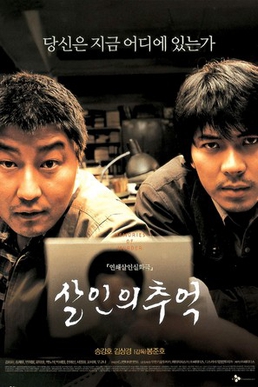
Behind the film
- Year
- 2003
- Director
- Bong Joon-ho
- Writers
- Bong Joon-ho, Shim Sung-bo
- Runtime
- 2h 12m
- Genres
- Crime thriller, Mystery, Drama, Police procedural
- Production
- CJ ENM Films & Television
- Country
- South Korea
- Cast
- Song Kang-ho, Kim Sang-kyung, Kim Roe-ha, Park Hae-il
About the film
Contains story spoilers.
Bong Joon-ho’s Memories of Murder begins in 1986 in a rural part of Gyeonggi Province, where detective Park Doo-man is called to a field after a woman’s body is discovered. The crime scene quickly becomes a public space, crowded with officials and onlookers, and the early investigation exposes how little control the detectives have over either evidence or the people around them. Park and his partner Cho Yong-koo rely on force, confident hunches and interrogation tactics that produce compliance more readily than truth. A special task force eventually brings in Seo Tae-yoon, a detective from Seoul who believes careful examination of facts can impose order. The film’s central tension is not simply between a right answer and a wrong one; it is between different ideas of police work, each tested by a case that keeps expanding beyond what these men know how to manage.
The murders continue, and the pattern points toward a culprit who returns under particular conditions. The investigation attends to weather, clothing, songs and the routines of the women who are attacked, while the detectives try to turn these repeated details into a profile. Park and Cho are used to treating suspects as people to pressure; Seo is more inclined to build a case from physical clues and timelines. Their disagreements are personal as well as professional. Park’s local familiarity sometimes produces useful leads, but his certainty can distort what he sees; Seo’s technical discipline can be more systematic, yet it cannot make incomplete evidence conclusive. The film keeps both approaches fallible. Rather than presenting a brilliant detective who can solve the case by assembling one overlooked clue, it shows how institutional limits and impatience shape the evidence before anyone can interpret it.
One of the investigation’s most painful turns centres on Baek Kwang-ho, a young man with an intellectual disability who is seen near a crime scene. The local police’s suspicion becomes a coercive confession, and the detectives initially treat his words as confirmation. Seo challenges the case by reconstructing what Kwang-ho could have seen and understood, revealing a weakness in the account. That correction does not restore the victim’s life or erase the harm done to Kwang-ho. It does, however, force the detectives to face the difference between a statement extracted from someone and reliable knowledge. The scene’s importance extends beyond a single suspect: the officers are under pressure to produce progress, but the methods that make progress look visible can actively move them farther from the truth. The film places this failure within a broader portrait of policing shaped by hierarchy, urgency and the use of violence.
As further cases accumulate, Seo and Park’s relationship changes. They work together, quarrel, and gradually recognize that neither can rely on his original assumptions. Evidence points toward a young factory worker, Park Hyeon-gyu, and the task force tries to link him to the crimes. DNA testing of semen recovered from a victim does not produce the decisive match the officers need. The story treats this not as a puzzle with one missing trick but as a collision between a suspect, an investigation and a scientific result too limited to settle guilt. Seo becomes increasingly convinced that Hyeon-gyu is the killer, while Park grows less certain. Their reversed positions reflect how prolonged failure reshapes each man: one retreats from confidence, the other becomes desperate for a conclusion. The case’s emotional pressure grows precisely because the film withholds the release of certainty.
A later attack leads to a confrontation near a railway tunnel, and Seo’s certainty breaks into rage. He pursues Hyeon-gyu with a gun, while Park intervenes and physically restrains him. Hyeon-gyu is not shown receiving a definitive verdict that resolves the murders; the detectives lack the evidence that would let the audience accept one. The investigation never supplies the resolution its detectives seek, and time passing does not turn that failure into an answer. Its ending returns Park to the first field years later. A child tells him another man came to look at the same place and seemed ordinary. Park turns toward the camera, searching the viewer’s face as if trying to recognize the person he could not identify. The gesture leaves the investigation open inside the film, not because the culprit’s identity has secretly been disclosed, but because the detectives never secured it.
Bong sets this failure against an observational style that allows humour and dread to coexist. Rural roads, fields, railway lines and drainage channels are not atmospheric backdrops alone; they organize the search and make the landscape seem to hold traces that the investigators repeatedly miss. Scenes can move from clumsy physical comedy to brutality without a change of location, exposing how easily the officers’ authority turns into harm. The camera often watches from a measured distance, showing bodies in space and the bustle around the crime scene rather than isolating a single heroic point of view. That approach makes the village feel inhabited, but it also shows the case consuming ordinary places and routines. The title’s “memories” belong to detectives, victims’ families and a country whose public institutions were under strain in the late 1980s.
The film was inspired by the Hwaseong serial murders, but the fictional investigation’s open ending should not be mistaken for a final statement about the real case. In 2019, DNA evidence identified Lee Choon-jae as the perpetrator of the real crimes; that later development occurred sixteen years after the film’s original release. The distinction matters because Bong’s ending is built around what Park and Seo could know during the events as the film presents them. It does not retroactively turn Hyeon-gyu into a stand-in for the real killer or establish guilt through resemblance. The final look remains a cinematic question about failure, memory and the ordinary appearance of a person who escapes suspicion, while the historical record has its own separate timeline and evidentiary basis. Keeping those tracks distinct preserves both the film’s unresolved dramatic force and the real victims’ factual history.