
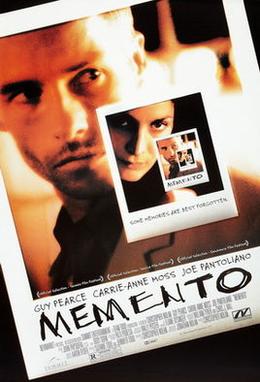
Behind the film
- Year
- 2000
- Director
- Christopher Nolan
- Writers
- Christopher Nolan
- Runtime
- 1h 53m
- Genres
- Neo-noir, Mystery, Flashback, Crime
- Production
- Newmarket Films, Summit Entertainment
- Country
- United States
- Cast
- Carrie-Anne Moss, Guy Pearce, Joe Pantoliano, Mark Boone Junior, Jorja Fox, Stephen Tobolowsky, Harriet Sansom Harris, Callum Keith Rennie
About the film
Contains story spoilers.
Christopher Nolan’s Memento makes the audience experience Leonard Shelby’s investigation through a fractured order. Leonard cannot form lasting new memories after a head injury, so he records facts on Polaroids, handwritten notes and tattoos. He believes he is pursuing the man who attacked him and killed his wife. Colour sequences move backward through the events of the investigation, while black-and-white scenes move forward and follow Leonard speaking with Teddy, a police officer who says he is helping. The strands meet near the end. This description distinguishes the film’s screen order from the chronology of the events: the opening image shows a killing that occurs later than much of what follows.
In the forward-moving black-and-white scenes, Leonard stays in a motel and explains the system he uses to keep his purpose intact. Facts he considers reliable become tattoos; provisional observations go on photographs; reminders are written on scraps. He tells the story of Sammy Jankis, a man whose memory condition led to a tragic insurance case. Leonard treats Sammy’s story as evidence that he understands his own condition, although it is also a way of arranging what he remembers about his past. The motel clerk Burt lets him keep multiple rooms, and Leonard’s reliance on routine makes this strange arrangement seem temporarily workable. The viewer learns the rules of his system before knowing how easily those rules can be exploited.
The colour story introduces Natalie, a bartender whose boyfriend Jimmy has disappeared, and Teddy, whose identity and motives shift with what Leonard can remember. Natalie claims she wants to help Leonard find the killer. She tests his condition by provoking him, then uses the fact that he will forget her actions to enlist his help against Dodd, a man threatening her. Leonard finds himself confused by a chase in which Dodd first follows him and later Leonard catches Dodd at the motel. The changing pursuit shows how missing context scrambles his sense of who is hunting whom. He eventually returns to Natalie’s home, where she promises to get a licence number for him. Her assistance has a practical purpose for her. The film does not present her as a neutral guide; she knows how to turn Leonard’s dependence on written evidence to her advantage.
Leonard meets Jimmy at an abandoned building and kills him, then discovers that Teddy has been using him to target other men. When Teddy arrives, he says that Leonard’s original attacker was already found and killed long ago, with Leonard himself responsible for the revenge. Teddy claims Leonard’s wife survived the assault but later died from insulin injections Leonard gave her after forgetting he had already administered them. He also says the story of Sammy is partly Leonard’s own. Because Teddy has lied and manipulated Leonard, the film gives his account force without making every element independently certain. What is clear is that Leonard cannot preserve this conversation as memory once it ends.
Leonard responds by deciding what his future self will believe. He writes Teddy’s licence plate information as a new clue and labels Teddy as the man to pursue. The final chronological decision is the cause of the film’s opening: Leonard will later follow that planted information and shoot Teddy. On screen, the audience first sees the reverse image of that act, then is carried through the events that make it possible. This structure removes the usual comfort of watching a detective accumulate evidence in a stable order. Each new scene revises the one before, and Leonard’s notes can preserve facts while hiding the choices that selected them.
The film repeatedly returns to the question of whether information is enough to make a trustworthy identity. Leonard can read his own tattoos as if they were written by someone else, and other people can place a note or photograph where he will find it. He knows his condition makes him vulnerable, yet he deliberately creates a new target after Teddy’s explanation threatens to end his search. His immediate reasons are shown; the full history of his wife’s death remains contested because the account comes from a compromised source and Leonard’s recollections do not settle it. The Sammy story also stays deliberately unstable: visual echoes suggest it may overlap with Leonard’s experience, but the film does not turn every implication into a confirmed fact.
Nolan’s structure depends on repetition, interruption and small visual clues. The opening photograph develops in reverse, and the colour sequence keeps taking away the context that would normally help a viewer understand a scene. Black-and-white passages offer a steadier timeline, but their convergence with the colour story changes what that steadiness means. Leonard’s narration sounds confident because he needs to trust his system, while the images let the audience notice gaps between certainty and proof. Guy Pearce’s controlled performance holds the character together across scenes that are chronologically disconnected. Carrie-Anne Moss and Joe Pantoliano play Natalie and Teddy with shifting mixtures of assistance, frustration and manipulation, each shaped by their own interests.
Memento ends not with Leonard solving his case but with him choosing to preserve the case as a reason to continue. The open-ended question is whether Teddy’s account of the original attack is true in all its details; the film gives grounds both to doubt Teddy and to suspect Leonard’s version of his past. The film leaves Teddy’s account open to question, but the actions on screen are clear: Leonard kills Jimmy, hears Teddy’s claim, writes down Teddy’s licence plate, and creates a clue that will make Teddy his next target. The result is a self-perpetuating investigation. Leonard cannot remember that he made this choice, but the audience can—and the reverse structure makes that gap the film’s final sting.